🍋 Lemons Carb Calculator
Estimate total carbs, net carbs, fiber, fresh juice, zest, whole pulp use, servings, and bottled lemon juice swaps in one kitchen-friendly view.
Use estimated lemon yield, measured juice, or both. The calculator separates juice carbs, zest carbs, and pulp carbs so net-carb and fiber totals stay visible.
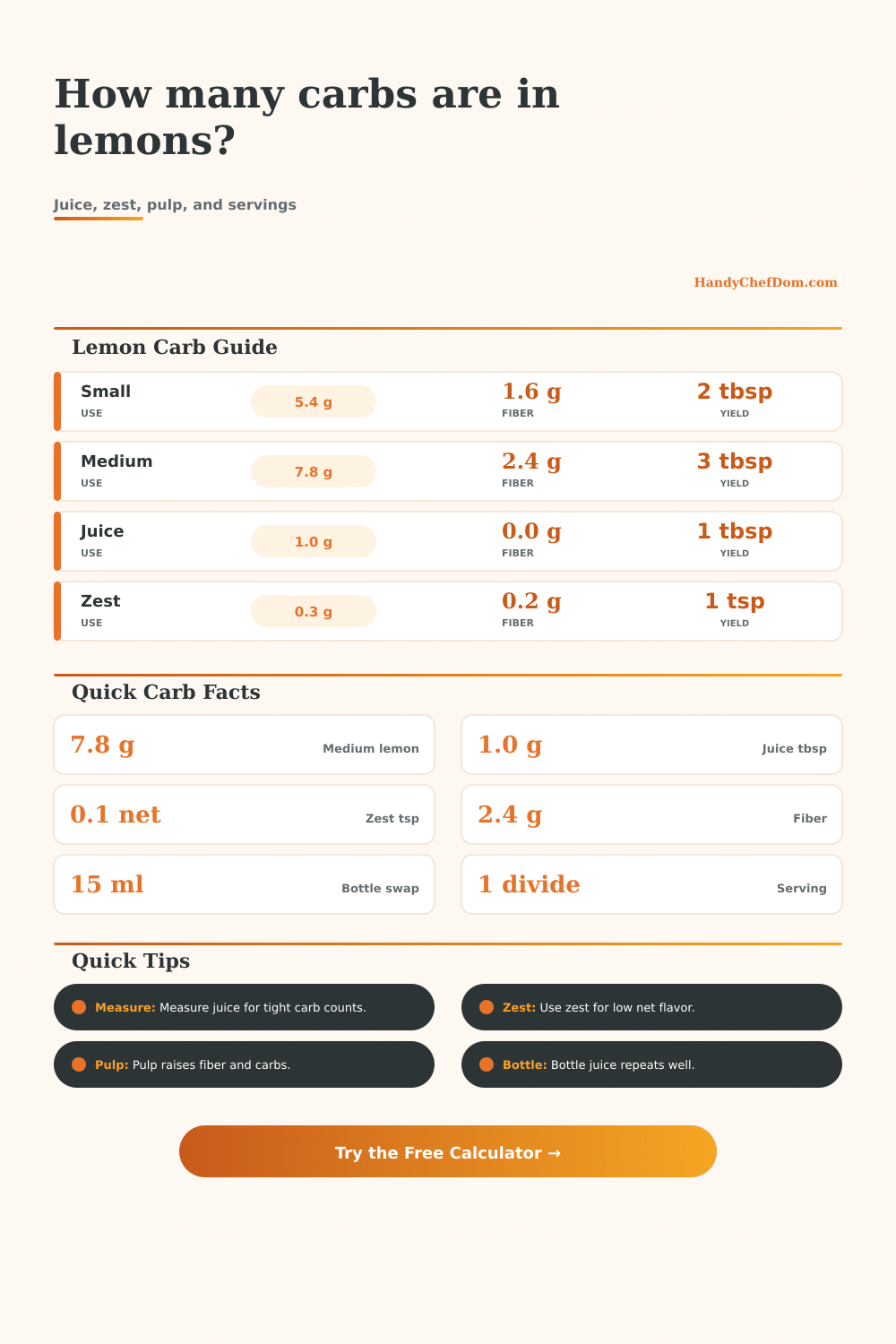
| Lemon size | Whole carbs | Fiber | Net carbs | Juice yield |
|---|---|---|---|---|
| Small | 5.4 g | 1.6 g | 3.8 g | 2 tbsp |
| Medium | 7.8 g | 2.4 g | 5.4 g | 3 tbsp |
| Large | 10.1 g | 3.0 g | 7.1 g | 4 tbsp |
| Extra large | 12.1 g | 3.6 g | 8.5 g | 5 tbsp |
| Juice amount | Milliliters | Fresh carbs | Bottled carbs | Typical use |
|---|---|---|---|---|
| 1 tsp | 5 ml | 0.3 g | 0.3 g | Tea squeeze |
| 1 tbsp | 15 ml | 1.0 g | 1.0 g | Dressing |
| 2 tbsp | 30 ml | 2.1 g | 2.0 g | One small lemon |
| 3 tbsp | 45 ml | 3.1 g | 2.9 g | One medium lemon |
| 4 tbsp | 60 ml | 4.2 g | 3.9 g | Large lemon |
| 8 tbsp | 120 ml | 8.3 g | 7.8 g | Batch citrus |
| Zest or pulp | Total carbs | Fiber | Net carbs | Best for |
|---|---|---|---|---|
| 1 tsp zest | 0.3 g | 0.2 g | 0.1 g | Bright flavor |
| 2 tsp zest | 0.6 g | 0.4 g | 0.2 g | Bars and glaze |
| Some pulp | 35 percent | more fiber | lower net | Thick drinks |
| All pulp | 100 percent | most fiber | whole fruit | Smoothies |
| No pulp | juice only | trace | lowest total | Water or tea |
| Peeled whole | full lemon | full fiber | full net | Blended use |
| Kitchen use | Lemons | Servings | Net per serving | Notes |
|---|---|---|---|---|
| Lemon water | 1 medium | 4 | 0.8 g | Juice only |
| Salad dressing | 2 medium | 8 | 0.8 g | Juice plus zest |
| Lemon bars | 4 large | 16 | 1.0 g | Juice and zest |
| Marinade | 3 medium | 6 | 1.5 g | Fresh juice |
| Keto tea | 0.25 lemon | 1 | 0.3 g | Small squeeze |
| Smoothie | 1 small | 1 | 3.9 g | Whole pulp |
When tracking macros, you get antsy for something besides boiled vegetables, but you also want it to taste like something. This is where lemons come in. Squeeze a wedge into some water, and it tastes bright and doesn’t cause a sugar crash.
But there’s more to it than a squeeze. It is more than just a matter of comparing lemon water to lemon bars. Because the math of what part of fruit you’re eating makes an order of magnitude of difference. And most people gets it wrong. They think all juice are created equal. They forget that green zest and white pith has their own metabolic impact.
Why Lemon Math Is Tricky
Most trackers provides a generic number for one lemon. That’s typically inaccurate for your particular pan (or pot). One store-bought, small, waxy lemon is not the same than another grown by your friend at his big tree. Once you enter your number and size into the calculator, it do the math for you. You don’t have to guess conversions and coefficients.
It tells the difference between the solid parts of fruit and its juice. Because fiber goes into the pulp. If you run your juice through a fine mesh sieve, you’re left with a lot of water and acid, but no fiber. You’ll see a lower number for net carbs. If you toss your whole, peeled fruit into a blender, you’re consuming all of its fiber and grams of sugar.
That option toggles on within the tool. You must choose whether you want a meal or drink. The flavor’s in the zest; the carbs is hiding there, too, if you’re not paying attention. Each teaspoon of zest contains almost no net carbs. It’s mostly pure essential oils with a small amount of plant matter.
But a little goes a long way. For every batch of cookies or lemon curd or other recipe, you may use three or even four teaspoons of zest. And the calculator will tally those up. It’ll tell you that a single teaspoon isn’t much, but that half a cup of zest add a large amount to your carb count for the day.
Zest doesn’t look like anything, so most folks forget about it. It’s colored dust on a grater. But when you’re measuring by grams, each speck adds up.
And there’s another factor: bottled juice. Convenient? Yes. Processed? Sure. Fresh squeezed juice go bad fast. It gets cloudy. Within an hour, it doesn’t taste as good. Bottled juice stays on the shelf for months. Sometimes they adds stabilizers or other things.
With this calculator, you can toggle between fresh-squeezed juice vs bottled juice. Is there a difference in carbs? Often no. Same volume. But what about texture? What about aftertaste? The tool provides the numbers, allowing you to purposefuly make the choice of convenience versus peak taste. Of fresh over easy.
The last filter is serving size. Four lemons are called for in a recipe. But do you scale down to four lemon bar? Or does it turn into four big fat cakes? The carb load per bar will be minimal. The carb load per cake will be heavy.
So the calculator asks what your serving size will be. It then divides the whole thing by that number. It gives you the per-plate reality. It is the way to avoid surprises at dinnertime.
Maybe you thought you ate two lemons’ worth of carbs. But you didn’t. You just made all those recipes bigger and now you eat eight. The breakdown section help with that too, breaking down the juice yield vs. The actual pulp content.
Keep in mind that a medium lemon contains roughly three tablespoons of juice. No more. No less. It is a fixed point in a sea of variables.
Lemons are still going on. It’s just that now they go on with your eyes open. It is because you want the lemon. You want the acid to cut through the fat of a steak, or the sweetness of a dessert. But you also want to know the price tag. And the calculator eliminates that friction.
It converts a sloppy kitchen estimation to a clean figure. Without all the guesswork, you get to keep the taste. That is why you track in the first place. You squeeze the lemon. You drink the water. You would of known exactly what you got.