Chicken Wing Carb Calculator
Estimate total net carbs, carbs per serving, edible bone-in yield, sauce impact, protein, fat, and party platter scaling for plain, breaded, sauced, or dry-rubbed wings.
Chicken Wing Carb Results
| Wing Style | Net Carb Driver | Typical Net Carbs | Best Use |
|---|---|---|---|
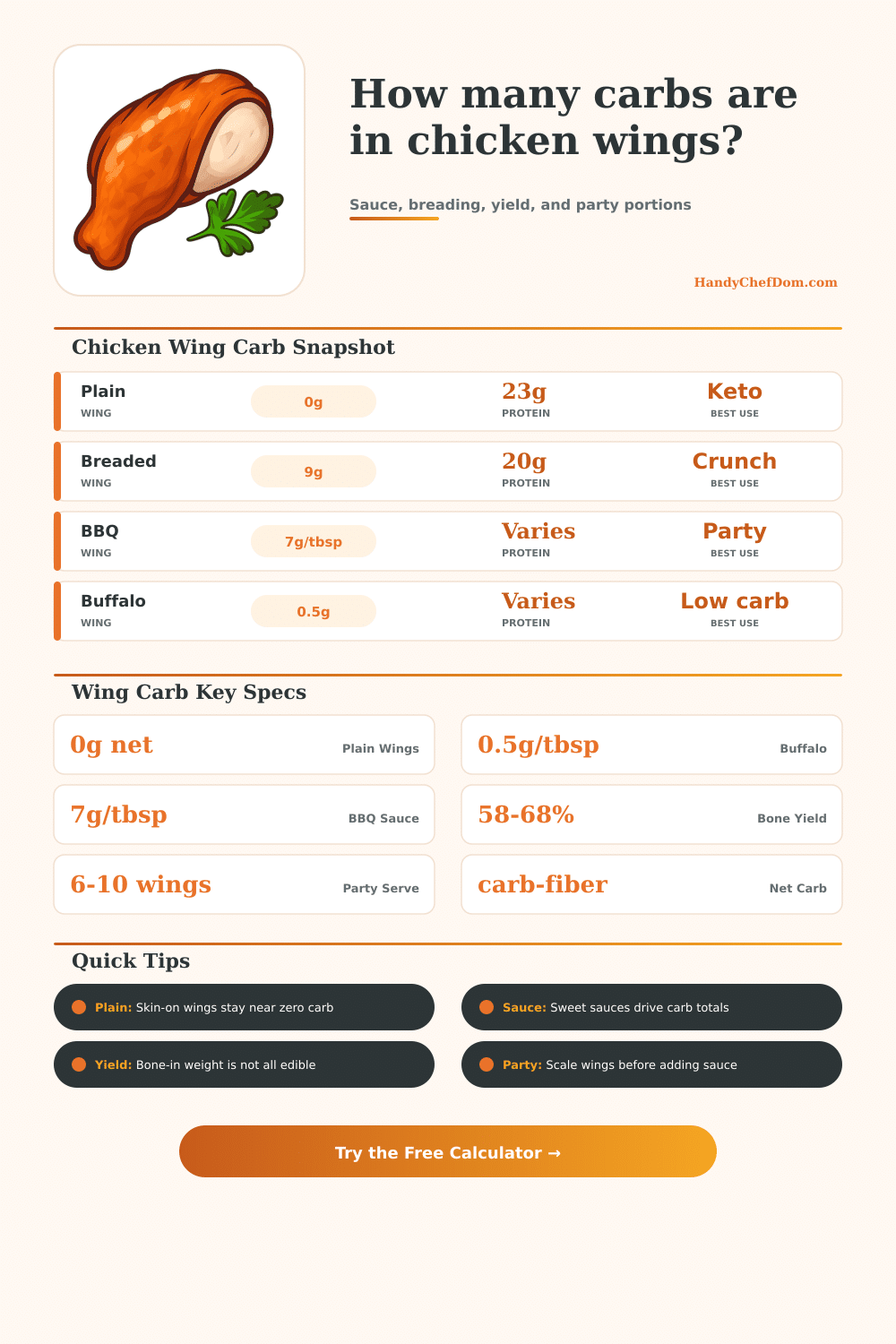
| Plain skin-on bone-in | No flour or sugar | 0 g per 100 g edible | Keto trays and low-carb meals |
| Light flour-dusted | Thin starch coating | 4 g per 100 g edible | Crisp texture with moderate carbs |
| Classic breaded | Breadcrumb or flour coating | 9 g per 100 g edible | Restaurant-style crunch |
| Battered pub-style | Wet batter absorption | 13 g per 100 g edible | Higher-carb party baskets |
| Boneless breaded bites | Breading plus lean meat | 15 g per 100 g edible | Bowls and fork-friendly platters |
| Keto crumb-coated | Nut or cheese crumb blend | 2 g per 100 g edible | Low-carb crunch alternative |
| Sauce Type | Net Carbs Per Tbsp | Fat Context | Carb Note |
|---|---|---|---|
| Buffalo hot sauce | 0.4 g | Low unless buttered | Usually vinegar-forward and low sugar |
| Garlic butter | 0.3 g | High fat | Carbs stay low while fat rises |
| Sweet BBQ sauce | 7.0 g | Low fat | Sugar makes sauce the main carb source |
| Honey garlic glaze | 8.5 g | Low fat | Honey and syrup stack quickly |
| Teriyaki glaze | 5.8 g | Low fat | Sweet soy glaze adds steady carbs |
| Dry rub seasoning | 0.6 g | Minimal | Check labels for added sugar |
| Cooking Method | Cooked Yield Factor | Fat Effect | Calculator Use |
|---|---|---|---|
| Air fried | 0.92 | Small fat loss | Good default for crisp wings |
| Oven baked | 0.90 | Moderate rendered fat | Useful for sheet-pan batches |
| Deep fried | 0.94 | Oil pickup possible | Adds fat without adding carbs |
| Grilled | 0.88 | More drip loss | Edible yield can look smaller |
| Smoked | 0.86 | Slow moisture loss | Best for dry-rub platters |
| Roasted on rack | 0.89 | Good fat render | Similar to baked but drier |
Lowest Carb Build
Plain, grilled, smoked, air-fried, or dry-rubbed wings keep the carb load near zero before sauce or dip is added.
Highest Carb Build
Breaded or battered wings tossed in honey garlic, BBQ, teriyaki, or sweet chili can turn the sauce into the largest carb source.
Best Party Estimate
Scale wing count first, then scale sauce tablespoons, because guests eat wings by piece count rather than edible ounces.
| Guests | Snack Tray | Game-Day Spread | Main-Dish Wings |
|---|---|---|---|
| 4 people | 16 wings | 32 wings | 40 wings |
| 8 people | 32 wings | 64 wings | 80 wings |
| 12 people | 48 wings | 96 wings | 120 wings |
| 25 people | 100 wings | 200 wings | 250 wings |
| 50 people | 200 wings | 400 wings | 500 wings |
Now there you stand before the cooler, twenty pounds of wings in hand, making a choice between carb coma and dinner triumph. The packet reads four and a half pounds, but who knows what bone and cartilage can do to skew the scale? When it comes to wing nutrition most folks go wild with their guesses, assuming all sauces and coatings act alike. They don’t. Take a plain, skin-on wing outta the package and it’s about as close to no carbs as you can get; unless, of course, you dump it in a honey- or high-fructose corn syrup-laden glaze. That makes all the difference for those on a tight low-carb diet (or anyone concerned with blood sugar).
First, select your wing style. The base ingredient sets the stage here; plain wings consists solely of fat and protein with almost zero carbs, making them OK on Keto. Then, plug it into the calculator at the top of this page. This is where the magic happens: The math runs itself, sparing you the mental work of estimating yields and converting ounces to grams.
How to Count Carbs in Chicken Wings
Then choose your wing style, your sauce type, and amount of breading present. Each step adds more gram to your carb count before your wings even touch the grill or fryer pan. Pick the style that reflects what’s already in your grocery bag, rather than the one you wished you’d purchased.
The true peril zone for low-carbers lies in the sauce. Spicy buffalo sauce is mostly vinegar with little added sugar. It adds plenty of heat but not enough carbs to blow your daily limit. However, honey garlic glazes and other sweeter BBQ sauces are another story altogether. With as many as seven grams of carbs per tablespoon, those thick, sticky sauces can quickly transform a carb-free protein source into a carb-bomb dessert. To account for this, the tool allows you to enter how much sauce you use and, as a result, the final tally represent exactly what ends up on your plate instead of just the pure weight of meat.
But then we have to talk about yield; how much food do I get for my money? Home cooks rarely consider this until they’re grasping a heap of bones and wondering why it’s all gone. Because you purchase bone-in wings, you’re not just paying for food, but also structure. After cooking, you’ll end up with around sixty percent of the original weight on your plate, which is mostly the skin and meat. Everything else is either rendered fat dripping down in the baking sheet, or simply waste. If you measure carbs by total package weight, you’re always going to be overestimating what you’re consuming; you’ve got inedible bone mass included in your calculations. Correcting for what is edible means that per-serving figures reflects reality.
There’s an additional wrinkle when it comes to party planning: how many wings someone eats depends on whether they’re just nibbling during a cocktail party versus having them as the focal point of a meal. If it’s a tray of lighter appetizers, maybe each person will take a few (and everyone should probably stand up). But if wings are the centerpiece of a meal (like the only major source of protein), figure on eight to ten wings each person, particularly if there isn’t anything else filling enough on the plate. This allows you to scale up to whatever number you need.
This way, you don’t end up with more than half a bag of wings rotting in the refrigerator by Monday, or worse, running out of meat before all your guests have had their fill. Just pick the number of guests, and the desired appetite level, cocktail party vs. Full-on wing dinner; and it spits out how much of a bag you should of been looking for at the grocery store.
Finally, even the cooking style subtly impacts that end nutrient profile. The air fryer renders fat efficiently without adding extra oil, keeping the calorie density slightly lower than deep frying. Grilled items lose water too, which concentrates their flavor but makes them smaller overall and results in an even lower percentage of edibility at the end. Those numbers change the yield slightly (and if you’re doing meal prep where every gram count towards your exact macronutrient goal, those tiny changes count). It is a small detail, but if you are counting grams instead of vibes, it does matter.
And then you understand it. It helps change how you shop for food and what you make in your kitchen. No more wondering how much sugar is in that sauce? Is this gonna be an exercise killer because of that breaded chicken wing? You realize that wings are no longer one-size-fits-all party fare. They’re a blank slate that can be changed by portion, sauce, and style. And when you stare down at that cooler again, you’ll have no need for a nutrition label per piece to decide just what to order.
You’ll know in advance: How many should I take? Which ones do I get? Know your inputs. Control your variables.