Broccoli Vitamin C Calculator
Estimate vitamin C from broccoli portions, prep style, cup weight, and daily target using USDA and NIH reference values
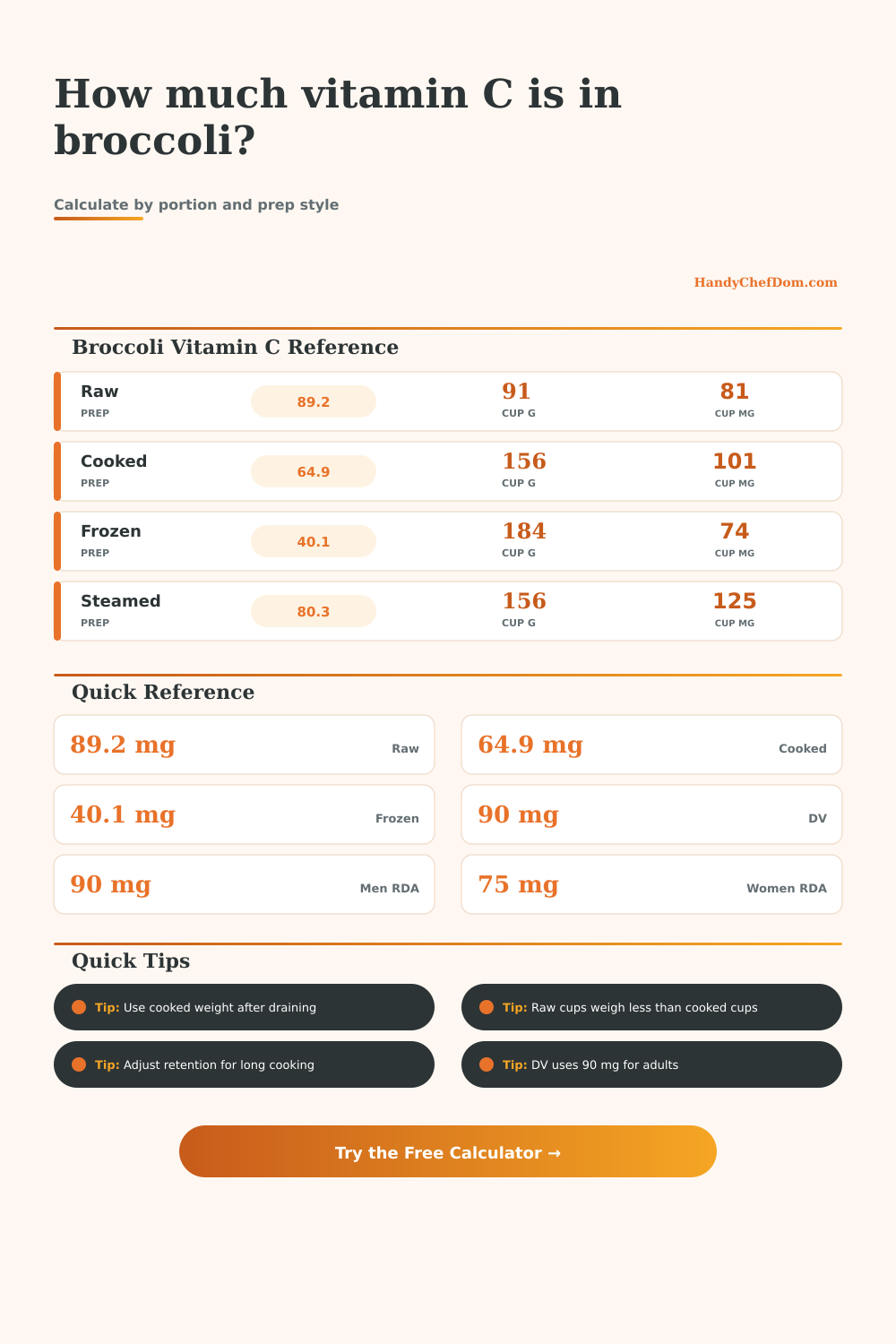
| Broccoli Form | Vitamin C | Cup Weight | Approx Cup Vitamin C |
|---|---|---|---|
| Raw chopped fresh broccoli | 89.2 mg per 100 g | 91 g per cup | 81 mg per cup |
| Raw fresh florets | 89.2 mg per 100 g | 71 g per cup | 63 mg per cup |
| Cooked boiled drained | 64.9 mg per 100 g | 156 g per cup | 101 mg per cup |
| Frozen chopped cooked | 40.1 mg per 100 g | 184 g per cup | 74 mg per cup |
| Target | Vitamin C | Best Use | Calculator Setting |
|---|---|---|---|
| FDA Daily Value | 90 mg | Label-style percent DV | Default target |
| Adult women RDA | 75 mg | Adult daily planning | Women RDA |
| Adult men RDA | 90 mg | Adult daily planning | Men RDA |
| Pregnancy RDA | 85 mg | Pregnancy daily planning | Pregnancy RDA |
| Lactation RDA | 120 mg | Lactation daily planning | Lactation RDA |
| Smoker adjustment | Add 35 mg | NIH smoker adjustment | Use smoker option |
| Prep Style | Calculator Basis | Default Retention | When to Adjust |
|---|---|---|---|
| Raw chopped | USDA raw value | 100% | Use lower if stored cut for long periods |
| Boiled drained | USDA cooked value | 100% | Use lower after long boiling |
| Steamed estimate | Raw value times retention | 90% | Lower for very soft broccoli |
| Microwave estimate | Raw value times retention | 88% | Lower if cooked in extra water |
| Frozen cooked | USDA frozen cooked value | 100% | Use as cooked drained portion |
| Roasted estimate | Raw value times retention | 70% | Lower for darker roasted edges |
| Portion | Raw Chopped | Cooked Boiled | Frozen Cooked |
|---|---|---|---|
| 1/2 cup | 46 g / 41 mg | 78 g / 51 mg | 92 g / 37 mg |
| 1 cup | 91 g / 81 mg | 156 g / 101 mg | 184 g / 74 mg |
| 3 oz | 85 g / 76 mg | 85 g / 55 mg | 85 g / 34 mg |
| 100 g | 100 g / 89 mg | 100 g / 65 mg | 100 g / 40 mg |
| Scenario | Portion | Raw mg | Cooked mg | % DV Raw | % DV Cooked |
|---|---|---|---|---|---|
| Small snack | 1/2 cup raw or cooked | 41 | 51 | 45% | 56% |
| Lunch side | 1 cup raw or 1/2 cup cooked | 81 | 51 | 90% | 56% |
| Standard serving | 100 g portion | 89 | 65 | 99% | 72% |
| Meal prep box | 150 g portion | 134 | 97 | 149% | 108% |
| Family side | 300 g total | 268 | 195 | 297% | 216% |
| Party tray | 600 g total | 535 | 389 | 595% | 433% |
| Frozen side | 1 cup frozen cooked | n/a | 74 | n/a | 82% |
| Generous bowl | 2 cups raw or cooked | 162 | 202 | 180% | 225% |
Broccoli is good for you. It’s packed with nutrients, though different preparation methods affect that. For example, you probably think one cup of broccoli have the same nutrition as any other cup of broccoli. That’s not true, because cooked broccoli absorbs water and gets heavier per cup, the nutrients are actualy more diluted when you measure by volume.
Why does this matter? Most people don’t think about the science of food when they cook (and certainly not when eating), and usually measure food in cups/volume. The problem is that a cup of cooked broccoli contain more water than a cup of raw broccoli. So even if you’re measuring out two equal portion of food, you won’t get the same amount of vitamin C.
How Cooking Changes Broccoli Nutrition
Above is a calculator that does all this work for you once you choose your preferred units and type of preparation (frozen vs. Fresh). Fresh; chopped vs. It includes whole, etc. Then it compares the USDA standards for each form: frozen chopped broccoli vs boiled drained broccoli and so on. The point of the calculator is that you can quickly understand just how much vitamin C has been destroy by heat.
For example, here’s what happens when you boil raw broccoli that has about 89 mg of vitamin C per 100 g. Vitamin C is water soluble: it goes down the drain in the cooking water. So cooked broccoli will be lower in vitamin C then raw or steamed broccoli. If you toss the starchy cooking water, you’ve lost the nutrient.
When you steam rather than boil, however, you end up retaining more vitamin C because there’s no water bath around the vegetable parts to extract any nutrient from them. People typically don’t realize that preparation style have a bigger impact on nutrient retention then they think. The calculator includes percent retention values to account for different cooking methods and times. While roasting sounds delicious, the high heat over long periods break down vitamin C at a greater rate compared to something like steaming.
If you overcooked your broccoli, you can increase that number in the app. Or maybe you cut your broccoli into pieces and left them on the cutting board for awhile before cooking. Again you can change that value downward to get a more accurate reading. Once plant cells have been compromised (cutting), enzymes starts to break down nutrients; therefore, chopped raw broccoli sitting around for an hour will contain less vitamin C than freshly-prepared broccoli.
Those preset buttons for making trays of broccoli for parties or meal prepping help you estimate the amount wasted when you aren’t sure how much was lost. To give you some perspective, these figures are relative to daily goals (e.g., the FDA-recommended daily intake of 90 mg for adults). However, those needs differs according to age, sex, health status, etc. For example, smokers have much higher needs, since smoking creates extra oxidative stress that depletes vitamin C levels.
Use the tool to plug in your broccoli consumption and see how it compares to certain goals, such as your recommended dietary allowance as a pregnant or lactating mother. This helps you determine if one broccoli side dish fulfills all your daily requirements or only part of them. More often than not, a modest portion of cooked broccoli will match, and even exceed (a typical adult’s total day’s worth). If handled properly, it’s a powerful source.
Once you grasp this, then broccoli becomes an opportunity to think strategically about nutrition. Rather than guess how many portions you should of eat, now you can think in terms of retention and density. When you’re plating up dinner tonight or meal prepping for the week, remember that a cup of cooked broccoli has less volume than raw broccoli. This means you know what to expect and can adjust your portions to match.
The calculator spells out the exact details, but the insight is in knowing why the numbers vary. It isn’t so much about the color as it is about eating smartly prepared green vegetables. After all, it’s your body that reacts to what’s left over after the cooking process, not just to what appeared appealing while sitting on the plate beforehand.