🍞 Sourdough in Fridge Proofing Time Calculator
Estimate a practical cold proof window from dough weight, hydration, starter level, fridge temperature, bulk rise, flour type, salt, shape, and desired tang.
Enter your shaped dough details after bulk fermentation. The calculator estimates a fridge-proof range, not a clock-only guarantee, because dough activity still depends on starter strength and how quickly the loaf chills.
| Fridge Temp | Typical Window | Best Use | Dough Cue |
|---|---|---|---|
| 34-36°F | 18-36 hr | Low starter, tangy loaf | Slow puff |
| 37-39°F | 10-24 hr | Overnight country loaf | Even dome |
| 40-42°F | 8-16 hr | Balanced short proof | Soft edge |
| 43-45°F | 5-10 hr | Warm dough short proof | Early bake |
| 46-48°F | 3-7 hr | Very active dough only | Watch closely |
| Flour Blend | Fermentation Pace | Timing Effect | Proof Note |
|---|---|---|---|
| Mostly white flour | Moderate | Neutral | Clean, predictable rise |
| Bread flour country blend | Moderate | Neutral | Strong shape hold |
| Whole wheat blend | Faster | Shorter | Bran speeds activity |
| Rye blend sourdough | Fast | Much shorter | Proof early and gently |
| Spelt or einkorn blend | Fast | Shorter | Weaker gluten feel |
| Strong high-protein flour | Slower | Longer | Handles extended proof |
| Loaf Shape | Cold Speed | Typical Window | Handling Note |
|---|---|---|---|
| Boule in banneton | Standard | 10-20 hr | Good insulation |
| Batard in banneton | Standard | 9-18 hr | Moderate chill rate |
| Sandwich tin loaf | Slower | 12-22 hr | Tin holds warmth |
| Baguette or demi baguette | Fast | 5-12 hr | Small dough mass |
| Tray sourdough focaccia | Fast | 6-14 hr | Wide surface chills |
| Small sourdough rolls | Very fast | 4-9 hr | Check early |
| Bulk Rise | Fridge Time Left | Flavor Result | Risk |
|---|---|---|---|
| 40-50% | Long | Mild to tangy | Underproof if rushed |
| 55-65% | Moderate long | Balanced | Low |
| 70-80% | Moderate | Classic sourdough | Medium |
| 85-95% | Short | Open and soft | Higher |
| 100% plus | Very short | Strong acid | Overproof likely |
You can use fridge to adjust how long your sourdough dough ferments by controlling temperature of your refrigerator. Late at night, you form the loaf then stow it in the cool. The next morning, it’s hot out of the oven for breakfast. It is convenient.
But the cold does something differnt to the dough: It doesn’t kill the yeasts, but it slow them down. It lets the organic acids builds up. And this produces a rich complexity that a warm-proofed dough can never match.
How to Use Your Fridge for Sourdough
Until you know what’s going on timing seems random. Cold proofing is often viewed by many bakers as an easy, time-based exercise: Twelve hours here because the recipe says so. Twelve hours there regardless of whether fridge is particularly warm or my starter is weak.
The calculator accounts for your particular ingredients, weight, hydration level, and starter percentage. Understanding what all these numbers mean make the difference between a good loaf and a consistent one.
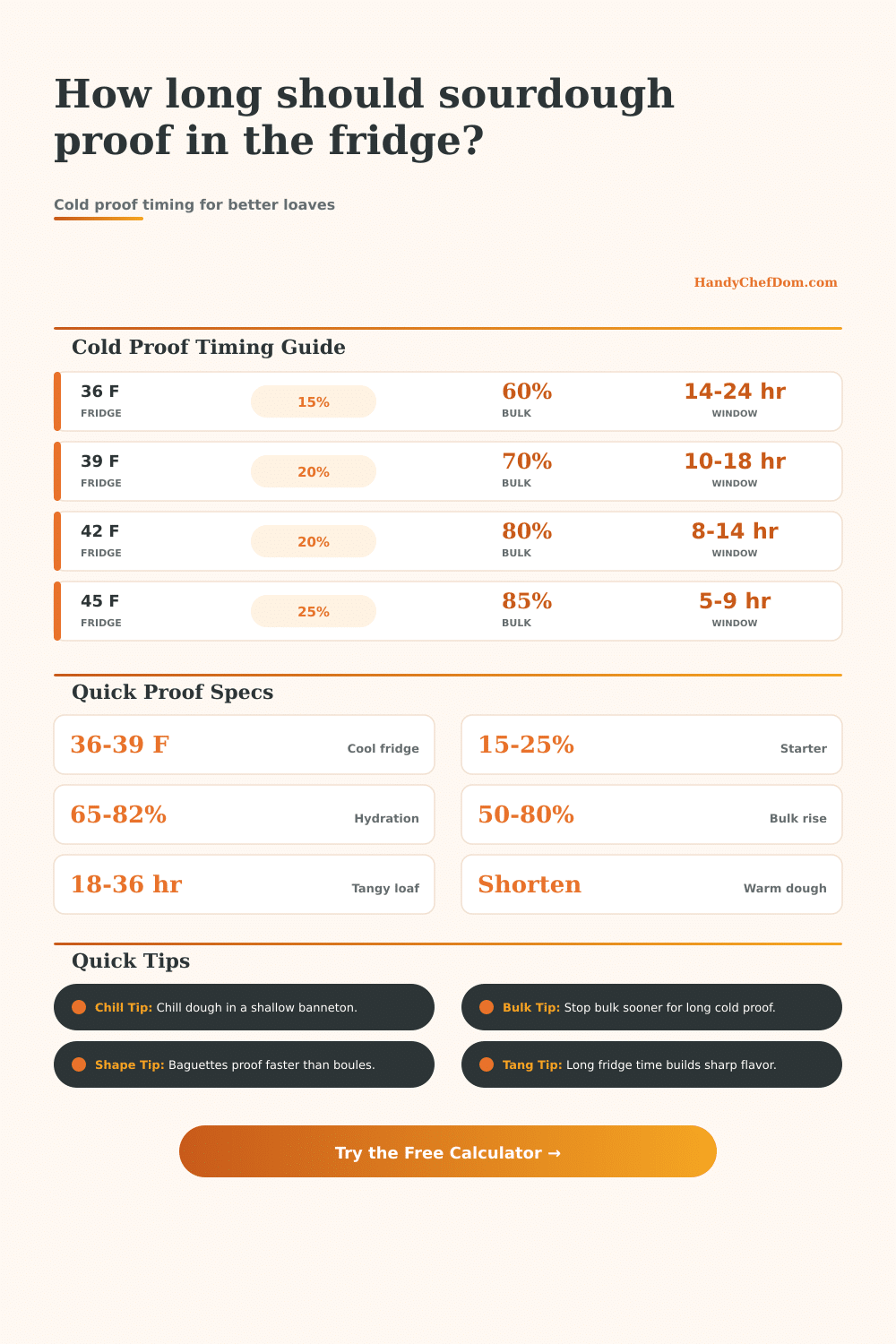
Before you even think about reaching for the fridge, consider bulk fermentation. That’s when dough rises vigorously on counter. It use much of its ability to expand. By the end it may have expanded as far as eighty-five or ninety percent of its total size. When you put that overeager dough in refrigerator, you begin a race against time. Cold causes it to proof rapidly, sometimes too rapidly and collapse. If you specify a long bulk rise, it shorten the suggested window for proofing. It prevents you from thinking the fridge can save overproofed dough. All the fridge do is slow it down.
Flour type and hydration matter a lot. Flour containing ash and bran (e.g., rye or whole wheat) speed up fermentation. They exhausts the food available for yeast more quickely than refined white flour. High hydration produces an airy, slack feel in your dough. It aids gas retention but also make the dough more delicate in structure. When combining a high-hydration dough with blend of whole wheat, clock is ticking faster. If you use a higher-hydration dough made from a whole wheat blend, you’ll need fewer hours in cold to get same result. Different grains shift the safe proofing window as illustrated in the reference table.
The fridge temperature is a wild card: The interior temperature of your fridge vary. According to most manuals, it should be kept at thirty-seven degrees. Your unit might sit at thirty-four or creep up to forty-two. If yours is warmer, you have to bake sooner; if it’s colder, it will buy you both sharper flavor and longer time. The calculator factors this into its estimate, which is nice, since a handful of degree could mean the difference between proofing for twelve hours versus eighteen. And that means it often rises past its prime. Your dough will lack strength and springiness (i.e., oven spring).
They also don’t realize how much shape count. Small rolls will proof quicker than thin baguettes; thin baguettes will proof quicker than a large boule. Why? The mass of dough insulates it, keeping it warm longer and making it take longer to proof. Divide the same quantity of dough into smaller pieces, and now the ratio of its surface area to volume have changed. The cold can get in there quickery. That’s why the tool tells you to make thick country loaves take longer, and rolls take less time. It’s a small physical reality that makes a big difference in execution.
There’s no tool that could of touch the dough for you. That number from the calculator is a good starting place. It is a scientific baseline you can trust. Always check it using signs from your own hands. Is it puffy? Relaxed? Does it spring back slowly when lightly pressed? If it leave an indent, it is ready now. More time! Too fast? Needs more time. Ready now.
Let the numbers guide your planning for the day ahead. Your fingers and eyes are what tell you when to turn on oven. The art of baking lives in this dance between looking and thinking, observing and calculating.