🍾 Servings per Champagne Bottle Calculator
Estimate toast pours, full flute servings, total bottles, refill demand, service buffer, and alcohol-free guest adjustments for sparkling wine events.
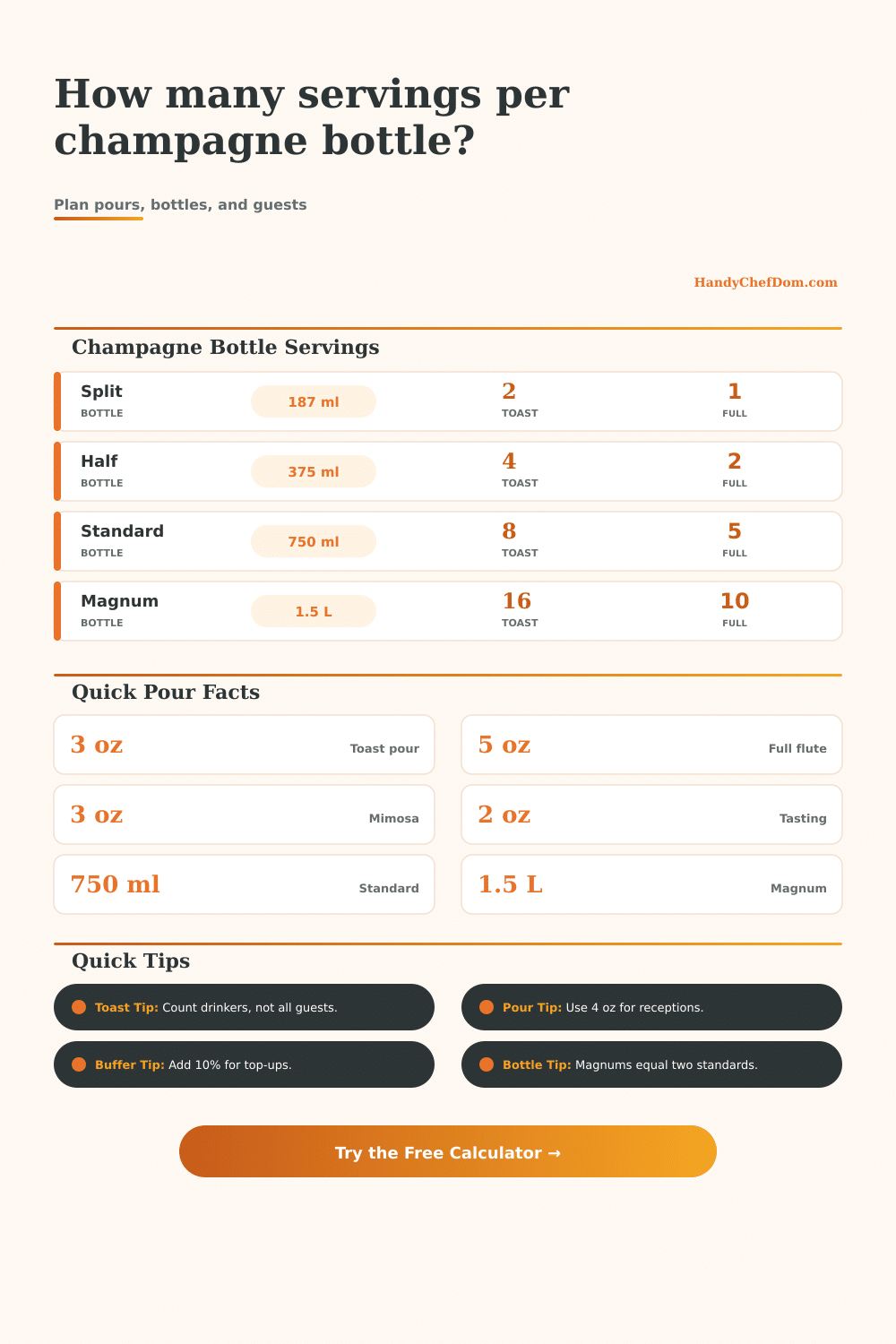
Use the bottle math for champagne, prosecco, cava, cremant, or other sparkling wines. Standard service references use 750 ml bottles, 3 fl oz toast pours, and 5 fl oz full wine pours.
| Bottle Size | Metric Volume | US Volume | Standard Bottle Equivalent |
|---|---|---|---|
| Split or piccolo | 187.5 ml | 6.3 fl oz | 0.25 standard bottle |
| Half bottle | 375 ml | 12.7 fl oz | 0.5 standard bottle |
| Standard bottle | 750 ml | 25.4 fl oz | 1 standard bottle |
| Magnum | 1.5 L | 50.7 fl oz | 2 standard bottles |
| Jeroboam | 3 L | 101.4 fl oz | 4 standard bottles |
| Rehoboam | 4.5 L | 152.2 fl oz | 6 standard bottles |
| Methuselah | 6 L | 202.9 fl oz | 8 standard bottles |
| Salmanazar | 9 L | 304.3 fl oz | 12 standard bottles |
| Balthazar | 12 L | 405.8 fl oz | 16 standard bottles |
| Nebuchadnezzar | 15 L | 507.2 fl oz | 20 standard bottles |
| Pour Style | Typical Pour | Servings from 750 ml | Best Planning Use |
|---|---|---|---|
| Tasting flight | 2 fl oz or 60 ml | 12 pours | Small comparison pours or tasting menus |
| Champagne toast | 3 fl oz or 90 ml | 8 pours | Weddings, speeches, countdowns, and short celebrations |
| Mimosa pour | 3 fl oz or 90 ml | 8 pours | Brunch service when juice shares the glass |
| Reception flute | 4 fl oz or 120 ml | 6 pours | Cocktail hour or tray-passed sparkling wine |
| Full wine glass | 5 fl oz or 148 ml | 5 pours | Dinner glass service or full pours at the table |
| Coupe glass | 4.5 fl oz or 133 ml | 5 pours | Vintage-style coupes with moderate fill lines |
| Event Format | Glasses per Drinker | Suggested Buffer | Planning Note |
|---|---|---|---|
| Single toast only | 1.0 glass | 5% to 10% | Most guests receive one partial glass at the same time. |
| Toast plus top-up | 1.2 to 1.4 glasses | 10% to 12% | Use when bottles stay open for table refills. |
| Cocktail hour | 1.5 to 2.0 glasses | 10% to 15% | Refill rate matters more than the first pour. |
| Brunch mimosa bar | 1.5 to 2.5 glasses | 12% to 18% | Juice lowers sparkling wine per glass but refills rise. |
| Dinner pairing | 1.0 to 1.8 glasses | 8% to 12% | Use smaller pours if champagne is one course only. |
| Tasting flight | 3 to 5 small pours | 5% to 8% | Enter the total flight count as refill demand. |
| Guests | Toast Bottles | Reception Bottles | Full Glass Bottles |
|---|---|---|---|
| 12 drinkers | 2 standard bottles | 2 to 3 standard bottles | 3 standard bottles |
| 25 drinkers | 4 standard bottles | 5 standard bottles | 6 standard bottles |
| 40 drinkers | 6 standard bottles | 8 standard bottles | 10 standard bottles |
| 60 drinkers | 9 standard bottles | 12 standard bottles | 15 standard bottles |
| 90 drinkers | 13 standard bottles | 18 standard bottles | 23 standard bottles |
| 120 drinkers | 17 standard bottles | 24 standard bottles | 30 standard bottles |
An empty bottle, an empty flute, it’s what causes a panic at corporate events, weddings, brunches. It appears as simple math, a standard bottle contain seven hundred fifty milliliters (but factors are slippery). First, there is carbonation loss when poured; second, guests go from a polite toast to a second glass in a hurry. To plan for serving sparkling wine, you need more than head counts. You need to understand foam, behavior, and volume.
Finally, the calculator turns that number of bottles and guests into real-world servings. But it requires that you consider what goes in. For example: many hosts believe all their guests will be drinkers. That’s why they need to subtract out non-alcohol drinker first before calculating how many bottle per person. Say there are one-hundred guests but twelve of them is drinking soda or sparkling cider. Those dozen aren’t going to influence your wine purchase. If you don’t account for this, you’ll end up buying too much booze and spending unnecessarily. The calculator helps here; it allows you to define the % of non-drinkers. This instantly shrinks your projection.
How to Plan Sparkling Wine for Your Event
From there: What’s your pour style? This is where most other estimates goes off the rails. For weddings/ceremonies, three ounces is standard. That gives people a quick sip and a little bit to clink, but doesn’t encourage anyone to overdo it. But if you’re throwing a long reception, then three ounce goes away in about ten minutes. For those types of events, a four-ounce pour are more comfortable for lingering guests. It cuts down on the number of drinks per bottle by a large amount, but it also feels better for guest. Ultimately, you’ve got to pick between “more refills / shorter pours” or “fewer glasses / longer pours.” You can toggle back and forth on the calculator to see how many bottles you’ll require for either situation.
Second, you have to consider size of the bottle itself. Not only does it affect presentation (and waste), but it can also keeps the bubbles finer and the wine colder for longer. For example: 1 magnum = two regular bottles. One magnum holds about two times as much wine. A magnum is more impressive on the table. However, if your event is short, then it’s risky because you’ll end up with an open bottle which will be flat the next morning. And what if all you want/need are three bottles? Buy two magnums and now you’ve got one bottle left over. Regular 750ml bottles give you most flexibility in case you’re having a smaller event. The tool provides reference tables breaking down the differences in volume. You can see at a glance how many standard bottles the Methuselah or Jeroboam replace. Seeing the volume expressed not simply in liters but in standard units makes it easier to visualize.
The secret ingredient to all good bar planning? Buffer. Always leave yourself a buffer of ten to fifteen percent on top of your total volume. For one thing, it allows for spillage. For another, it lets you account for that foam that floats up in your glasses and then settles down again. And finally, let’s face it: people gets excited, and they overpour. If you don’t have any buffer, you’ll run out of wine five minutes before the cake is cut. It is a tiny adjustment, but it will save your bacon when someone asks why there isn’t any more wine and you suddenly find yourself very publicly short. The calculator adds this percentage on to your usable volume. It tells you how many actual servings you’re getting, not some theoretical maximum.
The last part is the duration and refill rate: Do you have a four-hour dinner or a one-hour cocktail? And how many times will each guest get refilled? If they’re sipping non-stop cocktails all night, that’s another thing to consider. Here, you can adjust your refill rate by the hour to match what happens throughout the night. This makes you think about both number of people and the pace of the event.
Sparkling wine plans are more of an art then a science. There’s no way to know how many drinks your friends will consume, but there is a way to account for them by factoring in non-drinkers, determining appropriate pour sizes, and building in a reasonable safety margin. Your main goal is that the wine should of be sufficient to please everyone while not leaving you with two dozen opened bottles in your fridge tomorrow morning. Get this part right, and all the anxiety vanishes, leaving the fizz exactly where it belongs: in the glasses.