🧊 Water Freezing Time Calculator
Estimate kitchen ice timing from water volume, container shape, material, fill depth, starting temperature, freezer temperature, airflow, dissolved sugar or salt, and target firmness.
The estimate uses water heat capacity, latent heat of fusion, ice density, freezer temperature difference, exposed surface area, container conductivity, airflow, fill depth, and freezing point depression from dissolved solids.
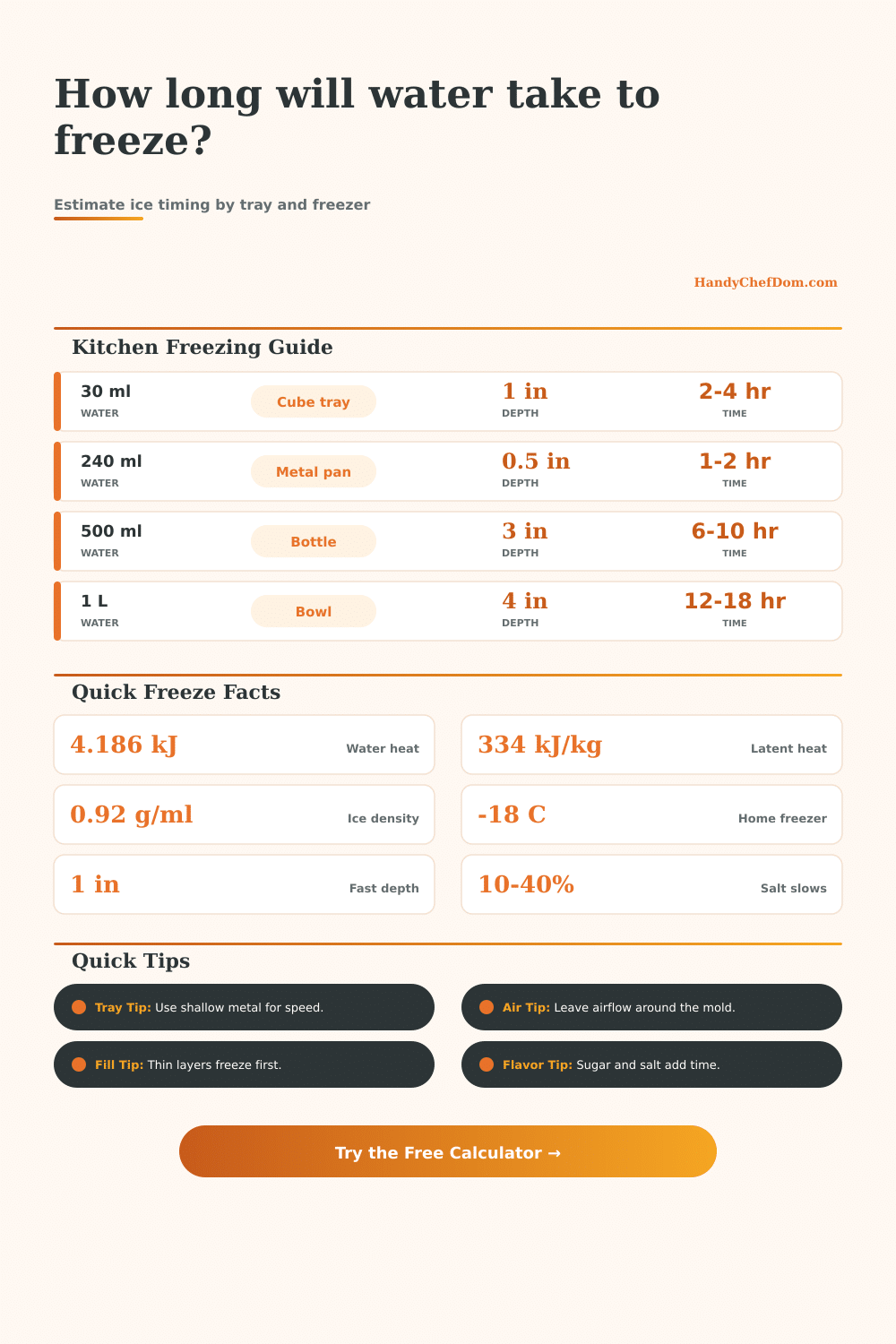
| Container Type | Typical Water Amount | Usual Fill Depth | Plain Water Time at 0°F |
|---|---|---|---|
| Standard divided ice cube tray | 300 to 450 ml total | 0.8 to 1.2 in | 2.5 to 4 hours for solid cubes |
| Large cocktail sphere mold | 50 to 75 ml each | 1.8 to 2.4 in | 4 to 7 hours because the center is thick |
| Shallow metal sheet pan | 1 to 4 cups | 0.25 to 0.75 in | 45 minutes to 2.5 hours for breakable ice |
| Flat freezer pouch | 1 to 3 cups | 0.3 to 0.9 in | 1 to 3 hours when laid flat |
| Water bottle or jar | 500 ml to 1 liter | 2.5 to 4 in diameter | 6 to 14 hours depending on fill and cap |
| Bowl or block mold | 1 to 2 liters | 3 to 5 in | 10 to 22 hours for a firm center |
| Freezer Air Temperature | Celsius Equivalent | Relative Speed | Kitchen Use Note |
|---|---|---|---|
| 10°F | -12°C | Slow | Small cubes freeze, but large molds can stay slushy overnight. |
| 0°F | -18°C | Standard | Common home-freezer setting used for most timing guides. |
| -5°F | -21°C | Faster | Useful for silicone molds or deeper cocktail ice. |
| -10°F | -23°C | Fast | Shortens the firming stage after the center freezes. |
| -20°F | -29°C | Very fast | Chest freezers can harden large blocks more evenly. |
| Container Material | Heat Transfer Effect | Best Kitchen Use | Planning Adjustment |
|---|---|---|---|
| Aluminum or stainless metal | Conducts heat away quickly | Thin slab ice, crushed ice prep, rapid chill disks | Often 15% to 30% faster than plastic |
| Rigid plastic tray | Moderate heat transfer | Everyday cubes and small divided molds | Use as the normal baseline |
| Silicone mold | Flexible but insulating | Ice pops, spheres, novelty cubes | Often 10% to 25% slower than plastic |
| Glass jar or dish | Moderate, with thicker walls | Small jars with headspace only | Use caution because ice expands as it freezes |
| Thin freezer pouch | High area and thin wall | Flat ice sheets and quick drink-chilling packs | Fast when laid flat in one layer |
| Insulated bottle | Low heat transfer | Partially frozen drink bottles | Can take several times longer than a tray |
| Dissolved Solids | Kitchen Example | Freezing Point Shift | Timing Effect |
|---|---|---|---|
| Plain water | Filtered or tap water | About 32°F / 0°C | Baseline freeze behavior |
| Mineral water | Trace minerals or a tiny pinch of salt | Usually less than 1°F lower | Small delay, often hard to notice |
| Light sugar | Light tea, coffee, or infused water | About 1°F to 3°F lower | Slower center and softer ice |
| Sweet drink mix | Sweet tea, coffee cubes, syrup water | About 3°F to 7°F lower | Can add 15% to 35% more time |
| Light salt water | Quick chill bottle or mild brine pack | About 2°F to 6°F lower | Edges freeze later and remain slushy longer |
| Briny chill pack water | Reusable salty ice pack mixture | About 8°F to 18°F lower | May never freeze hard in a warm freezer |
| Water Volume | Approximate Mass | Ice Volume After Expansion | Common Kitchen Equivalent |
|---|---|---|---|
| 1 tablespoon | 15 g | 16 ml ice | Half of a small cube cavity |
| 1 fluid ounce | 30 g | 33 ml ice | One small cube |
| 1 cup | 237 g | 258 ml ice | About 8 standard cubes |
| 2 cups | 473 g | 516 ml ice | One full small tray |
| 1 liter | 1000 g | 1090 ml ice | Large bottle or block mold |
| 1 gallon | 3.79 kg | 4.13 liters ice | Party bin or large tub |
When the doorbell rings and you’re out of ice, what’s your first reaction? Do you panic? Grab some water bottles and hope for the best? If you freeze ice without a strategy, you’re at the mercy of chance. That’s why I made this calculator, it do all the calculations.
But if you want to freeze ice quickly, you need to understand the physics involved. It’s all about surface area, heat transfer and water’s properties. The second thing is depth. Shallow water freezes faster because the heat has less distance to travel to reach the cold air. That means that deep water will freeze slower then shallower water. A block of ice in a bowl might take overnight, but a thin pool of water on a metal sheet pan could be ready within an hour.
How to Freeze Ice Faster
This is where the tool comes in, it lets you specify what size container, and how much water’s inside. So if you’re in a hurry, don’t put all of the water in a single deep jar, just get out some shallow tray instead. And check out reference table on the page; a couple inches of difference in depth can practically double your wait time.
It is a geometry problem. It is a kitchen chore. The speed is also dependent on material, although maybe not as much as you might suspect. Aluminum trays will seem cold when touched because metal is such a good conductor of heat out of the water. On the other hand, plastic and silicone tend to insulate heat from the water, retaining more heat over time. This means that if you’re making cocktail spheres in a silicone mold, prepare for it to take a bit longer than your standard plastic tray.
The calculator accounts for this difference in conductivity. Does this mean you HAVE to have metal trays to be efficient? No, not at all, but do account for this if you’re working with flexible mold.
But then there’s the water. If you’re adding things that lower the freezing temperature (like salt or sugar), the water has to reach an even lower temp before it freezes. Coffee and tea ice cubes will take much longer to freeze up compared to plain water. Their centers is typically still slushy by the time their outer surfaces have hardened. That’s also why those juice ice pops can be soft after hours in the freezer. Because of the solute factor, your ice-on-a-stick won’t disappoint when you open the mold to find yourself staring at liquid.
The tool takes this into account to give you a reasonable estimate on how long any given flavor of ice will take. One other thing that folks don’t think about; what’s the temperature of your freezer? Most freezers in people’s homes is roughly zero degrees Fahrenheit (that’s the normal baseline). So if yours is warmer, it’ll take longer. But you can only crank it down so far before it actualy speeds things up (to like -10 degrees or something).
Basically, the colder the temperature difference, the faster it’ll drive the heat out. But then once you get below the phase change point, there’s this huge latent heat release as it goes from liquid to solid at the same temperature. That’s why freezing takes longer than just cooling down a cold drink, because it’s a huge energy sink. Covering the tray tightly or stacking them traps that escaping heat. Leave some space between your containers so the cold air can circulate and get to work.
It is a small detail, but it matter. You want that freezer to breathe around that water. Freezing ice is a battle against thermodynamics. Keep it cold. Keep it uncrowded. Use conductive material. Increase surface area and you will beat the clock.
The calculator provides an exact estimate, but what’s the strategy? How do you set up to freeze? That’s the next best thing. When the bin is empty and the party is coming, don’t just dump some water in and hope for the best. Think: air, material, depth. It transforms a frantic scramble into a simple plan. Instead of warm excuses, your guests has cold drinks.