Crock Pot To Dutch Oven Conversion Calculator
Turn slow cooker recipes into oven-braised Dutch oven plans with time, temperature, fill, liquid, and finish guidance.
| Setting | Oven band | Factor | Best use |
|---|---|---|---|
| Warm | 250-275F | 0.42x | Slow hold |
| Low | 300-325F | 0.33x | Steady braise |
| High | 325-350F | 0.28x | Faster cook |
| Keep warm | 225-250F | 0.48x | Gentle finish |
| Style | Time | Liquid | Finish |
|---|---|---|---|
| Stew | 1.00x | Normal broth | 10 min rest |
| Braise | 1.08x | Extra body | 15 min rest |
| Chili | 0.95x | Add depth | 8 min rest |
| Roast | 1.12x | Less liquid | 18 min rest |
| Size | Typical batch | Fill | Best for |
|---|---|---|---|
| 3 qt | 2-3 servings | 55-60% | Small batch |
| 4.5 qt | 3-5 servings | 60-70% | Midweek meal |
| 5.5 qt | 5-7 servings | 65-75% | Family dinner |
| 7.25 qt | 7-10 servings | 70-80% | Big braise |
| Profile | Add | Finish | Cue |
|---|---|---|---|
| Light sauce | 0.25 c | 5-8 min | Bare coverage |
| Balanced | 0.50 c | 10-12 min | Keeps moisture |
| Thick braise | 0.75 c | 12-15 min | Needs a lid |
| Finish glaze | 0.00 c | 15-20 min | Reduce at end |
To convert a recipe from a slow cooker to an Dutch oven, you must understand how heat is delivered from each of these two kitchen appliances. Slow cookers provides warmth to the food while trapping almost all of the moisture that the food releases during the cooking process. Dutch oven use dry heat from the oven to cook the food, and since the lid of a Dutch oven isnt as airtight as the lid of a slow cooker, more evaporation occur in a Dutch oven than in a slow cooker.
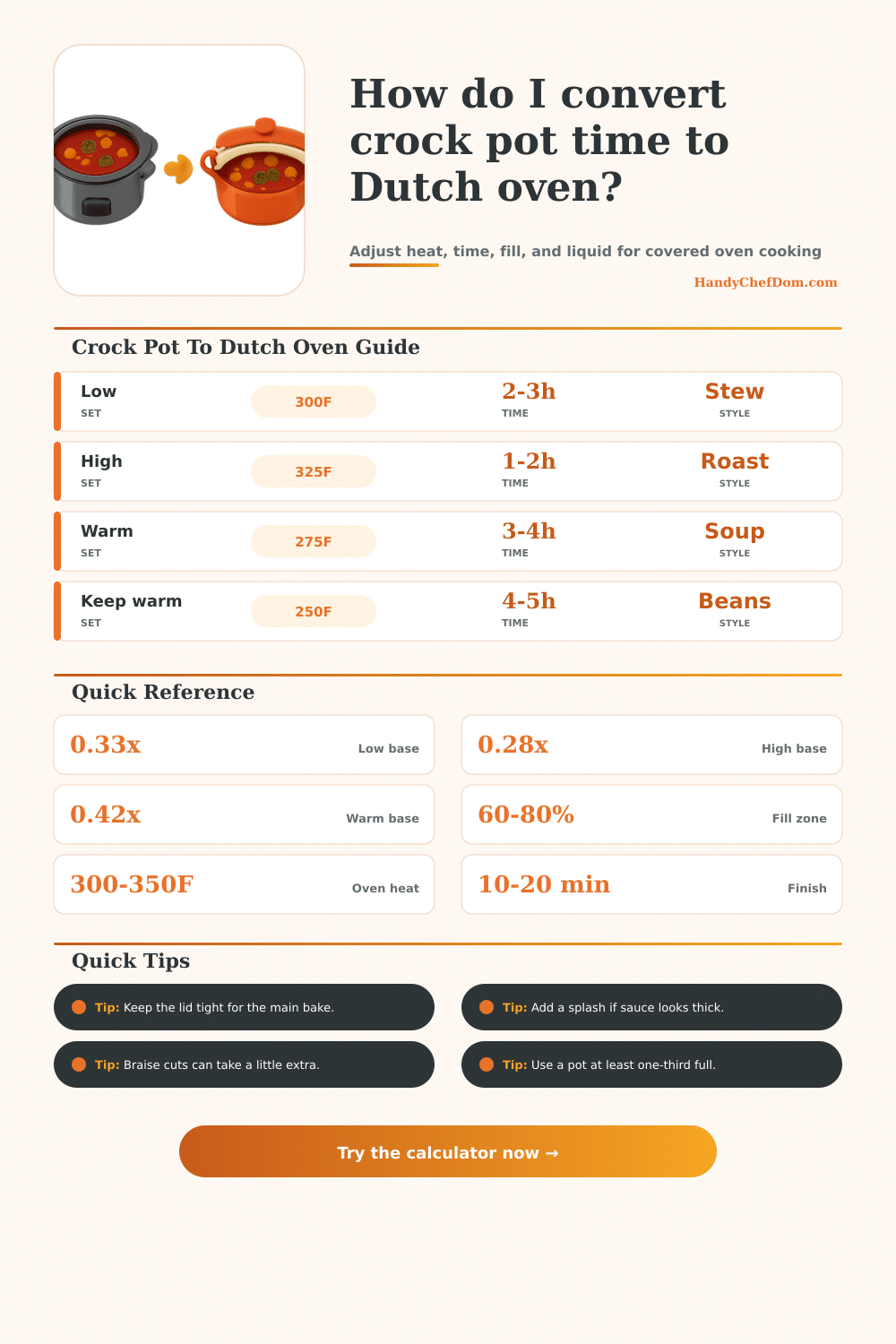
Because more evaporation occur in a Dutch oven, the cooking times for Dutch oven recipes must be adjusted so that the food does not become dryer. Cooking times must be adjusted for recipes that is converted from slow cookers to Dutch ovens. Recipes that require eight hour of cooking in a slow cooker on the low setting will typically require approximately two and a half hours of cooking in a Dutch oven at 315 degrees Fahrenheit.
How to change slow cooker recipes for a Dutch oven
Additionally, any recipe that require five hours of cooking in a slow cooker at high heat will cook in a Dutch oven at 335 degrees Fahrenheit for a shorter period of time. The cook must reduce cooking times when converting recipes from slow cookers to Dutch ovens because the heat from an oven is more intense then the heat that a slow cooker emits. Additionally, cooking times may need to be adjusted during the cooking process to account for the differences in cooking temperature between one oven and another.
The amount of food that is to be cooked in a Dutch oven will impact the cooking process. The recipe should be filled to between seventy and eighty percent of the total capacity of the Dutch oven. If the Dutch oven is filled to past eighty percent of its capacity, the food may boil over the side of the Dutch oven due to the heat that the Dutch oven can produce.
Additionally, if the Dutch oven is filled to less than sixty percent of its capacity, the center of the food may cook longer than the edges of the food which can cause the edges to scorch. By filling the Dutch oven to seventy to eighty percent of its capacity, the likelihood of these problem will be eliminated. The levels of liquid that are required in a Dutch oven recipe should be increased in comparison to the amount of liquid required in a slow cooker recipe.
Slow cookers do not allow much evaporation of the liquid that is released from the food. Dutch oven, on the other hand, lose ten to twenty percent of the liquid that the food releases during the cooking process. To account for the evaporation of the liquid from the food in a Dutch oven, a half cup of broth should be added to the recipe.
If the liquid in the Dutch oven appears to be bare of food during the cooking process, more liquid should be added to the recipe to prevent the food from scorching at the bottom of the Dutch oven. Managing the lid of the Dutch oven during the cooking process is necessary to control the texture of the food. The lid should remain on the Dutch oven during the majority of the cooking process to retain the steam that exit the Dutch oven.
However, if the desired texture of the food is thick sauce, you should remove the lid of the Dutch oven during the last ten to twenty minutes of cooking. By removing the lid of the Dutch oven, the sauce will naturaly reduce which will thicken it and enhance its flavors. The flavor of the food can be enhanced by using the stovetop before placing the Dutch oven into the oven.
Since slow cookers do not allow meats to sear before they are cooked, Dutch ovens allow meats to be seared on the stovetop prior to being place into the Dutch oven. By searing the meat, a brown layer forms on the meat and flavor is naturaly created at the bottom of the Dutch oven where the meat was seared. Additionally, the food should be allowed to rest for ten minutes after it is cooked.
Allowing the food to rest permit the heat to continue to finish cooking the interior of the food and ensures that the meat will remain tenderly. It is important to not rush this part, and you should of waited for the meat to settle. The cooks ability to manage heat is also important for a luxurios meal.