🧄 Garlic Curing Time Calculator
Estimate how many curing days your garlic needs from bulb size, harvest wetness, stem thickness, air movement, temperature, humidity, bundle density, and dryness target.
Use the count field for a household harvest, or enter total harvest weight when you sort garlic by crates. The calculator converts everything to an estimated curing load, then adjusts time for neck moisture and environment.
| Garlic Type | Typical Cure Window | Neck Behavior | Best Target |
|---|---|---|---|
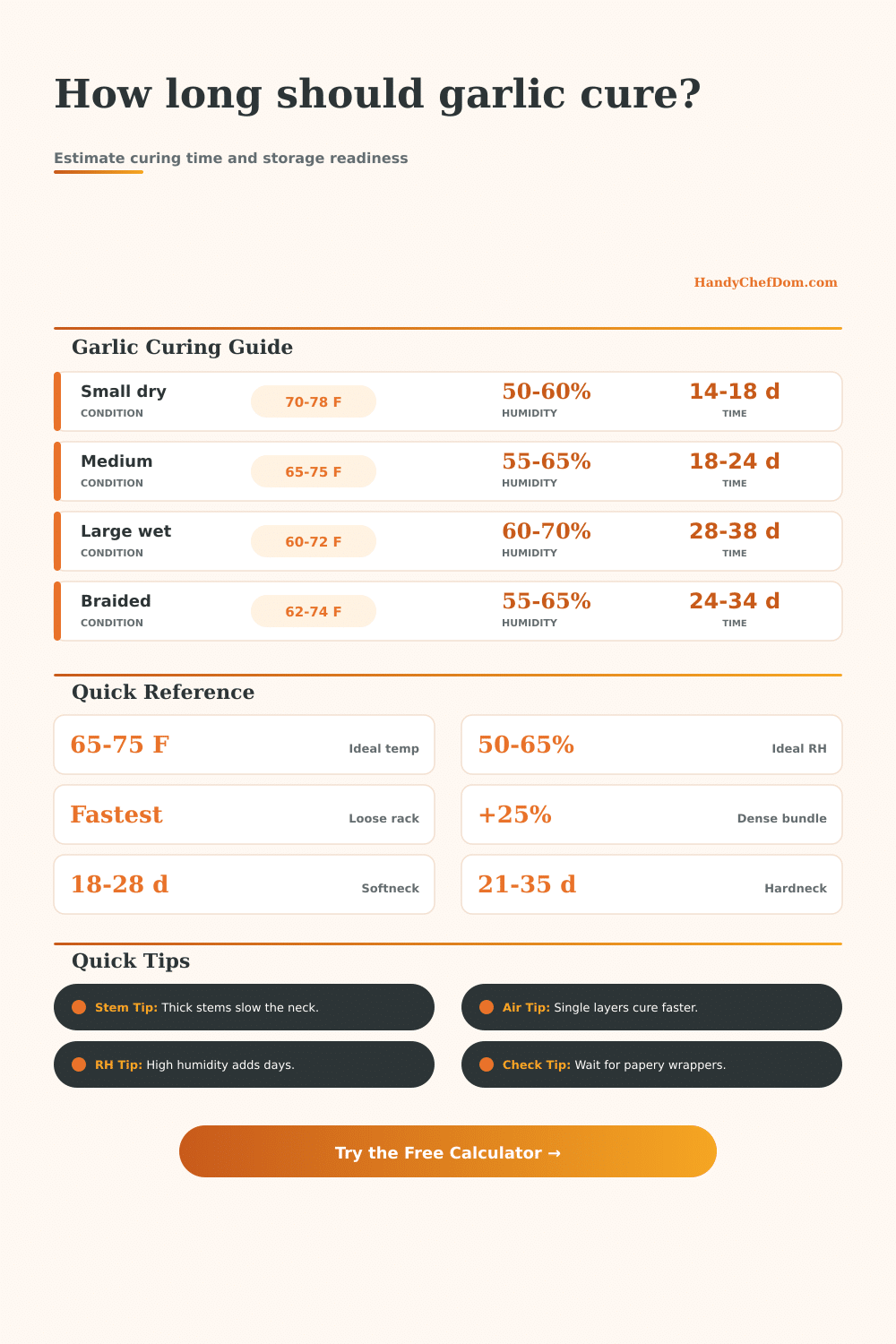
| Softneck garlic | 18 to 28 days | Flexible neck dries evenly in loose groups | Standard storage or braiding |
| Hardneck garlic | 21 to 35 days | Firm scape stem keeps moisture longer | Standard to long storage |
| Porcelain hardneck | 24 to 38 days | Large cloves and thick wrappers slow drying | Long storage or seed garlic |
| Rocambole hardneck | 20 to 30 days | Looser wrappers dry faster but store shorter | Standard storage |
| Artichoke softneck | 20 to 30 days | Many cloves and layered wrappers need steady airflow | Standard storage |
| Silverskin softneck | 24 to 36 days | Tight wrappers reward a longer dry-down | Long storage |
| Elephant garlic | 35 to 50 days | Very thick neck and large head hold moisture | Long storage |
| Environment Reading | Ideal Range | Time Effect | Watch Point |
|---|---|---|---|
| Warm dry room | 70 to 78°F, 45% to 55% RH | Can shorten cure by 2 to 4 days | Do not overdry thin wrappers |
| Balanced curing room | 65 to 75°F, 50% to 65% RH | Baseline for most estimates | Check neck firmness on schedule |
| Cool dry garage | 58 to 65°F, 45% to 60% RH | Adds 2 to 5 days | Slow neck dry-down |
| Humid shed | 60 to 72°F, 68% to 78% RH | Adds 5 to 10 days | Move air around bunches |
| Still enclosed corner | Any temp with weak airflow | Adds 4 to 8 days | Open spacing between bulbs |
| Fan-assisted rack | 62 to 78°F, 45% to 65% RH | Can shorten cure by 2 to 5 days | Keep fan indirect |
| Harvest Wetness | Bulb Surface | Root Zone | Added Cure Time |
|---|---|---|---|
| Dry lift | Skins feel dusty and outer leaves are fading | Roots are dry and soil falls away | 0 to 2 days |
| Normal lift | Bulbs feel firm with light garden moisture | Roots are flexible but not wet | 2 to 4 days |
| Damp lift | Outer wrappers feel cool or slightly tacky | Soil clings around roots | 4 to 7 days |
| Wet lift | Bulbs were pulled after rain or irrigation | Roots hold visible moisture | 7 to 12 days |
| Muddy lift | Bulbs need gentle drying before brushing | Root plate stays damp longest | 10 to 16 days |
| Mixed harvest | Some bulbs dry, some damp | Sort wet bulbs into a separate cure | Use the wetter group |
| Curing Method | Best Load Pattern | Relative Speed | Storage Yield Note |
|---|---|---|---|
| Raised mesh rack | Single layer, bulbs spaced apart | Fastest | Usually 89% to 92% after trimming |
| Window screen tray | Light single layer | Fast | Good for small and medium bulbs |
| Hanging bunches | 6 to 12 bulbs per bunch | Moderate | Check inner necks before trimming |
| Slatted crate layers | Shallow layers with open sides | Moderate to slow | Rotate crates during humid spells |
| Softneck braid cure | Braid once stems are pliable and drying | Slow | Best after a few days of pre-drying |
| Shed rafter bundles | Loose hanging groups, not packed | Variable | Depends strongly on shed airflow |
| Paper-lined trays | Thin layers only | Slow if crowded | Paper should stay dry to the touch |
It’s that time for gardening. You are excited to harvest, but anxious about how to preserve it. Your garlic comes out of the ground with dirt clinging to its roots, and then what?
Garlic’s about pride in the yield…but also hurry up. Cure too soon and it will get all shrivelled and its skins will split apart. Too late and before bulbhead begins to tighten against the neck, mold sets in.
How to Dry Your Garlic Correctly
Sounds like it’s all guesswork, or gut instinct. But no… It’s physics. Enter the garlic-curing calculator (above). It works out your particular growing conditions, and converts that data into a concrete time frame. No more guessing.
People also tend to forget how wet the bulbs were when they came up. Did you lift them on a day that was irrigated? Or was it a day of particulary heavy rain? Those are soaked bulb. And the water has got to go somewhere. First, it comes out the stem. Then it goes through the bulb, and out the stem.
Bulbs with thicker stems is kind of like a bottleneck. Water will linger in them longer. The same applies to bulbs with firm stems (like a hardneck with a firm scape) compared to softer ones (such as a softneck with a straw stem).
Because all this matters, tool considers both bulb size and stem thickness at the base to adjust starting time from that point. A jumbo bulb with a thick neck is not simply an oversized version of a small bulb. It’s a whole other drying puzzle.
And then there’s the climate you expose your garlic to. Common wisdom says to keep them warm and dry…well, okay, yes, but not all the time. It has to be moist enough so they don’t dry out too fast. It also needs to be relatively dry so they don’t rot. Rotting happens if it is too hot and outside dries while the inside remains wet.
A breezy shady location where it’s about 75 degrees is ideal, not too damp or dry, because moisture on surface invites rot. Airflow matters. In a heavy pile or a crate, outer heads are done curing by the time those in center even start. It is better to stack each one separately on a mesh rack so each neck and root gets air circulation, which makes a big difference in days.
These environmental factors is broken out nicely in the reference tables on the page. Notice how a fan-assisted rack will reduce the drying time, while a humid shed increases it? That doesn’t tell the full tale; you have to know when they’re realy ready. Time does not equal ready, because you also need to know what ready looks like. The neck should be dry and tight, the wrapper papery and crisp, and the roots should have a clean trim-off without oozing. No matter what the timer says, if there’s a damp bend to the neck, it ain’t done.
Generally speaking, softernecks (with flexible stems) cure better because they shed water more evenly. Firmer-stemmed hardnecks (such as rocamboles or porcelain types) require a longer, more gradual cure to bring the outer parts of the wrapper down to match the insides.
This is good. To braid, faster but traditionally. Tie all the stems into a bundle with one another; that protects the valuable interiors of individual bulbs from exposure to the air. Expect it to take longer if you braid.
The weight goes down once you cut off the tops and trim the roots. Don’t worry; it’s all right. What you’ve lost is the non-edible portion of the bulb (the water weight). Expect roughly 88-92 percent of your fresh-weight bulbs to be edible garlic. The calculator tells you your expected harvest size, which helps with meal planning and food preservation. Nobody wants to end up with a thirty-pound bag of fresh garlic but only three dehydrator trays’ worth of preserved.
Another useful feature is the inspection rhythm setting. Two-day checks are fine if you have a damp harvest that needs constant watching. Five-day intervals will save time when it’s nice and dry in there. It’s all about matching your watchfulness to potential for harm.
If moisture is high and air isn’t flowing freely, be careful. If moisture is low and air flow is good, take it easy. That’s where calculation and experience meets. Estimate the window, then let your eyes do the talking.
In gardening as in life, there’s a lot to be said for working with nature rather than against her. Growing garlic is no exception. Curing is just helping the plant do what it wants to do: complete its task. The cure tool is simply your exact instrument for setting the conditions.
In the end, however, the verdict rests with the appearance of the garlic skin and the way the neck feels. If the latter is sealed shut and the former is crisp, congratulations: You’ve put the brakes on the season. You’re ready to stash all that hard work from high summer into the deep cold of winter ahead.