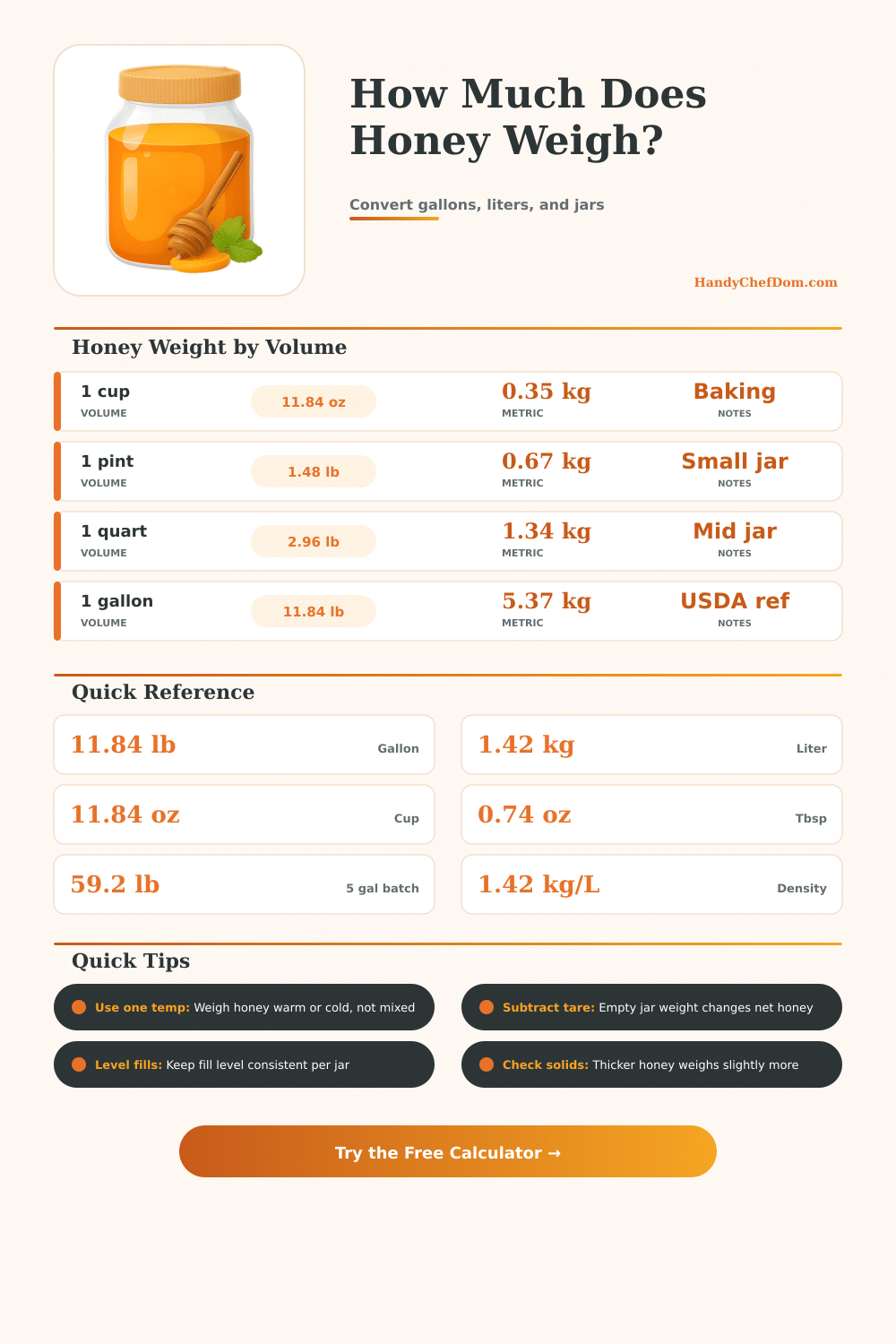
How Much Does a Gallon of Honey Weigh?
Convert honey by gallon, liter, cup, or jar using USDA-backed weight values and packing estimates
| Volume | Weight | Metric | Use Case |
|---|---|---|---|
| 1 tbsp | 0.74 oz | 21 g | Tea |
| 1 cup | 11.84 oz | 0.35 kg | Baking |
| 1 quart | 2.96 lb | 1.34 kg | Jar batch |
| 1 gallon | 11.84 lb | 5.37 kg | USDA ref |
| Texture | lb/gal | kg/L | Comment |
|---|---|---|---|
| Runny | 11.65 | 1.40 | Warm flow |
| Light | 11.75 | 1.41 | Loose pour |
| Standard | 11.84 | 1.42 | USDA ref |
| Thick | 12.02 | 1.44 | Slow pour |
| Temp | Factor | Moisture | Factor |
|---|---|---|---|
| 60 F | 1.03 | 17% | 1.02 |
| 70 F | 1.01 | 18% | 1.01 |
| 80 F | 1.00 | 19% | 1.00 |
| 90 F | 0.98 | 20% | 0.99 |
| Batch | Honey | Gross | Notes |
|---|---|---|---|
| 5 gal pail | 59.2 lb | 61.7 lb | Packout |
| 10 gal lot | 118.4 lb | 120.9 lb | Small run |
| 30 gal drum | 355.2 lb | 357.7 lb | Bulk fill |
| 55 gal drum | 651.2 lb | 653.7 lb | Truck lot |
Honey has a specific weight, but this weight can vary depending on several differents factors. In order to correctly understand the weight of honey, a person must consider how the weight of honey can change depending on a variety of factors. The standard weight of honey are 11.84 pounds per gallon.
This is the weight provided for honey by the USDA. However, if the temperature of the honey change, this weight can change, as well. Warm honey is less dense then cold honey.
What Affects the Weight of Honey
Therefore, warm honey will weigh less per gallon than cold honey. If honey is heated to 100 degrees, it will be less dense than honey that is colder than 60 degrees. The moisture content of honey also change it’s weight.
The moisture content of good honey is 18 percent. If the moisture content of the honey is 17 percent, the honey is drying out and will weigh more. If the moisture content of the honey is 21 percent, the honey will be wetter and will weigh less than honey with a higher percentage of moisture.
Therefore, the moisture content of the honey will change its weight. The texture of honey can change the weight of the honey. Runny honey is less dense than thick honey.
Therefore, runny honey will weigh less per gallon than thick honey. Additionally, crystallized honey is the most dense form of honey so crystallized honey will weigh more per gallon than honey that dont contain crystals. Because honey comes from different floral source, the different types of honey will have different textures which will ultimately change the weight of each type.
When weighing honey, the weight of the container in which the honey is stored will change the weight of the honey. The weight of an empty container is known as a tare weight. If only the weight of the honey are being measured, then the weight of the honey alone is known as the net weight.
However, if the honey and container together are being weighed, the total weight of the honey and container together is known as the gross weight. For instanse, if honey is pour into a jar, the gross weight of the jar and honey will be the weight of the honey plus the weight of the jar. To find the net weight of the honey, you must subtract the tare weight of the container from the gross weight.
These facts about honey and its weight can be used in various situations to avoid mistake. For instanse, in baking recipes, the weight of the honey should be measured instead of the volume of honey so that the weight of the honey is accurate in the recipe. Additionally, beekeepers can use this information to determine the weight of they honey harvest.
Finally, people who ship honey must understand the weight of honey to ensure that they are not being charged extra fees for package that contain more than the expected weight of honey. In each of these situations, the weight of the honey will ensure that the measurements is precise.