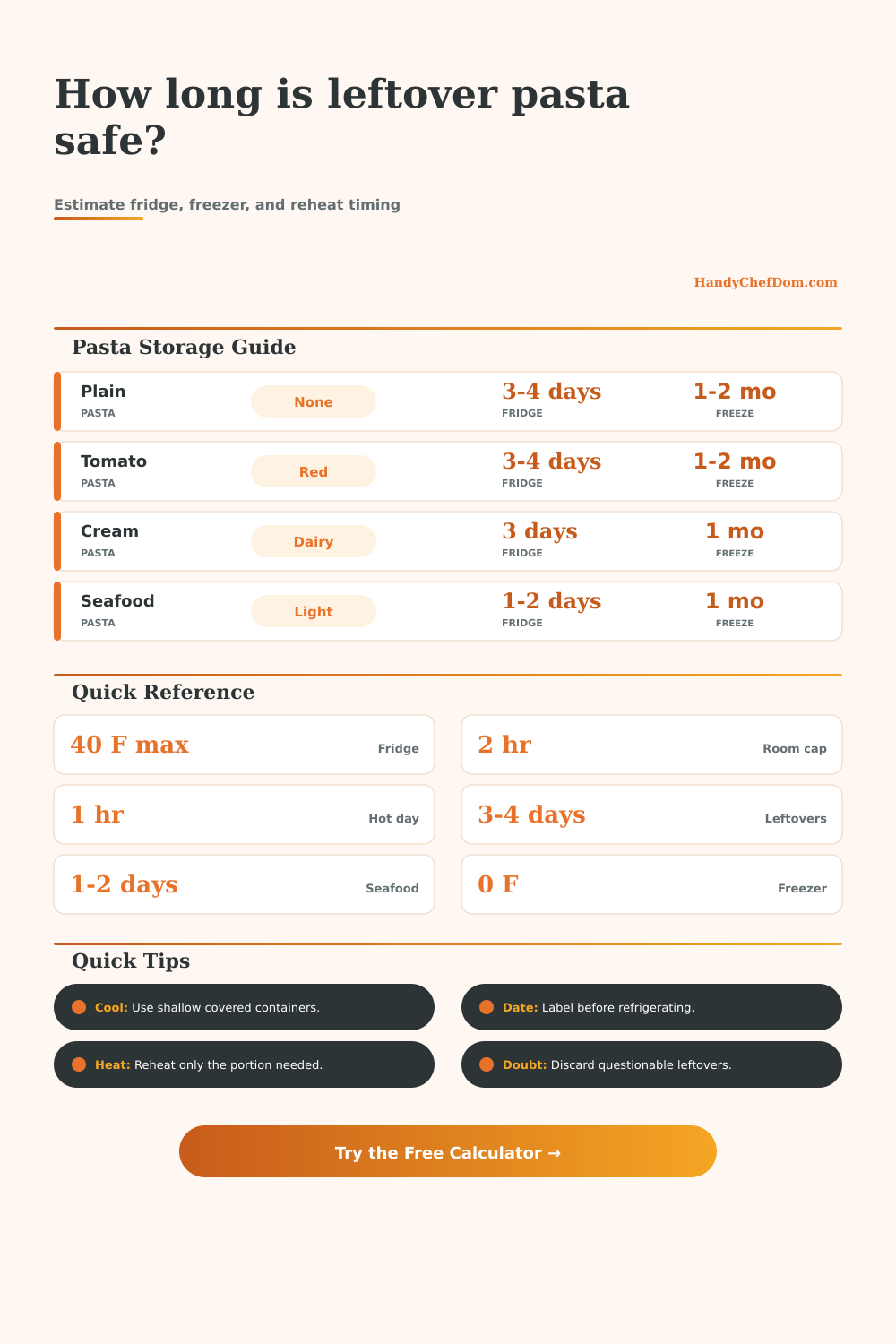
🍝 Leftover Pasta Shelf Life Calculator
Estimate a conservative leftover pasta storage window from pasta type, sauce, refrigerator temperature, cooling delay, container seal, add-ins, portion depth, freezing plans, and reheats.
Use a conservative home-kitchen estimate. This tool assumes clean handling, prompt cooling, refrigerator storage at 40°F or below, and reheating only the portion you plan to eat.
| Pasta Type | Conservative Fridge Window | Freezer Quality | Storage Note |
|---|---|---|---|
| Cooked dry wheat pasta | 3 to 4 days | 1 to 2 months | Best separated from sauce when possible |
| Fresh egg pasta | 2 to 3 days | 1 month | Shorter window because of egg and moisture |
| Filled pasta or ravioli | 2 to 3 days | 1 month | Use filling ingredients to choose the shorter side |
| Baked pasta or lasagna | 3 to 4 days | 1 to 2 months | Cool in shallow portions before refrigerating |
| Whole wheat pasta | 3 to 4 days | 1 to 2 months | Quality may dry faster than plain pasta |
| Gluten-free pasta | 2 to 3 days | 1 month | Texture breaks down faster after chilling |
| Rice noodles | 2 to 3 days | 1 month | Keep cold and covered; texture firms quickly |
| Gnocchi or potato pasta | 2 to 3 days | 1 month | High moisture means use the shorter side |
| Sauce or Add-In | Fridge Effect | Best Range | Practical Caution |
|---|---|---|---|
| Plain, oil, or butter | Neutral | 3 to 4 days | Use clean utensils and a tight cover |
| Tomato or marinara | Neutral to slight reduction | 3 to 4 days | Refrigerate promptly after serving |
| Cream, Alfredo, or cheese | Shortens quality window | 2 to 3 days | Reheat gently and avoid repeated cooling |
| Pesto or herb oil | Slight reduction | 3 days | Keep sealed to limit quality loss |
| Meat sauce or sausage | Shortens to leftover meat range | 3 days | Use shallow portions and thorough reheating |
| Shrimp, fish, or shellfish | Shortest practical range | 1 to 2 days | Discard if mishandled or odor changes |
| Mayo pasta salad | Use deli-salad caution | 3 to 4 days | Never leave out during service |
| Storage Timing Grid | Room Temperature | Action | Calculator Treatment |
|---|---|---|---|
| 0 to 1 hour | Up to 90°F | Refrigerate in shallow covered containers | Best case timing |
| 1 to 2 hours | Up to 90°F | Refrigerate now and use shorter side | Small shelf-life reduction |
| Over 2 hours | Up to 90°F | Discard perishable pasta leftovers | Discard verdict |
| 0 to 1 hour | Above 90°F | Refrigerate immediately | Shorter side of range |
| Over 1 hour | Above 90°F | Discard perishable pasta leftovers | Discard verdict |
| Power outage over 4 hours | Fridge above safe range | Discard leftovers if held above 40°F too long | Discard or zero remaining |
| Container and Portion Depth | Cooling Speed | Storage Fit | Use In Calculator |
|---|---|---|---|
| 1 inch shallow meal prep | Fast | Airtight boxes or zipper bags | No depth penalty |
| 1 to 2 inch covered portion | Good | Most home leftovers | Neutral treatment |
| 2 to 3 inch casserole slice | Moderate | Lasagna, baked ziti, stuffed shells | Use shorter side |
| Over 3 inch deep tray | Slow | Party trays and family pans | Strong reduction |
| Airtight container | Best quality hold | Fridge or freezer portions | Small quality boost |
| Open or poor seal | Fast drying and exposure | Temporary only | Shortens window |
| Reheat and Freeze Choice | Fridge Impact | Freezer Quality | Recommended Handling |
|---|---|---|---|
| No reheats yet | Use full adjusted window | Best if frozen early | Reheat only the portion needed |
| One reheat cycle | Use within 1 to 2 days | Freeze only if still early | Cool quickly if saving again |
| Two or more reheats | Use the same day or discard | Freezing not ideal | Avoid repeated cool-reheat cycles |
| Freeze today | Stops fridge clock for quality planning | 1 to 2 months best | Pack airtight in flat portions |
| Already frozen | Track thawed leftovers separately | Safe while frozen at 0°F | Use after thawing within leftover window |
Eventually the lasagna ends up in the back of the fridge, morphing from dinner to a lunch that might be on the verge of crossing the line. You’re standing in the kitchen holding a fork, wondering if this thing is still okay. It looks OK, it smells OK, but… something’s amiss. It’s instinct, not paranoia. Home kitchens aren’t always sterile, which make following food safety rules easy in theory but messy in practice.
The calculator take all these variables, including the ones that make sense, and converts them into a clear time window within which it’s safe. You know why each of these inputs matters, making tool more trustworthy than just guessing.
How to Keep Your Leftovers Safe
Usually the pasta isn’t what’s going wrong. Noodles are surprisingly durable. They’re dry, which means they have very little of anything in them. It’s when you throw other stuff into the mix, like protein, dairy or moisture. Cream sauce is a real petri dish waiting to grow bacteria. Because tomatoes are acid and generally less susceptible to decay, they holds up better than cream. Add some seafood (shrimp, crab) and now the timer gets cranked even further. Seafood is delicate. It doesn’t last long.
The computer know all this and adjusts the estimated expiration date to match. It’s an acknowledgement of the fact that certain things gives up before others do. It’s not just about whether it tastes good anymore, it’s about the risk.
The primary variable here is temperature. Just because it feels cold to you doesn’t mean your fridge are cold enough. For example, a refrigerator must remain below 40 degrees Fahrenheit to sufficiently slow bacteria growth. At warmer temperatures, things spoils quicker. To test this, use an inexpensive thermometer and place it in the middle shelf of your fridge. What does it say? If it’s warmer than that, the calculator will adjust the window down to match. Why? It takes into account how much colder things actualy are, not how cold they ideally are. In other words, the timer only resets according to real world, not the perfect one.
Secondly, depth also play a role. When things are sitting deep in a casserole dish, for example, they take longer to cool. The outside cools down while the inside stay warm. That’s a bacterial haven. Shallow dishes avoids this problem. More of the container is exposed to the cold air. This is a slight physical adjustment with a significant safety impact.
The second significant variable is time spent at room temperature. Perishables should never be left out past two hours. In warm kitchens, that drops to one hour. All too commonly, people set out the pasta and then chat with their friends or do dishes. Nothing wrong with that, right? Wrong. As soon as the timer begin ticking, bacterial growth explodes. Some types of bacteria produce toxic byproducts that can’t be killed, even if reheated to death. There’s no getting safe cooking from unsafe food once it’s sat around too long.
That’s what the tool is designed to flag in an instant. Cross the delay threshold and it tells you: toss your meal. Sure, wasting a couple bucks on dinner sucks. But spending a day on the porcelain doesn’t sound so great, either.
The great pause button: freeze! But do it right. Freezing pauses the clock on bacteria; it doesn’t rewind the damage that’s been done. Freeze when something is still fresh. Don’t wait until the very last minute to freeze it.
Over time, food in the freezer will go bad and lose quality. Sauces will separate; things won’t taste as good. Best quality is different from safest. The calculator has a best quality time frame. At zero degrees, anything is safe forever. Eventually it just won’t taste as good. That way you know the difference and can plan ahead. Freeze that extra from Friday so that next Wednesday night you’re all set.
Your nose is overrated. While smell is great at detecting decay, it’s not necessarily great at detecting foodborne illness. Many pathogen don’t have an odor. When in doubt, throw it out. This is simple advice that avoids any complex consequences.
Use the calculator as a framework, but ultimately trust yourself to make the call. If you want to stay safe, then keep your fridge cold, keep your portions shallow, and keep the lid on tight. When you grab for that container, you’ll know exactly what you’re getting into.