🌿 Thyme Sprig To Dried Converter
Convert counted fresh thyme sprigs into dried teaspoons, tablespoons, and grams for roasts, stews, bouquet garni, braises, sauces, and scaled herb prep.
Start with the fresh thyme sprigs you counted. The converter estimates stripped leaf yield first, then turns that into dried leaf, rubbed thyme, or ground thyme while adjusting for sprig size, stem woodiness, cooking style, and jar strength.
| Fresh Sprig Type | Typical Length | Fresh Leaf Yield | Dried Leaf Starting Point |
|---|---|---|---|
| Petite tender sprig | 2 inches | 1/6 tsp leaves | Small pinch dried |
| Standard market sprig | 3 to 4 inches | 1/3 tsp leaves | 1/9 tsp dried |
| Long garden sprig | 5 to 6 inches | 1/2 tsp leaves | 1/6 tsp dried |
| Bushy side-branched sprig | 4 to 6 inches | 2/3 tsp leaves | 2/9 tsp dried |
| Woody roasting sprig | 4 inches | 1/4 tsp leaves | Scant 1/8 tsp dried |
| Soft lemon thyme sprig | 3 inches | 1/4 tsp leaves | Scant 1/8 tsp dried |
| Flowering thyme tip | 3 to 5 inches | 0.45 tsp leaves | 0.15 tsp dried |
| Sparse trimmed sprig | 2 to 4 inches | 0.20 tsp leaves | Small pinch dried |
| Fresh Sprigs Counted | Stripped Fresh Leaves | Dried Thyme Leaves | Tablespoon View |
|---|---|---|---|
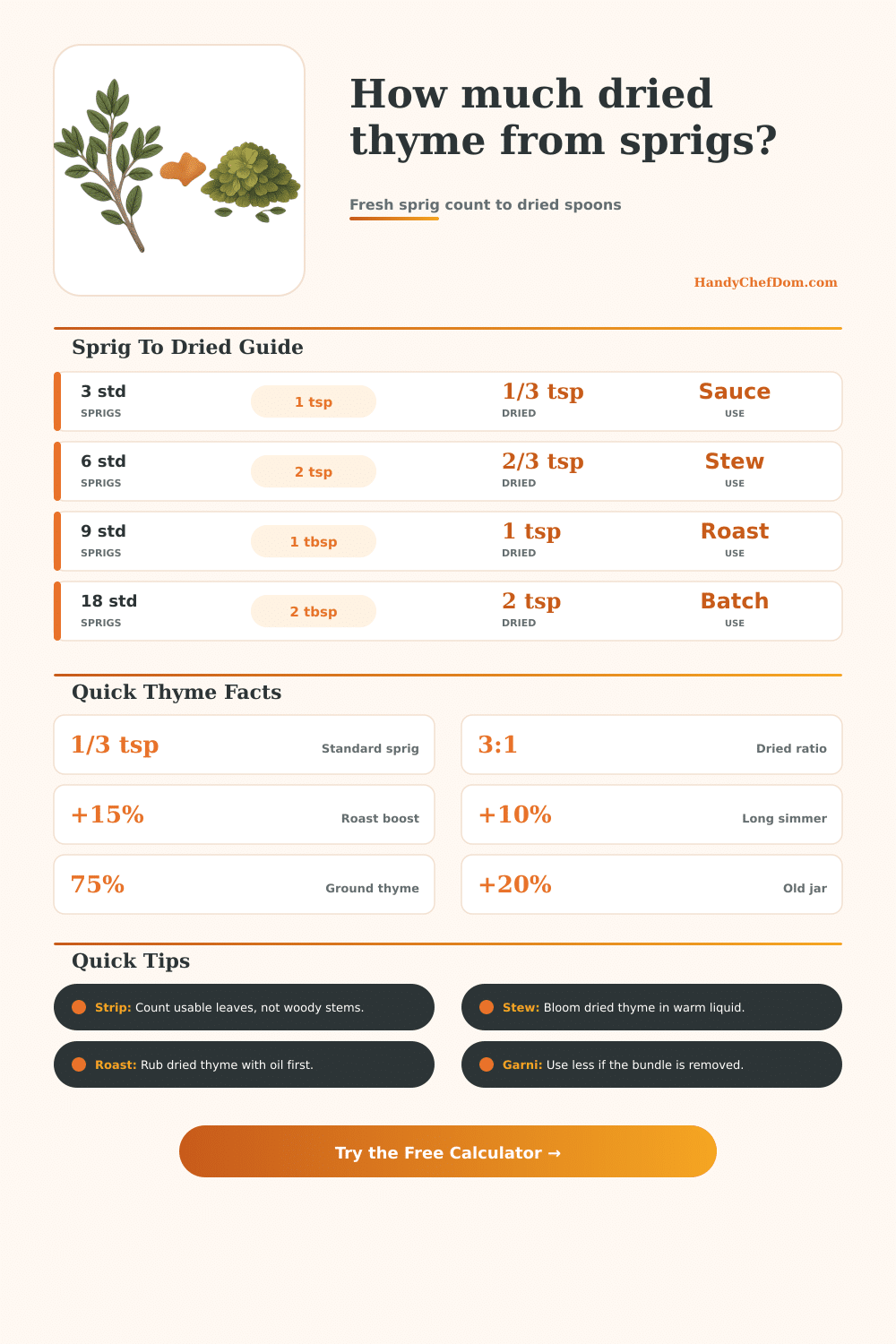
| 3 standard sprigs | 1 tsp fresh | 1/3 tsp dried | 0.11 tbsp |
| 6 standard sprigs | 2 tsp fresh | 2/3 tsp dried | 0.22 tbsp |
| 9 standard sprigs | 1 tbsp fresh | 1 tsp dried | 1/3 tbsp |
| 12 standard sprigs | 4 tsp fresh | 1 1/3 tsp dried | 0.44 tbsp |
| 18 standard sprigs | 2 tbsp fresh | 2 tsp dried | 2/3 tbsp |
| 27 standard sprigs | 3 tbsp fresh | 1 tbsp dried | 1 tbsp |
| Dish Style | Sprig-To-Dried Adjustment | Why It Changes | Practical Target |
|---|---|---|---|
| Roast chicken or turkey | 1.15x | Dry heat softens herb aroma | Oil-rubbed dried thyme |
| Beef stew or braise | 1.10x | Long simmer mutes top notes | Add early, taste late |
| Bouquet garni stand-in | 0.80x | Fresh bundle is removed | Keep dried amount gentle |
| Stuffing or savory bread | 1.20x | Bread absorbs seasoning | Distribute with fat first |
| Pan sauce or butter | 0.85x | Small volume tastes direct | Start low and whisk in |
| Beans or lentils | 1.05x | Earthy base can take thyme | Bloom with aromatics |
| Fish or light vegetables | 0.70x | Delicate food can taste woody | Use a lighter pinch |
| Marinade or rub | 1.00x | Direct contact carries flavor | Crush leaves before mixing |
| Dried Form | Spoon Factor | Approx Weight | Best Measuring Note |
|---|---|---|---|
| Dried thyme leaves | 1.00x | 0.8 g per tsp | Use level teaspoons for the baseline result. |
| Rubbed dried thyme | 0.90x | 0.9 g per tsp | Lightly compacted leaves need a bit less volume. |
| Crushed dried thyme | 0.85x | 1.0 g per tsp | Crushed pieces disperse quickly in liquid. |
| Ground thyme powder | 0.75x | 1.2 g per tsp | Powder tastes stronger and should be measured carefully. |
| Fresh jar adjustment | 0.90x | varies | Strong aroma can carry with less dried thyme. |
| Faded jar adjustment | 1.25x | varies | Increase gently only when the aroma is weak. |
Use three sprigs of fresh thyme. That’s what recipe says: three sprigs fresh thyme, from 1974.
Three sprigs? Okay, you say, but I don’t have any thyme. I don’t even have fresh thyme. All I’ve got is a jar of dried leaves, back there behind the cinnamon sticks. What now?
How to Use Dried Thyme Instead of Fresh
That’s one of the most typical cooking problems. And also one that can result in food that are either bland or tastes like chemicals. Yes, we all know: Fresh herbs is milder than their dried counterparts. But what’s worse is this: We don’t realy understand how much space those leaves take up once they shrivel up and go dry.
Turns out people blindly apply the three-to-one ratio that most of us know. It happens every time. We assume each sprig are interchangeable. They’re not. A woody stem isn’t the same thing as a bushy garden sprig, which contains far more leaf than the first. Make an equal swap, and you’ll mess up your seasoning.
After entering in information on your sprigs, the calculator does all math for you. It requires you to count up what you’ve got, and stops you from guessing at the conversions. The tool prompt you with questions about how full (or not) the leaves are, and how woody (or not) the stems are.
Why? You don’t eat the woody bit. So if yours were tough, there’s less yield of usable leaf. That means less fresh equivalents needed to equal the same quantity when it’s dried. On the other hand, tender lemon thyme in a pot will hold more volume-wise per stem than tough stuff outside. Not accounting for that variable is why some folks think dried thyme are too strong and others find it weak. Often it’s because they guessed wrong about the leaf density on that particular bunch.
Dried herbs also matter. It’s not just their quantity that matters, but their form. Will you be using the ground powder or whole rubbed leaves? Rubbed leaves is not the same as whole dried leaves. Because a ground herb such as thyme has greater surface area than a leaf, it’ll give its flavor sooner, and therefore taste stronger at equal-teaspoon strength. Measure ground thyme according to what’s written on jar, and you’re going to overdo your dish; too late, because now the sauce is ruined. That slight variation is the cause of many sauces’ undoing, and it isn’t something most cooks think about.
It isn’t a problem anymore, thanks to this tool, which accounts for it automatically. All you have to do is indicate what form your dried herbs are stored as.
But there’s another factor, how old is the jar? If it’s a fresh jar, the volatile oils are intact, giving a bright, sharp aroma. If it’s an older jar, particularly if stored by the stove, it’s lost most of its top-note. This is why fading jars gets a little bump at the converter level: You have to add slightly more physical herb to reach the desired scent. It’s not strictly a matter of bulk; it’s about retaining potency.
Because dry flavors don’t travel as well on dry air, you need a little bit more dried thyme to bring out roast-potatoy goodness than you would for a damp braise. Roasted herbs must be stronger, too, to really punch through potatoes and poultry, while long-cooking softens their rougher edges and blends them into the dish smoothly.
Another difficult spot is finding bouquet garni substitutes. If your recipe asks for a bunch of herbs (fresh) bundled up in cheesecloth, then pulled out later, the flavor will be gentle and diffused. But dried-herb thyme leaves, left to sit around in the pot for an hour or two, might turn woody or bitter. Because infused flavors is different than those of things steeped whole, the tool advises cutting back when you’re trying to approximate the pulled-out bundle. You don’t want a foreground-punchy thing; you want it to serve as a background note.
But at the end of the day, thyme conversion isn’t just arithmetic. It’s appreciation; it’s recognizing where an ingredient began (stem) and where it ends up (spoon). Knowing what amount corresponds to your particular jar of sprigs, whether they go into a robust beef stew or a light fish pan sauce, removes the fear of using herbs.
It eliminates guesswork and replaces it with intent-tasting. And that peace of mind would of been more valuable than a whole spice-rack filled with partially empty glass bottles. It’s just leaves, but knowing exactly how many there are is the difference between a meal cooked in a rush and one made with care.