🥗 Dressing per Salad Calculator
Estimate salad dressing from greens cups or greens weight, salad style, add-ins, dressing type, coating level, servings, reserve dressing, absorption, and tossed or plated service.
Choose whether you know the greens volume or greens weight. The calculator converts cups, ounces, tablespoons, fluid ounces, cups, and milliliters for a practical dressing plan.
| Greens Type | Approx Weight Per Cup | Dressing Tendency | Calculator Note |
|---|---|---|---|
| Spring mix or baby lettuces | About 0.6 oz per cup | Needs a light coat | Soft leaves collapse if overdressed. |
| Chopped romaine | About 1.7 oz per cup | Handles creamy dressing | Good for Caesar and chopped bowls. |
| Baby spinach | About 1.1 oz per cup | Moderate absorption | Use more with berries, nuts, or cheese. |
| Arugula | About 0.7 oz per cup | Use a light drizzle | Peppery leaves are best lightly coated. |
| Chopped kale | About 1.3 oz per cup | Absorbs more dressing | Massage or toss well before serving. |
| Shredded cabbage slaw | About 2.5 oz per cup | Needs the most dressing | Dense shreds coat better with extra time. |
| Salad Style | Greens Per Serving | Starting Dressing | Best Coating Level |
|---|---|---|---|
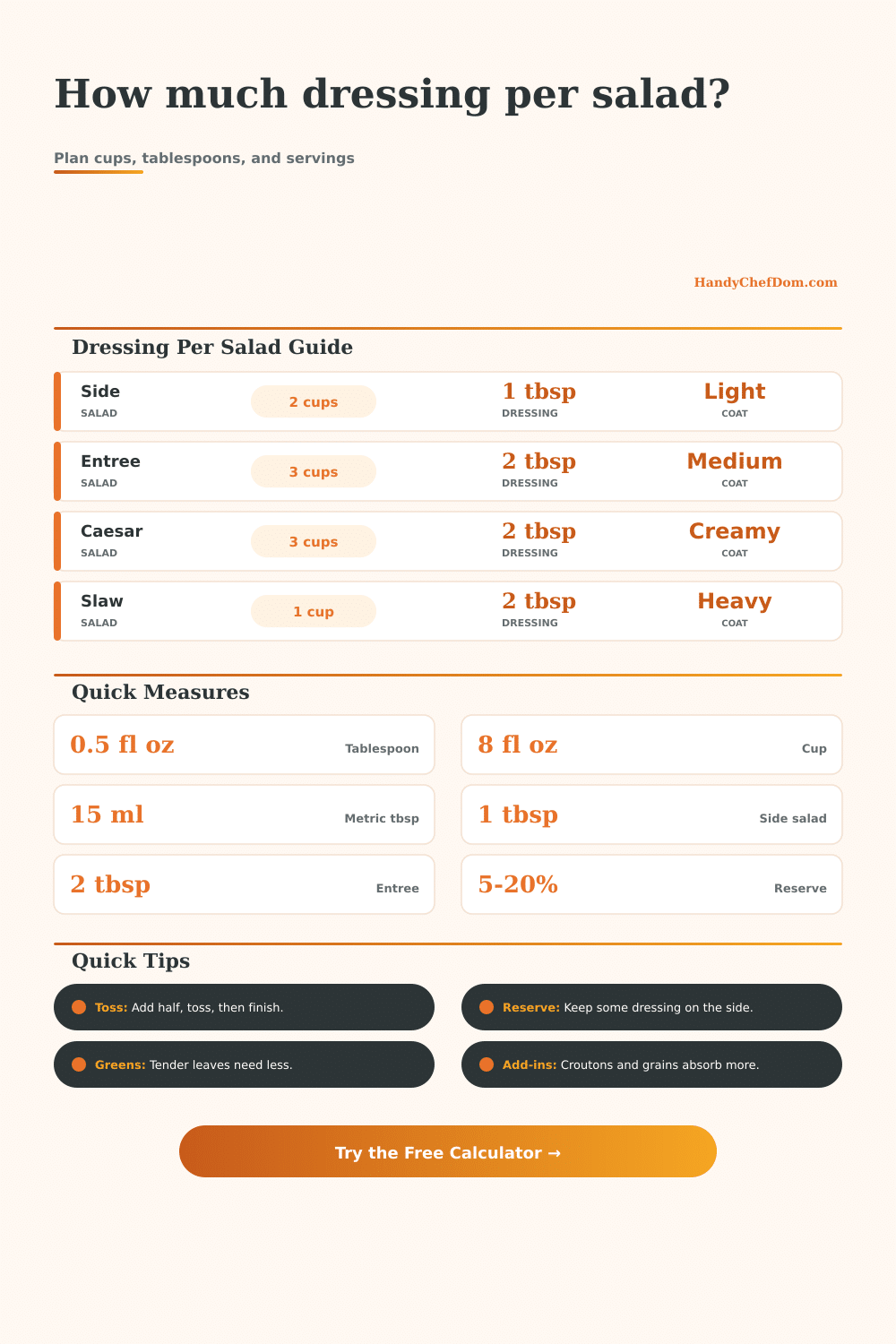
| Light side salad | 1.5 to 2 cups | 1 tablespoon each | Lightly dressed |
| Entree salad | 3 to 4 cups | 2 tablespoons each | Medium coat |
| Caesar-style salad | 2.5 to 3 cups | 1.5 to 2 tablespoons each | Medium to generous |
| Chopped salad | 2 to 3 cups | 1.5 tablespoons each | Medium coat |
| Grain or bean salad | 1.5 to 2 cups greens | 2 tablespoons each | Generous coat |
| Slaw-style salad | 1 to 1.5 cups | 2 to 3 tablespoons each | Heavy coat |
| Dressing Type | Texture | Use Factor | Planning Note |
|---|---|---|---|
| Classic vinaigrette | Thin and glossy | Baseline | Spreads quickly through most tossed greens. |
| Creamy ranch or blue cheese | Thick and clingy | Slightly less | Coats leaves strongly, so start lower and add more. |
| Caesar dressing | Creamy emulsion | Near baseline | Works well with romaine and crunchy add-ins. |
| Olive oil and vinegar | Very fluid | Less | Thin dressing spreads fast and can pool on plates. |
| Citrus vinaigrette | Bright and thin | Slightly more | Often tastes lighter, so a little extra is common. |
| Tahini or nut dressing | Dense and absorbent | More | Clings to grains, kale, cabbage, and chopped salads. |
| Measure | Fluid Ounces | Tablespoons | Milliliters |
|---|---|---|---|
| Small drizzle | 0.25 fl oz | 0.5 tablespoon | About 7 ml |
| Side salad serving | 0.5 fl oz | 1 tablespoon | About 15 ml |
| Entree serving | 1 fl oz | 2 tablespoons | About 30 ml |
| Quarter cup | 2 fl oz | 4 tablespoons | About 59 ml |
| Half cup | 4 fl oz | 8 tablespoons | About 118 ml |
| Full cup | 8 fl oz | 16 tablespoons | About 237 ml |
You’ve dumped all that salad dressing onto your lettuce, but it’s sitting in the bottom of the bowl, not on greens. Too much? No; it’s about how much area is covered, not amount of liquid. Use this: a salad-dressing calculator will tell you just how much to put on (it’s all about the kind of greens, plus their volume). So it’s no longer a guess, but rather part of a plan. Leaves get dressed; not soggy!
Greens: Different types of greens has different textures and their ability to retain dressing varies. Delicate greens (such as arugula and baby spinach) are tender and will wilt if pressed too hard. Lighter is better for these dainty plants, you don’t want to squash them completely; that’s why it doesn’t work to treat them like tougher greens (more on that next). Greens such as kale and romaine are stronger and can withstand dressings with more weight. Thicker tahini or creamy ranch won’t break down these firmer cells. Depending on what you use as your base (spring mix versus something sturdier), the calculator starts from a different place.
Why Use a Salad Dressing Calculator
The amount of dressing also vary depending on what you put in it. A bowlful of beans or grains need more dressing than just plain lettuce. Dry ingredients soak up moisture like sponges. You’ll need to adjust accordingly if you don’t take these add-ins into consideration: The leaves becomes sodden and the grains remains dry. To achieve balance, you have to adjust upward for large add-ins. For grain salads, you can use the calculator to boost the dressing percent. Everyone gets there fair share of flavor.
Thicker dressings also has an impact. They clump together when mixed. They take more vigorous tossing to spread. You typically need to use more to get visually similar results then you do with a thinner dressing. Olive oil covers a whole plate in no time and in even distribution; a gloppy, creamy blue cheese coating will form lumps that won’t spread easy without aggressive tossing. The calculator assumes a thinner dressing needs less starting material, and a thicker dressing, more. That’s because people commonly try too little of the latter.
A good trick is to reserve some dressing. Tastes differ, and the texture of the greens will also vary depending on how well they are dried. Sometimes you want things a little more acidic; sometimes you don’t. Having some reserved means there’s wiggle room. Add a bit more dressing if need be, but never take away what has been soaked up. That way you can taste as you go along, adjusting for flavor before you serve it. The whole thing becomes less formulaic, more interactive check.
The calculator handles the math once you plug in your greens volume and style, turning vague intuition into a precise plan. It’s more about getting the right balance between ingredients than anything else. You’re looking for enough dressing so each leaf is coated in flavor while still remaining relatively light. You aim for a glossy coating that makes the greens look moist instead of soggy. With the proper ratio, the dressing complements the vegetables’ own flavors.
You begin by estimating and adjust accordingly. Eventually, you know when to use more or less. The amount of dressing depends on your judgment, and the calculator helps guide you. A good balance improves even a simple side dish.