Meatballs in Sauce Simmering Time Calculator
Estimate how long meatballs need to simmer in sauce from diameter, count, meat blend, raw or cooked state, sauce depth, pot crowding, simmer temperature, and target center temperature.
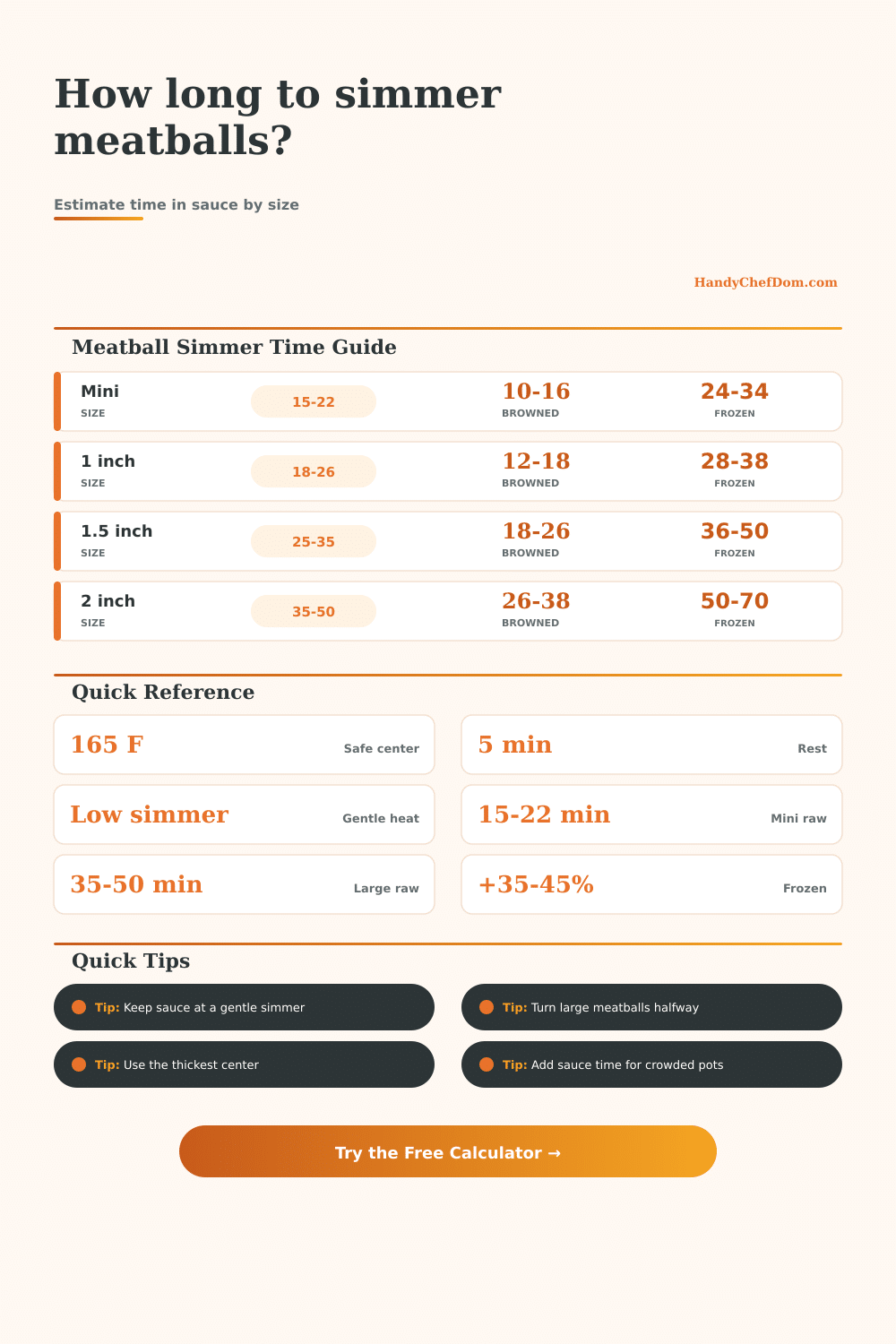
| Meatball size | Raw in sauce | Browned first | Cooked from frozen |
|---|---|---|---|
| Mini, about 3/4 inch | 15 to 22 minutes | 10 to 16 minutes | 24 to 34 minutes |
| Small, about 1 inch | 18 to 26 minutes | 12 to 18 minutes | 28 to 38 minutes |
| Standard, about 1 1/2 inch | 25 to 35 minutes | 18 to 26 minutes | 36 to 50 minutes |
| Large, about 2 inches | 35 to 50 minutes | 26 to 38 minutes | 50 to 70 minutes |
| Meatball type | Center target | Texture note | Best check point |
|---|---|---|---|
| Beef, pork, lamb, or mixed meatballs | 160°F / 71°C for raw ground meat | Juices clear, center firm | Largest meatball in center of pot |
| Turkey or chicken meatballs | 165°F / 74°C | Poultry center fully opaque | Thickest poultry meatball |
| Cooked leftovers or frozen cooked meatballs | 165°F / 74°C | Hot through center | Coldest center piece |
| Plant-based or seafood-style meatballs | Hot center or package target | Gentle simmer protects texture | Largest piece under sauce |
| Setup | Timing effect | Why it changes | Calculator use |
|---|---|---|---|
| Wide skillet or saute pan | Slightly faster | More surface area heats sauce evenly | Small or single-layer batches |
| Dutch oven or braiser | Baseline | Steady heat and moderate sauce depth | Family pasta batches |
| Tall saucepan or stockpot | Slower center | Deep sauce and stacked meatballs lag | Large sauce pots |
| Thick ragu, gravy, or cream sauce | Longer simmer | Viscous sauces move heat more slowly | Dense sauces or covered pots |
| Slow cooker on high | Longest range | Gentler heating and crowded sauce | Holding or party service |
| Scenario | Count | Size | State | Sauce | Simmer time | Total plan |
|---|
The other day I dropped some raw meatballs into a pot of bubbling tomato sauce, then panicked: How long would they be cooked? I peeked inside one. Still pink! Five minutes later: Still pink. An hour after that, the thing was hard as a rock but I was finaly sure that it was safe to eat.
It wasn’t really a failure of my cooking skills; it was a case of heat transfer physics masquerading as dinner. After all, a meatball is a dense mass of protein floating in a fluid environment (of variable depth and varying degrees of thickness). That’s a lot of variables to manage in terms of heat movement.
Why Size and Sauce Change Cooking Time
When you plug them into your calculator above (and make your selections), it do the equations for you, and takes away the guessing game aspect of thermal dynamics. But knowing what’s going into those inputs makes you cook differntly. One thing that is absolute most important variable here? Size.
This seems like an “obvious” answer, I know, but again, we’re gonna say it anyway, since everyone forgets this all the time. It’s not just proportional, a two inch meatball won’t take twice as long than a one inch; it’ll take exponentially longer. Why? Because heat creeps in from surface outward. That big ol’ sphere has a long way to go before its core hits safe temperatures.
And if you try to hurry things along by turning your stovetop up to high, you’re going to end up with a crispy-crust exterior while the insides is still dangerously undercooked. You’ll be left chewing on a leathery outer shell covering a cold-as-ice center. The device factors in the diameter variable automatically, providing a realistic window that takes into account the slow crawl of heat towards the middle.
What also matters is what happens to meatball prior to dropping into the pot. Many meatball recipes instruct browning the meatballs beforehand (to create more flavor via the Maillard reaction). Great idea for taste; bad idea if you want to stick to schedule. Because a browned meatball has already cooked the outside layers, all of your simmer time now goes toward completing the interior rather than cooking the whole volume. The calculator treats raw drops and pre-browned batches differently, so it won’t overcook a batch that just needs to have its center warmed through.
But if you start with frozen meatballs, then the additional penalty in time is substantial, since you’re up against two factors: size and initial temperature. The sauce is part of that, too, so don’t be dismissive. Thin marinara will conduct heat better than a thick chunky ragu, which will conduce better than a rich cream sauce. Heat travels slower through thick liquids. This is what happens when you have meatballs sitting in a dense sauce.
The thickness resist flow, making the liquid molecules less willing to move. When meatballs sits in a dense sauce, this resistance slows down the heat transfer. And since you’re probably stacking the meatballs one upon another in whatever pan you’ve got, the resistance compounds. Whatever’s in the middle of a stack of meatballs in your Dutch oven will lag behind what’s closer to the surface. That’s why checking for temp is never optional when you’re dealing with a big batch.
Visual clues fool you. A meatball may appear done on the outside but remain uncooked within, particularly if it’s in a bed of thick sauce or stacked underneath others. That range, by the way, is no accident; home stoves are all over the map when it comes to how much actual heat they deliver at various burner settings.
Something like 200 degrees on the low setting might gently simmer along, letting some of the warmth in but not enough to fall apart tender meats like meatballs. At an active boil they’ll get shredded. Based off the simmer you choose, the tool adjusts the estimate for those minutes. If you’re re-heating something like leftovers that need to reach 165 degrees at the center or you’re using poultry, always err toward the lower end of the range. For things with pork or beef in them, 160 degrees will do just fine. And keep things juicy.
In summary, this isn’t a substitute for a thermometer. It’s a planning tool. It is a way to know when it’s time to check. Plug in amount of sauce, depth of sauce, batch size, and what kind of meat, and follow the map. But remember, what your thermometer says about the temperature of the biggest, thickest meatball you have in there is always the last word.
You want tender but safe. You want meatballs that hold together and aren’t gooey because they’ve been soaking in warm liquid for an hour out of fear you’d overcook them. Let the math guide you, then double-check with the tool. Then eat confidentally.