🌿 Vanilla Beans in Vodka Soaking Time Calculator
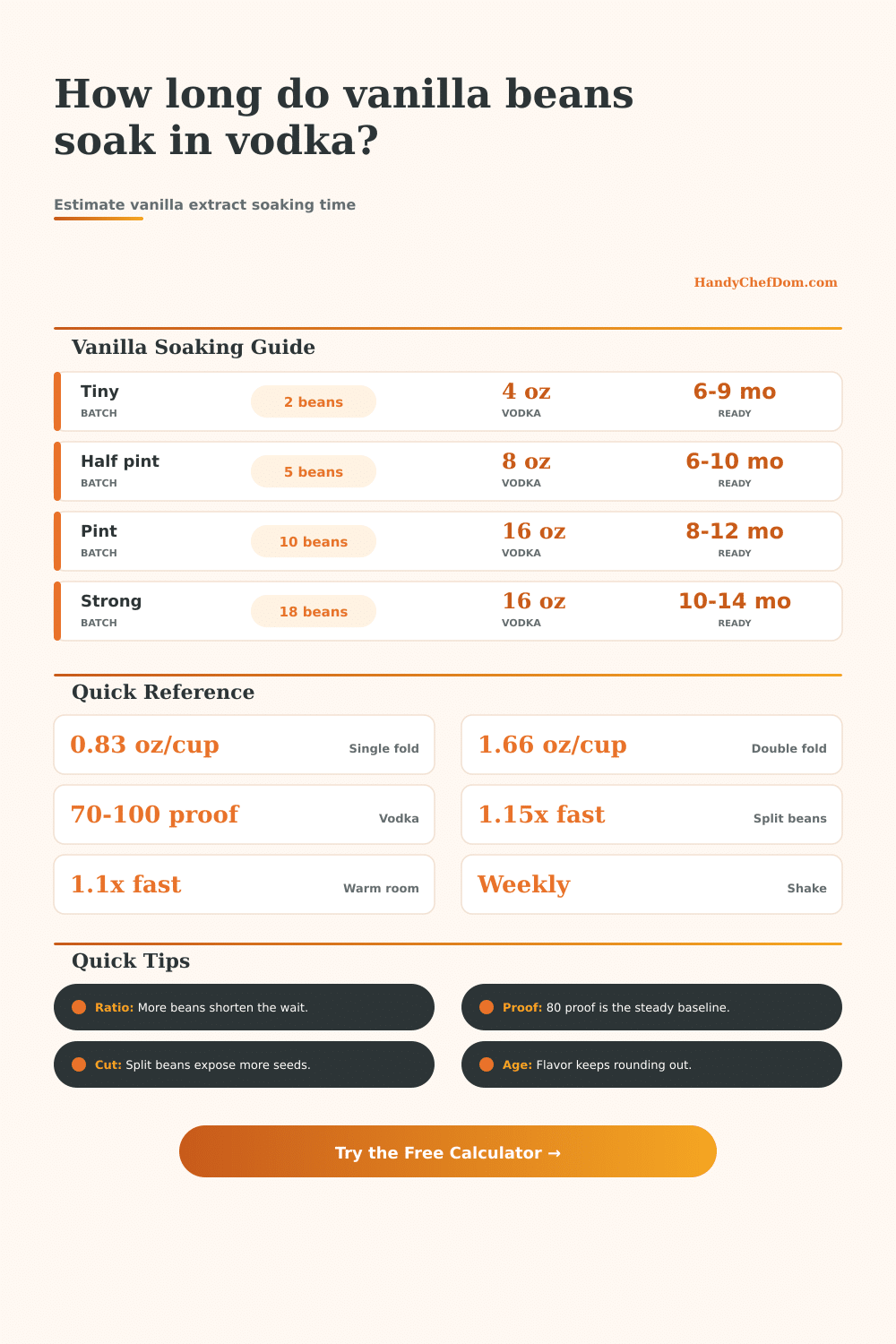
Estimate vanilla extract soaking time from bean count or weight, vodka volume and proof, bean grade, split or chopped prep, bottle size, shake frequency, desired strength, room temperature, and current batch age.
Enter your bean load and vodka volume, then choose the extraction style. The calculator compares your bean-to-alcohol ratio with single fold and double fold targets, adjusts for bean prep, proof, room warmth, headspace, shaking, and current age, then estimates the remaining soaking window.
| Bean or prep choice | Average weight each | Extraction speed | Calculator use |
|---|---|---|---|
| Grade A plump beans | About 4.5 g | Steady, aromatic | Good for visible gift bottles and rounded aroma. |
| Grade B extract beans | About 3.5 g | Efficient | Good extract choice; count may need more beans. |
| Dry or older beans | About 3 g | Slower start | Use weight if possible and allow extra time. |
| Tahitian-style wide beans | About 5 g | Soft floral | Often smells ready sooner but benefits from aging. |
| Whole beans | Varies by grade | Slowest | Clean look, longest extraction window. |
| Split or chopped beans | Same weight | Faster contact | Better liquid contact and stronger early color. |
| Vodka proof | ABV | Soaking effect | Best fit |
|---|---|---|---|
| 70 proof | 35% | Gentle extraction | Minimum-style extract strength. |
| 80 proof | 40% | Balanced baseline | Most homemade vanilla extract batches. |
| 90 proof | 45% | Slightly faster | Dense bean batches with good aroma hold. |
| 100 proof | 50% | Fast early pull | Double fold or short-start batches. |
| Over 120 proof | 60%+ | Sharp extraction | Use only when intentionally blending down. |
| Under 70 proof | Under 35% | Weaker solvent | Longer aging and lower extract confidence. |
| Batch age | What changes | Color and aroma cue | Calculator note |
|---|---|---|---|
| 0 to 4 weeks | Early color pull | Alcohol-forward, light vanilla | Shake often and keep beans submerged. |
| 1 to 3 months | Seed and pod extraction builds | Medium brown, sharper aroma | Useful for progress checks, usually not mature. |
| 3 to 6 months | Flavor starts rounding | Deeper color, softer alcohol edge | Light batches may be usable near this range. |
| 6 to 12 months | Standard maturity window | Full aroma, balanced taste | Most single fold batches land here. |
| 12 to 24 months | Long aging smooths edges | Dark, rounded, less sharp | Good for rich and double fold batches. |
| 24 months plus | Slow refinement | Very mellow aroma | Top off if beans are exposed. |
| Vodka volume | Single fold beans | Rich batch beans | Double fold beans |
|---|---|---|---|
| 4 fl oz / 118 ml | 2 to 3 beans | 3 to 4 beans | 5 to 6 beans |
| 8 fl oz / 237 ml | 5 to 6 beans | 7 to 9 beans | 10 to 12 beans |
| 12 fl oz / 355 ml | 8 to 9 beans | 11 to 13 beans | 15 to 18 beans |
| 16 fl oz / 473 ml | 10 to 12 beans | 14 to 18 beans | 20 to 24 beans |
| 500 ml / 16.9 fl oz | 11 to 13 beans | 15 to 19 beans | 21 to 25 beans |
| 750 ml / 25.4 fl oz | 16 to 19 beans | 23 to 28 beans | 32 to 38 beans |
| Shake pattern | Early extraction | Best bottle fill | Use when |
|---|---|---|---|
| Daily first month | Fastest start | 85% to 95% | New chopped or scraped batches. |
| Twice weekly | Strong steady pull | 85% to 98% | Standard bottles and most presets. |
| Weekly | Reliable baseline | 80% to 98% | Split beans in narrow bottles. |
| Monthly | Slower contact | 90% to 98% | Long-aging pantry batches. |
| Rarely shaken | Slowest | 90% to 100% | Whole beans with plenty of time. |
| Too much headspace | Uneven coverage | Under 75% | Use a smaller bottle or add vodka. |
Homemade vanilla extract demands patience. Invest in high-quality beans, submerge them in clear alcohol, then wait. Newbies purchase beans, fill up a jar with booze, give it a quick shake and call it good. Done deal? Nope. Patience is required: Months are needed as the alcohol gradually extracts flavor compounds from seed pods. To get a rich extract rather than a thin one, just two things matter, Ratio & Time. And that’s where my Vanilla Extract Calculator make your life easy. It does all the math for you (bean weight v liquid volume).
Home cooks begin with rough ratios. Most home cooks starts with vague ratios, throwing a few beans into a bottle without considering how much surface area the alcohol actualy contacts. Splitting the beans in half is significant because it exposes the gooey insides of the pod. That’s where the seeds are, and that’s where the alcohol do its work: it’s a solvent. Beans also extract at different speeds; whole beans looks pretty in a jar but they take more time. With the tool, you can think about that design decision alongside your desired completion time. Did you chop them? Split them? Leave them whole? That makes a difference then; the tool scales up or down depending on how finely you chopped. The tool also factors in type of bean you’re using (the plumper the pod, the more oil it contains). You might find that Grade B pods is slightly drier, while Grade A ones are fatter and hold more. This change how much weight you need to get the strength you want.
How to Make Great Vanilla Extract
It turns out, there’s a strange part to proof in all of this: 100 proof vodka will extract more quickly than, say, 80 or 90 proof. But sometimes (especially with something subtle like floral notes), higher proof can rob you of those flavors. Because of this, 80 proof is fixed value in the calculator. That’s where we find the sweet spot between maximum efficiency and maintaining the aroma profile. For less expensive, lower-ABV spirits, the tool add time to compensate for its lackluster solvent properties. The pages include reference tables that outline the range of proofs (i.e., the ABV) so you have an idea how alcohol strength influence more than just flavor character but also preservation.
Also, when I say “shake,” don’t trust your gut. For initial 30 days, vigorously shake daily so they get wet. Once you’ve started it, just gently rock them back and forth from then on. Depending on how many beans are in each bottle and what size bottles you use, the calculator tells you how much shaking to do (to ensure they aren’t getting banged around and bruised too early). It’s all about circulating liquid inside, but not beating up the beans. It also takes into account space between the top of the beans and the rim of the bottle, aka headspace. If there isn’t enough vodka covering the beans, the rest won’t be contributing anything to the taste. You’ll want to add a little more vodka if the beans begin to float. Any exposed surface area is wasted opportunity.
But then it ages. At first, that fresh extract tastes like alcohol with a sharpness. It’s flatly one dimensional; all vanilla. Six to a dozen months later and it rounds out; the rough corners dissapears. Woody notes shows up along with deeper caramel. Depending on the strength you want, the tool gives you a window of time when you’re likely ready. The tool give you a ready window based off your desired strength, whether you want a light baking extract or a dense double-fold concentrate.
It’s still the same process. The numbers don’t matter much. What matters more is that your nose tell you when. When you smell deep vanilla from the liquid, you’re likely there. The color should be a dark, rich amber. The calculator will provide a plan, but your sense will provide the verdict.
Patience is the secret ingredient that transforms common ingredients into something extraordinery. And yes, waiting IS the key ingredient.