🔥 Broiler in Oven Preheat Time Calculator
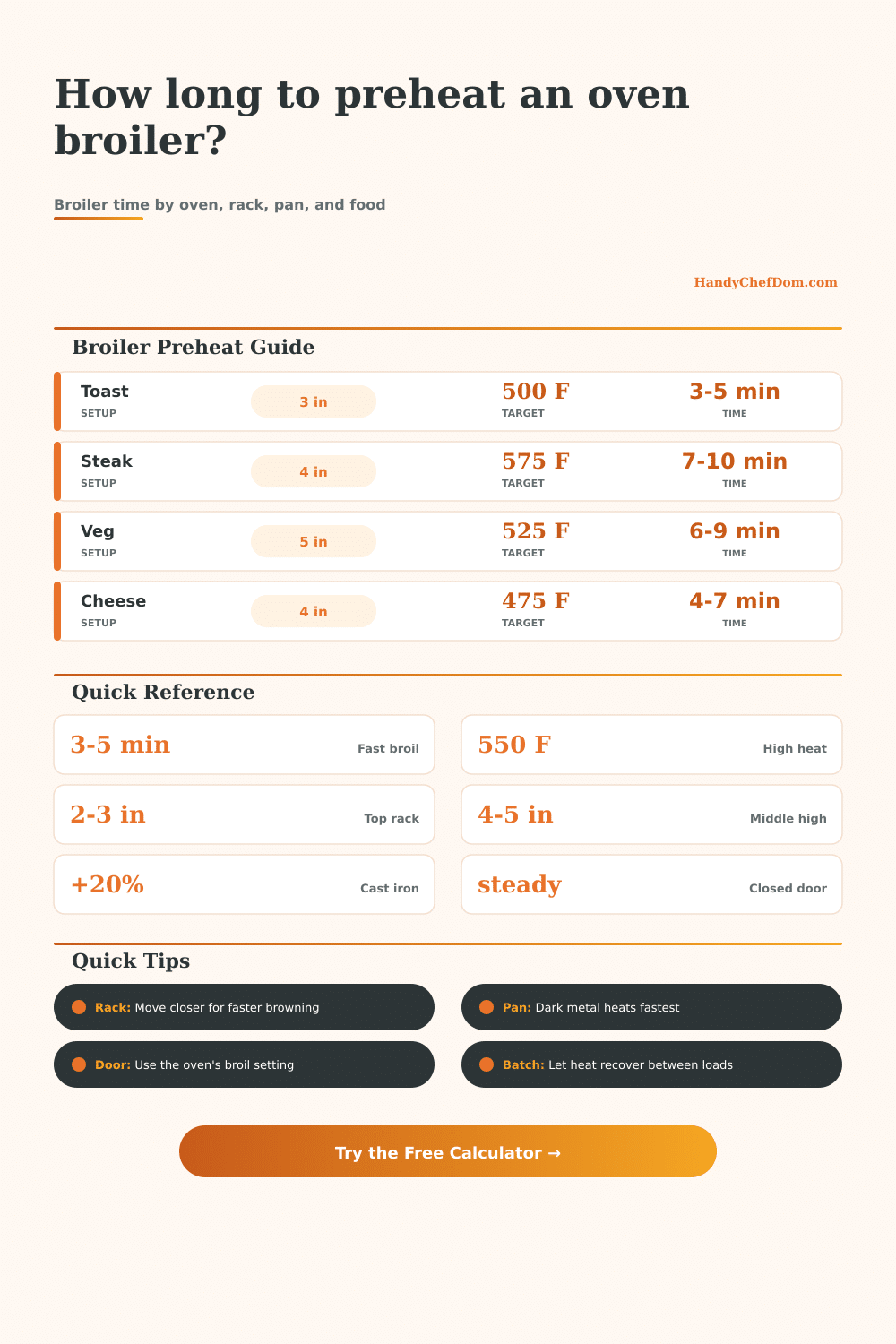
Estimate broiler preheat time from oven type, broiler element, rack distance, target surface temperature, pan material, food type, door position, altitude, and batch urgency.
Use the oven manufacturer's door guidance for broil mode. This calculator estimates how long it takes for the upper heat zone and pan surface to reach a useful browning range.
| Oven Setup | Element Style | Typical Preheat | Best Use |
|---|---|---|---|
| Full-size electric | Exposed coil | 6 to 9 min | Daily broiling |
| Full-size gas | Open flame | 5 to 8 min | Fast top heat |
| Convection oven | Fan assist | 6 to 8 min | Even trays |
| Infrared oven | Ceramic radiant | 3 to 6 min | Quick sear |
| Countertop oven | Compact element | 3 to 5 min | Small batches |
| Broiler drawer | Low compartment | 5 to 8 min | Toast and browning |
| Rack Distance | Heat Speed | Common Target | Typical Food |
|---|---|---|---|
| 2 inches | Very fast | 475 to 525 F | Toast, melts |
| 3 inches | Fast | 500 to 550 F | Nachos, fish |
| 4 inches | Balanced | 525 to 575 F | Steak, chops |
| 5 inches | Moderate | 500 to 550 F | Vegetables |
| 6 inches | Gentle | 450 to 525 F | Casseroles |
| 8 inches | Slowest | 425 to 500 F | Thick dishes |
| Pan Material | Warm-Up | Heat Hold | Broiler Note |
|---|---|---|---|
| Dark sheet pan | Fast | Medium | Quick browning |
| Bare aluminum | Normal | Light | Even but bright |
| Stainless steel | Slower | Medium | Needs more time |
| Carbon steel | Slower | Strong | Good searing |
| Cast iron | Slow | Very strong | Best recovery |
| Wire rack pan | Fast air | Light | Crisp underside |
| Food Type | Target Zone | Rack Fit | Preheat Bias |
|---|---|---|---|
| Toast or buns | 475 to 525 F | 2 to 3 in | Shorter |
| Steak or chops | 550 to 625 F | 3 to 5 in | Longer |
| Fish fillets | 500 to 550 F | 4 to 5 in | Normal |
| Vegetables | 500 to 575 F | 4 to 6 in | Longer |
| Cheese melts | 450 to 500 F | 3 to 5 in | Shorter |
| Casserole top | 425 to 500 F | 5 to 8 in | Gentle |
The element glows a fiery-red in seconds, and that’s when you see it: that visual feedback fools you into believing your oven’s ready. But it’s not. Although the air within its cavity may now reach temperatures hot enough to burn your hair off, the actual piece of metal upon which you’ll cook; the part you really give a shit about… Are still cold. It’s this gap between heat source and the cooking surface that will cause failure after failure in your kitchen. You plop a steak onto an unheated pan, and instead of a crispy-seared exterior, all you’re left with is a steaming, lifeless gray.
How can you avoid this? Learn the difference between surface-readiness and ambient heat, and you’ll achieve a nice, crisp crust every time. After choosing your rack placement and oven type, the calculator (above) do the math for you, no more guessing how long you need to wait for your dinner to cook. It factors in things that most home chefs fail to consider: How far away from the heating element is my food? What kind of pan am I using? Is it made out of cast iron, which retains heat very different than a flimsy sheet of aluminum? Does my appliance use an exposed electric coil, or a hidden gas flame? The tool predicts how long it will take that particular piece of cooking equipment to reach the right temperature to brown (not merely surrounding air).
Why You Must Preheat Your Pan
Take into account the pan. Darker rims on a sheet pan will absorbs radiant heat aggressively. Stainless steel pans is reflective and help bounce energy away. Because of this, you’ll hit your desired surface temperature sooner then with a dark-rimmed sheet pan. But there’s more to it than just speed. While a lightweight pan will get warmer quicker, you must wait for heavier pans like cast iron skillets to warm up. That hefty slab of iron require far more time to reach five hundred degrees Fahrenheit than a lightweight pan. But when it does, it doesn’t let go. Drop a cold piece of steak in a preheated cast iron pan, and the temperature won’t budge. Drop that same steak into a thin aluminum pan, however, and watch that temperature plummet. Cooking come to a halt. Searing never occurs.
The other thing that really makes a difference is where you put the rack in relation to the food. For example if you raise the rack just an inch or two you’ll dramatically reduce your preheating time. But it also will have changed the way you cook. Too high and everything burns on the outside while center is still raw. Too low and now you’re basically baking instead of grilling. Depending upon what you’re cooking certain things require a more gentle touch; like a delicate piece of fish fillet versus a big slab of thick beef. You need the surface to brown but not the heat penetrate so aggressively as to dry out meat before it’s cooked all the way through.
It matters if the door is open or closed: You’d think that doesn’t affect things much. Sure, there’s the issue of altitude, which impacts how heat transfers. People living at higher elevations requires more patience. But when you open the door, all that thermal mass goes away. Each time you do that, you’re resetting the clock on the temperature inside your pan. Opening and closing the door happens often in a typical kitchen. We’ve incorporated this into the calculator. It accounts for how many times per hour you might open it by adjusting its predicted ready-in-time to match.
Rush it, skip the complete preheating process, and your results will show in the final texture. There’s also more complexity with batch cooking. When doing multiple loads, how long will it take for the pan to recover? Will it be fast (when you remove the first batch and place the next one in a heavy pan)? Or slow (you put the second batch in a light pan, which takes several minutes to reheat)? The tool calculates that recovery window, enabling you to plan out your cooking rather than spend your time standing around while it heats back up. It makes the messy thing much more manageable based off a timeline.
Broiling in general is all about managing heat. It is not merely cranking up the dial. But making sure what’s touching your food is hot enough to carry out the chemical reaction that produces flavor. And that reaction need continued heat. You can’t have an unpreheated pan. That won’t do it. You need a preheated one. When you do, you get a rich, deep crust on whatever you’re cooking that shows the dish is well-made. Let the pan do its job and trust the wait. That glowing element is only the start.