🧁 Mini Cupcakes per Person Calculator
Estimate mini cupcakes for adults, kids, event type, serving duration, appetite, other desserts, mini size, leftover target, and frosting richness.
Enter adults and kids separately, then choose the event and dessert style. The calculator adjusts the mini cupcake count before rounding into tray-friendly totals.
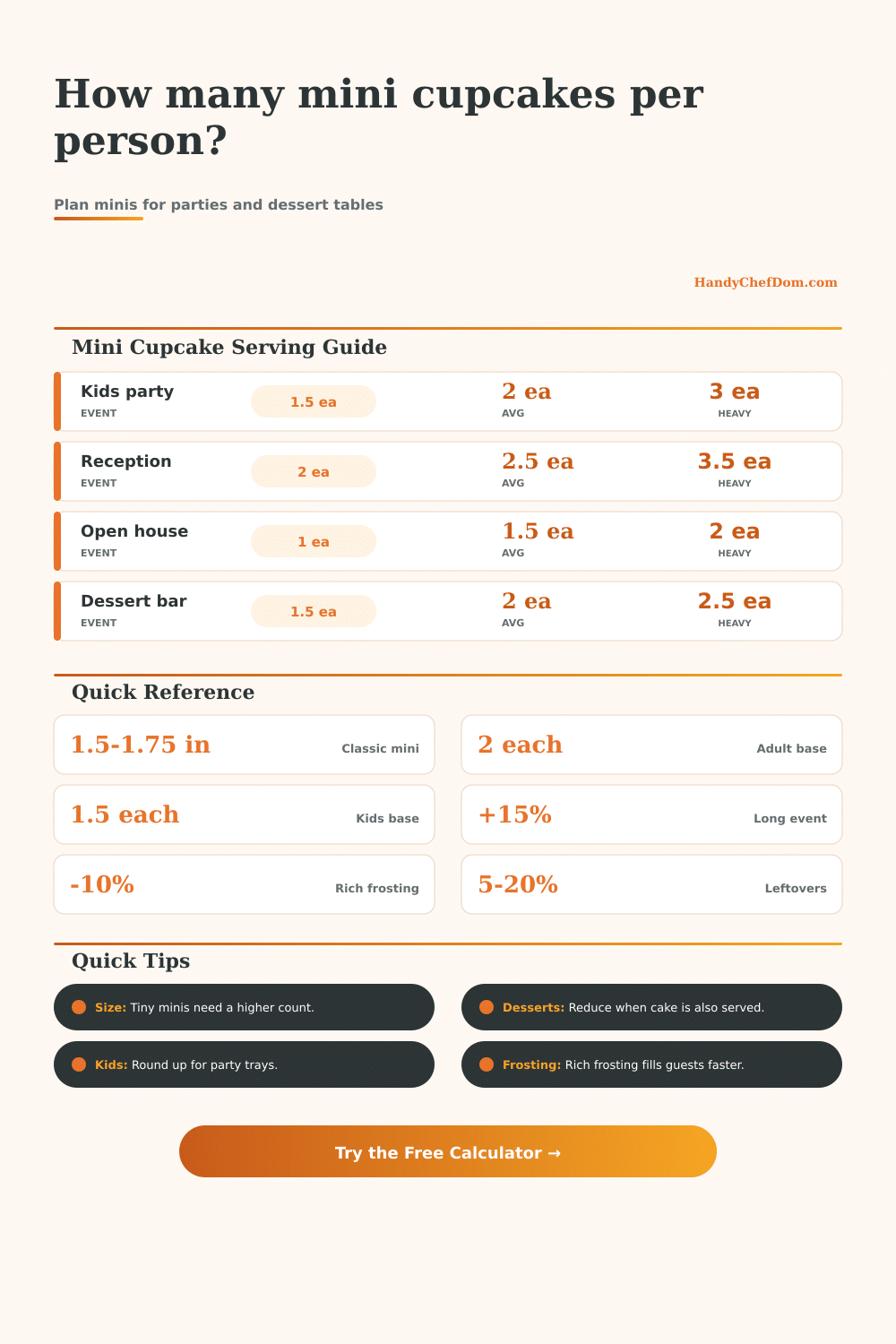
| Event Type | Base Minis Per Adult | Best Baseline | Planning Note |
|---|---|---|---|
| Birthday party | 2.0 | 2 to 3 each | Round up when cupcakes are the main sweet. |
| Wedding dessert table | 1.5 | 1 to 2 each | Usually shares attention with cake and other sweets. |
| Office or meeting tray | 1.4 | 1 to 2 each | People often take one now and one later. |
| Open house grazing | 1.3 | 1 to 1.5 each | Use a longer duration adjustment for slow arrivals. |
| Shower or brunch | 1.6 | 1.5 to 2 each | Good with coffee, fruit, and small plated bites. |
| Cocktail reception | 2.2 | 2 to 3 each | Guests graze and may return to the dessert table. |
| Holiday meal dessert | 1.7 | 1.5 to 2 each | Reduce if pies or plated sweets are also served. |
| School classroom party | 1.8 | 2 each | Simple tray counts are easier for classrooms. |
| Buffet dessert bar | 1.5 | 1 to 2 each | Many choices usually reduce cupcake count. |
| Mini Size | Typical Diameter | Count Adjustment | Serving Style |
|---|---|---|---|
| Tiny one-bite minis | About 1.25 in or 3.2 cm | Add about 18% | Best for tasting flights and cocktail trays. |
| Classic minis | About 1.5 to 1.75 in or 3.8 to 4.4 cm | Baseline | Best everyday party size. |
| Bakery-style minis | About 2 in or 5 cm | Reduce about 10% | Feels closer to a small cupcake. |
| Tall frosted minis | About 1.75 in or 4.4 cm | Reduce about 6% | Use with tall buttercream or decorations. |
| Guests | Light Dessert Mix | Average Party | Sweet Crowd |
|---|---|---|---|
| 12 guests | 18 to 24 minis | 24 to 30 minis | 36 minis |
| 20 guests | 30 to 36 minis | 40 to 48 minis | 60 minis |
| 35 guests | 48 to 60 minis | 72 to 84 minis | 96 to 108 minis |
| 50 guests | 72 to 84 minis | 96 to 120 minis | 144 minis |
| 75 guests | 108 to 132 minis | 150 to 180 minis | 216 minis |
| 100 guests | 144 to 168 minis | 200 to 240 minis | 288 minis |
| Frosting Richness | Guest Effect | Count Adjustment | Best Use |
|---|---|---|---|
| Light glaze or whipped top | Feels lighter | Add about 5% | Good for brunch and fruit-forward trays. |
| Standard buttercream swirl | Normal party serving | No adjustment | Use as the default for classic minis. |
| Rich buttercream or ganache | More filling | Reduce about 10% | Works well for chocolate-heavy assortments. |
| Filled or heavily decorated minis | Most filling | Reduce about 14% | Use for premium-looking dessert tables. |
There’s a particular type of panic that sets in when you come to realize that your dessert table isnt shaping up so well. You invited 30 people. Those 24 mini cupcakes has dissapeared faster then the cake can get served. In most cases it’s not a matter of lack of effort. It’s a matter of not understanding geometry of grazing.
Mini cupcakes present an interesting case: sitting in an awkward mid-ground between too-large-to-ignore (sprinkles) and too-small-to-count-as-a-full-dessert (cake). It’s this ambiguity that makes planning difficult. How do you translate number of guests into number of real baked goods without either running out on the hungriest toddler in the room or having half a sheet pan of leftovers? It’s the kind of math you’d like to get right without having to guess in the dark. Thanks to the calculator up top, you don’t have to guess.
How to Calculate Mini Cupcakes
Once you know what sort of event you’re hosting and how many guests will be there (and what percentage are kids versus adults), the calculator figure the rest out for you. Now, why do these variables matter? Why should you trust the results? Knowing where these numbers come from give you confidence in their accuracy.
First, who are we feeding? Kids and adults eat differently, both literally and figuratively! One mini cupcake can serve as a polite post-meal treat for an adult. For a kid, it’s three or four mini cupcakes that dissapears off the dessert table because they’re small, individual bites. And if you have a combination of kids and adults, averaging this out isnt going to work. You want to weigh big eaters’ appetites accordingly. Using the tool to separate adults from kids allows you to do just that and make your base case reflect real world.
Another silent variable is duration. Is this a six hour wedding reception? It could also be an office meeting that lasts only two hours. On the one hand, guests are grabbing what they like and moving on. On the other, dessert table is a playground. Guests graze. They come back for more. Try again. Try something different. The more time your event has, the more minis you’ll burn through. That feels odd at first. “How can I think time alters anyone’s appetite?” But it does. It alters opportunity. The more time, the greater number of opportunities to eat.
And finally, there is competition. What else will be served? Knowing that answer matters. Serving your guests a cookie jar, a fruit platter, and a full slice of chocolate cake means the mini cupcakes would be a side dish, an option rather than a necessity. You could knock down the number quite a bit. However, if they’re the only sweet item being served, then minis transform into the main event. That change in stature matters, too. Because of this, the calculator asks about additional desserts. It’s a quick toggle, but it completely changes the equation.
The type of frosting matters here as well. A heavy buttercream or ganache filling makes each cupcake more substantial. Guests fills up quicker, meaning they can have less. On the other hand, a light glaze makes things airy and light. It doesn’t feel like much of a commitment, and you may find your guests consuming more. And then there’s the matter of size. It is true in terms of volume and physical size. Small bites that look like pieces of candy vanish in an instant, and they taste exactly like them. Larger bites that feel like a real dessert allow you to serve fewer. For bite-size treats, you’re going to go through more per person; for almost-regular-size mini-treats (like what you’d get at a bakery), you’ll be able to provide fewer. Diameter is what makes the difference between a dozen and thirty cupcakes sometimes.
And lastly, consider leftovers. Some people love leftovers. Some people can’t stand waste. You can also specify how many cupcakes you’d like to have left over. Ten percent is a safe buffer. Twenty percent is generous. Five percent is risky. This preference comes down to your comfort level with imperfection. At a party, no one recalls exactly how many cupcakes were served. They’ll recall if it felt abundant or if they ran out before everyone got one. Your aim is to land in that sweet spot: a table that appears abundant while the fridge cries come the next morning.
First, choose your event type in the tool. Add your guests. Watch as number of trays goes up (or down). Baking isnt all there is to it, this is a game of logistics. If you need twenty-four cupcakes, you don’t want to buy forty-eight. And you certainly don’t want to do that scrambling at the last moment. You should of planned ahead. The math is easy. But the psychology of the party? It is not so much. Plan for the kid. Plan for the grazer. Plan for the extra hour. And plan to have one or two trays more, just in case. That’ll keep the panic away.