🍞 Stiff Sourdough Starter Calculator
Build a stiff sourdough starter from a liquid or firm seed by calculating the target amount, 45-65% hydration, fresh flour, fresh water, seed share, room temperature timing, and conversion notes.
Choose the final stiff starter amount you want. The calculator counts the flour and water already inside your seed starter, then solves the fresh flour and water needed to land in the 45-65% stiff range.
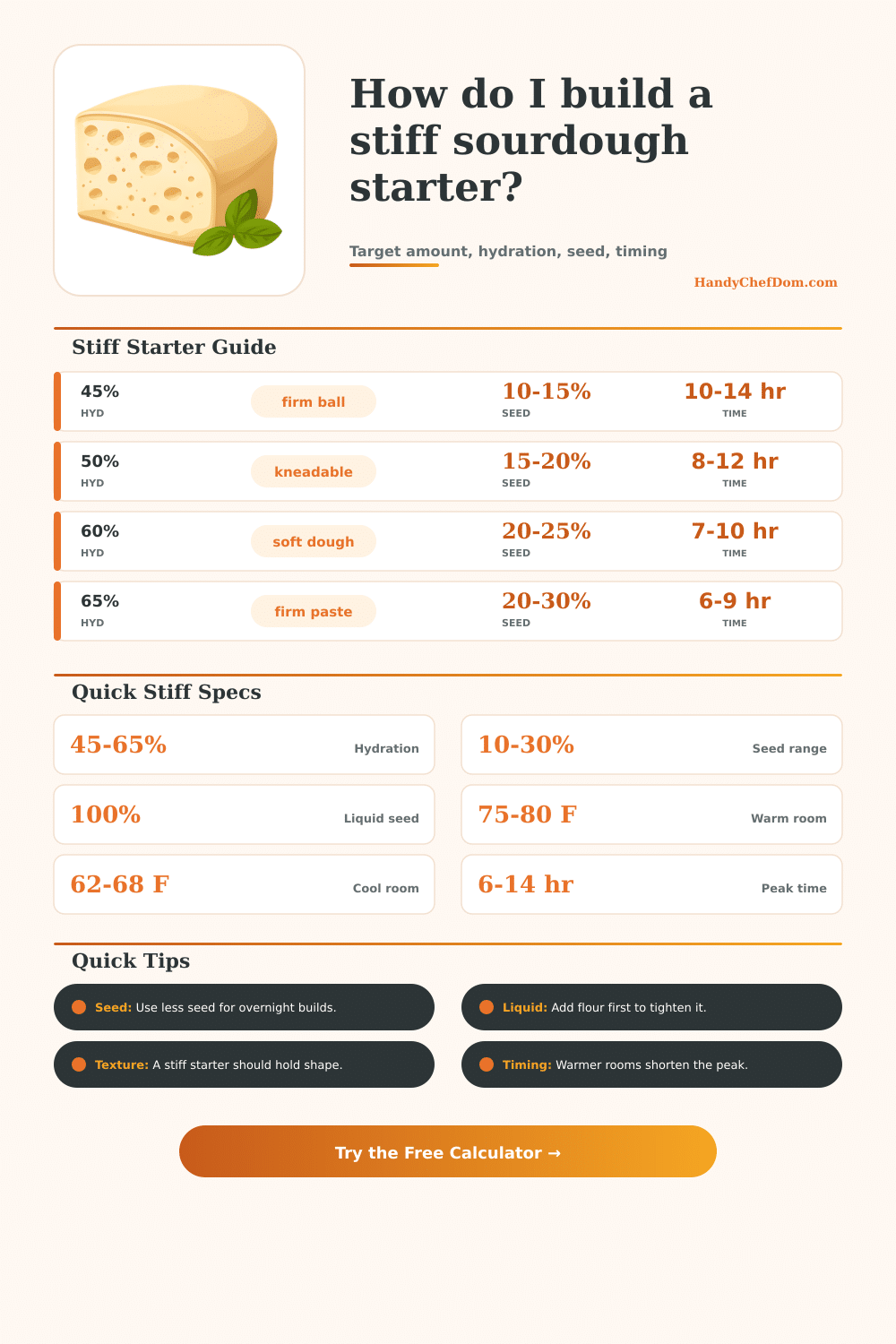
Kneadable ball that resists spreading and matures slowly.
Firm, smooth starter often refreshed by kneading.
Dough-like build that holds shape and favors mild acidity.
Firm but easier to mix, useful for most stiff levain builds.
Still stiff, but more spreadable and faster to ferment.
Equal flour and water seed usually needs extra flour to tighten.
Rye absorbs more water, so the same hydration feels firmer.
Low hydration slows activity and keeps the jar compact.
| Target hydration | Texture cue | Best use | Mixing note | Fermentation cue |
|---|---|---|---|---|
| 45 to 48% | Very firm ball | Pasta madre style builds | Knead until smooth | Slow dome, tight bubbles |
| 49 to 52% | Kneadable dough | Sweet dough and enriched bread | Use small water changes | Rounded top and elastic feel |
| 53 to 58% | Firm dough | Classic stiff starter refresh | Press flour fully into seed | Expanded but not loose |
| 59 to 62% | Soft dough | Everyday stiff levain | Mixes easier than 50% | Domed surface with bubbles |
| 63 to 65% | Firm paste | Transition from liquid starter | Good first stiff conversion | Faster peak, softer shape |
| Liquid seed | Target hydration | Target build | Approx flour add | Approx water add |
|---|---|---|---|---|
| 20 g at 100% | 50% | 100 g | 57 g | 23 g |
| 30 g at 100% | 60% | 150 g | 79 g | 41 g |
| 40 g at 100% | 55% | 200 g | 109 g | 51 g |
| 50 g at 100% | 65% | 250 g | 127 g | 73 g |
| 100 g at 100% | 60% | 300 g | 138 g | 62 g |
| Room temperature | Starter pace | Seed share | Likely peak | Planning note |
|---|---|---|---|---|
| 60 to 64 F | Slow | 20 to 30% | 10 to 16 hours | Use warmer water if needed |
| 65 to 70 F | Moderate | 15 to 25% | 8 to 13 hours | Good overnight range |
| 71 to 75 F | Balanced | 12 to 22% | 7 to 11 hours | Most predictable zone |
| 76 to 80 F | Fast | 8 to 18% | 5 to 9 hours | Lower seed for overnight |
| 81 F plus | Very fast | 5 to 12% | 4 to 7 hours | Watch before collapse |
| Final amount | Common seed | Good hydration | Use case | Scale cue |
|---|---|---|---|---|
| 60 to 100 g | 10 to 20 g | 55 to 65% | Small jar refresh | Round to 1 g |
| 120 to 180 g | 20 to 35 g | 50 to 60% | One-loaf stiff levain | Keep a 10 g reserve |
| 200 to 300 g | 30 to 60 g | 50 to 65% | Two-loaf build | Use a wide jar |
| 500 to 800 g | 75 to 150 g | 55 to 65% | Production levain | Round to 5 g |
| 1000 g plus | 100 to 200 g | 55 to 60% | Bakery batch | Mix by hand or spiral |
Timing is an estimate. Flour age, starter strength, water temperature, jar shape, and kneading level can move the peak, so use the calculated window with visual starter cues.
A stiff sourdough starter will change the behavior of a loaf of breads because the sourdough starter affect the dough before it ever hits the counter. A liquid sourdough starter can help flavor the dough quick but can collapse if it isnt used in a proper time window. In comparison, a stiff sourdough starter will slow the process and allow for more breathing room in the process.
A stiff sourdough starter will change the behavior of the dough by affecting how it hold its shape and how much acid is in the finished loaf of bread. Many people will discover the benefit of using a low-hydration sourdough starter if they use it for enriched dough or dough that proofs for a long period of time in a cool environment. The ratios in the sourdough starter is the most important element of making sourdough starter.
How a stiff sourdough starter affects bread
The amount of sourdough starter that will be used and the target hydration rate will determine how much mature sourdough starter will be used. A calculator will calculate the amount of flour and water that will be added to the mature sourdough starter. All the variable listed for sourdough starter will change the outcome of the sourdough starter.
For instance, using a larger amount of seed will shorten the time required to make sourdough starter but will also create a stronger flavor in the sourdough starter. Using a warmer temperature will shorten the peak of the sourdough starter by several hour but will require the sourdough starter to be placed in a cool spot to make the sourdough starter last longer. The texture of the sourdough starter can help determine if the number that are used for sourdough starter are working correctly.
Using a very low hydration rate will produce a sourdough starter that feels like a ball that can be kneaded but does not spread. Using a higher hydration rate will produce sourdough starter that feels like soft dough that can be pressed into a jar. The calculator will provide an estimate of the final hydration rate of the sourdough starter after rounding to the nearest hundredth.
Using the description of the texture of sourdough starter, individuals can determine whether it will behave like a stiff sourdough starter or a firm paste. Using rye flour or whole grain flour will change the texture of the sourdough starter. Rye and whole grain flour absorbs more water than other types of flour.
Many people misunderstand the concept of timing in the sourdough starter process. Warmer kitchens with lower percentages of seed will shorten the time for the sourdough starter for different reasons. Warmer kitchens increase the rate of the yeast in the sourdough starter but a lower percentage of seed mean that there is less momentum for the sourdough starter to begin rising.
For instance, if the kitchen maintain a temperature of 75 degrees and the goal is for the sourdough starter to be ready for use in the morning, a calculator can be used to determine the correct amount of seed that will be used to prepare sourdough starter in time for morning use. However, the sourdough starter must be watched in the jar once prepared. A domed top and an fermented smell are more important then the time that was calculated for the sourdough starter to peak.
Converting sourdough starter from liquid to stiff requires a specific process. The water content of the seed counts towards the hydration of the sourdough starter. More flour and less water will be required to reach the target hydration of sourdough starter.
The calculator will alert the baker if negative numbers will be calculated to the amount of water that will be added. To avoid adding too much water, the baker can decrease the amount of sourdough starter seed or increase the amount of sourdough starter that will be built. After performing this process several times, individuals will remember the steps that is required for the process.
The type of flour that will be used will impact the sourdough starter. For instance, bread flour will behave differently from all-purpose flour. Additionally, using whole wheat or rye flour will affect the sourdough starter in that the sourdough starter will set more fast.
Using different types of flour than those listed in the sourdough starter calculator will change the outcome of the sourdough starter. Thus, flour is another variable that should be included in the sourdough starter calculation. Storage builds for sourdough starter will operate on a different logic than the active sourdough starter.
In order to allow the sourdough starter to remain usable in the refrigerator for several days, a lower hydration rate of sourdough starter will be used. Additionally, using a cooler spot in the refrigerator will aid in the sourdough starter remaining usable for longer period of time. To make sure that the sourdough starter does not stall in its rising process, there must be enough momentum when creating the sourdough starter.
A calculator can be used to simulate the sourdough starter that will be stored in the refrigerator by altering the mode and temperature of the sourdough starter. The decision can then be made as to whether or not the sourdough starter will last in the refrigerator long enough before additional attention must be given to it. Many individuals make mistakes with sourdough starter use.
For example, many use 20 percent seed but have learned of sourdough starter use from a recipe that used such a percentage. Additionally, other cooks use the same hydration percentage for sourdough starter but for different types of flour and at different temperatures. When making sourdough starter, each individual variable impact the outcome of sourdough starter.
Thus, it is up to each cook to determine the correct amount of sourdough starter to use by running the calculation, determining the texture, and adjusting the process for the best outcome. The most important habit to develop in making sourdough starter is to always watch the sourdough starter in the jar. While the sourdough starter calculator provides an estimate for the parameters of sourdough starter, the final decision for how sourdough starter should be made is up to the individual.
Once individuals watch sourdough starter in the jar for a few batches of dough, it will become a habit and stiff sourdough starters will become a tool that each individual can use to make the type of sourdough bread that they would like to bake.