🍊 Orange Calorie Calculator
Estimate calories, carbs, fiber, and vitamin C from whole oranges, peeled weight, sections, cups, or juice portions.
Choose how you measured the orange. Whole fruit estimates use peeled edible weight, while juice mode switches to a low-fiber juice profile.
| Orange size | Peeled edible weight | Typical sections | Approx calories |
|---|---|---|---|
| Clementine size | 74 g / 2.6 oz | 9 sections | 35 cal |
| Mandarin size | 88 g / 3.1 oz | 9 sections | 47 cal |
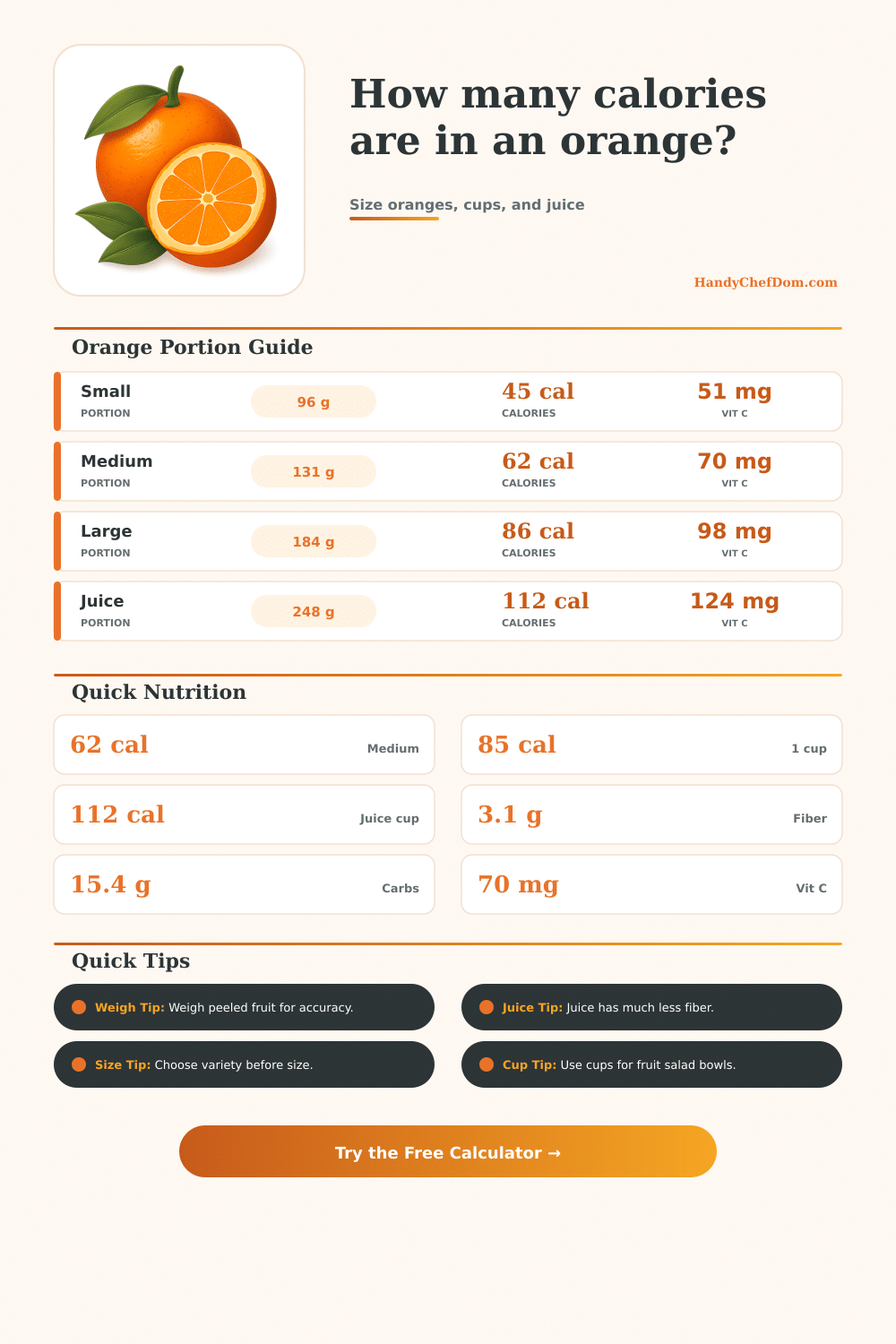
| Small orange | 96 g / 3.4 oz | 10 sections | 45 cal |
| Medium orange | 131 g / 4.6 oz | 10 sections | 62 cal |
| Large orange | 184 g / 6.5 oz | 12 sections | 86 cal |
| Extra large orange | 230 g / 8.1 oz | 12 sections | 108 cal |
| Variety | Calories | Carbs | Fiber / Vitamin C |
|---|---|---|---|
| Navel orange | 47 cal | 11.8 g | 2.4 g / 53 mg |
| Valencia orange | 49 cal | 12.5 g | 2.2 g / 49 mg |
| Blood orange | 50 cal | 11.9 g | 2.0 g / 45 mg |
| Cara Cara orange | 49 cal | 12.0 g | 2.6 g / 70 mg |
| Mandarin orange | 53 cal | 13.3 g | 1.8 g / 27 mg |
| Clementine | 47 cal | 12.0 g | 1.7 g / 49 mg |
| Tangerine | 53 cal | 13.3 g | 1.8 g / 27 mg |
| Satsuma | 53 cal | 13.3 g | 1.8 g / 31 mg |
| Measurement | Estimated weight | Best for | Nutrition note |
|---|---|---|---|
| 1 orange section | 9 to 15 g | Counting wedges | Varies by size |
| 1 cup sections | 180 g / 6.3 oz | Fruit bowls | About 85 cal |
| 1/2 cup sections | 90 g / 3.2 oz | Small snack | About 42 cal |
| 1 cup juice | 248 g / 8.7 oz | Juice glass | About 112 cal |
| 1/2 cup juice | 124 g / 4.4 oz | Small pour | About 56 cal |
| 1 medium orange | 131 g / 4.6 oz | Whole snack | About 62 cal |
| Portion style | Fruit amount | Juice amount | Typical use |
|---|---|---|---|
| Light snack | 75 g / 2.6 oz | 1/3 cup | Clementine style |
| Standard snack | 131 g / 4.6 oz | 1/2 cup | Medium orange |
| Fruit bowl | 180 g / 6.3 oz | 2/3 cup | One cup pieces |
| Large snack | 184 g / 6.5 oz | 3/4 cup | Large navel |
| Juice glass | 260 g / 9.2 oz | 1 cup | Fresh juice |
| Party wedges | 360 g / 12.7 oz | 1 1/3 cups | Shared platter |
The citrus oil hits your nose as you peel an orange in your hand. That bright scent tells you: you’re about to enjoy something healthy. But it doesn’t tell you how many calories you just ate. If most people grabbed for a fruit, it’s because they want feel light, but they have no idea whether that piece of produce will fit into their daily carb allowance, or whether they should hold some space open for yogurt later in the day. At the root of why most casual dieters stall out is the gap between wanting to eat healthfully and knowing exactly what to track. A sense of proportion is all you need to live well, but you don’t need to carry around a kitchen scale.
This page’s calculator closes the gap by translating fuzzy ideas like “a medium orange” into concrete nutritional information you can use.
How to Count Orange Calories
Nutritionists: Orange is orange, right? Wrong! First things first, not all oranges is made alike. I have a huge navel orange here and a small clementine there, yet both appear identical to the naked eye. Yet inside they’re worlds apart in terms of how many sections they contain, and how heavy they are. To counter this, the tool lets you pick your variety.
This is where you select your specific orange variety. The tool then updates its baseline to adjust for how much fiber and sugar density that fruit will have. For example, mandarins usually weighs in with higher sugar-per-gram ratios, while blood oranges tend to be denser with those healthy antioxidants. Guessing “orange” means you could miss out on a bunch of vitamin C, and/or be off by twenty calories. It’s that part people mess up. They assume all citrus fruit are one and the same, when in fact the juice-to-shell ratio makes all the difference. Pick your variety from the list and you’ll get numbers that match the actual item in your grasp, not some imaginary average.
Another variable that gets people: Size. How many sections are there? Nine in a small orange, but maybe 12 or more in a large one. Once you enter your fruit size, calculator does the rest (and avoids having to guess at numbers and other conversions). It also accounts for what’s actualy edible, the part left once you remove the peel. Because let’s be honest: Nobody eats the rind. The tool subtracts that weight and only considers the flesh you eat. For those who manage their blood sugar (or count macronutrients for fitness), knowing the actual gram weight of the edible part helps avoid little errors building up over time. You’re not just counting calories, you’re counting actual fuel.
Even more important than the size is how you prepare it. If you eat the entire section (including the white membrane), you’ll get way more fiber from the whole thing compared to when you juice the fruit. Because fiber slows the absorption of sugars, it also will keep you full longer and stabilize your energy levels. If instead, you shift the tool to juice mode, it will automatically adjust for less fiber since that pulp is getting left behind in strainer.
That’s a key point for those of you who believe that drinking orange juice is just like having eaten the fruit. It’s not. You’re getting the calories but none of the structural bulk or satiating texture. Knowing this trade-off helps you decide if you want an immediate sugar hit or something that will sustain you over time.
There are also handy comparison tables at the bottom of the page so that you don’t need to run through the entire calculation if you just want to see how different portions stack up. For example, I make a lot of fruit salads and rather than weigh every single slice, you can look in the table to find out how many cups of sections equal a certain calorie count. This is handy if you’re doing some meal prepping. It’s the little things, and helpful when you’re rushing around in the morning trying to simplify everything!
The accompanying tips explain that the gold standard is the weighed peeled weight, as this is the most accurate method. Use a digital scale if you’ve got one. Otherwise, the best bet is size estimates. So, yeah, an orange is just an orange, but the way you eat one can make all the difference in your overall diet.
Peel those sections into a lunchbox or squeeze fresh juice for breakfast. Whatever you choose, know what’s going into your body so you can see how it makes you feel afterwards. That burst of refreshing citrusy aroma at the beginning and the visual snapshot of your nutritional choices upon completion: It ain’t rocket science, but then again, it doesn’t have to be. Awareness, not perfection, is the goal here. You should of looked closer.