🍞 Bread Ingredients Calculator
Scale flour, water, salt, yeast, starter, preferment, sugar, and fat for loaves, pans, boules, baguettes, focaccia, and enriched dough.
Choose flour-weight scaling when you already know the flour amount, or loaf-target scaling when you want the calculator to solve the flour needed for your loaf count and baked size.
| Style | Hydration | Leaven | Salt | Sugar/Fat | Common Shape |
|---|---|---|---|---|---|
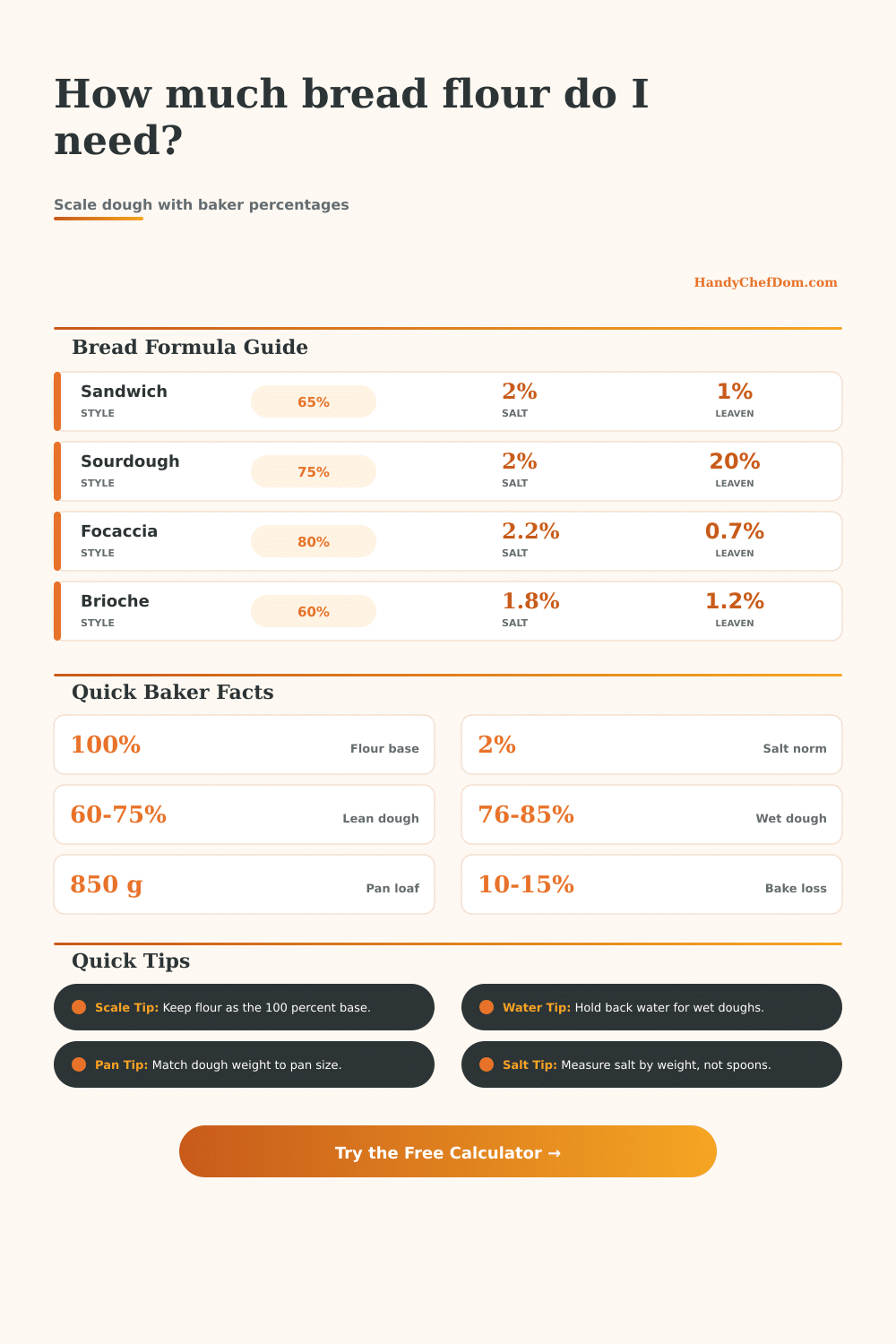
| Sandwich loaf | 63-68% | 0.8-1.5% yeast | 1.8-2.1% | 2-6% | Loaf pan |
| Lean hearth | 68-75% | 0.2-0.8% yeast | 1.9-2.2% | 0-2% | Boule or batard |
| Sourdough boule | 70-82% | 15-25% starter | 1.8-2.2% | 0-2% | Round boule |
| Baguette | 68-72% | 0.2-0.5% yeast | 1.9-2.1% | 0% | Long stick |
| Ciabatta | 78-90% | 0.2-0.6% yeast | 2.0-2.3% | 0-3% | Slab or slipper |
| Focaccia | 75-90% | 0.5-1.0% yeast | 2.0-2.4% | 4-10% oil | Sheet pan |
| Whole wheat pan | 72-85% | 1.0-1.8% yeast | 1.8-2.2% | 3-8% | Loaf pan |
| Brioche | 52-65% | 1.0-1.8% yeast | 1.4-1.9% | 20-45% | Loaf or rolls |
| Flour Blend | Typical Hydration | Absorption | Dough Feel | Best Use |
|---|---|---|---|---|
| Bread flour | 65-78% | Medium-high | Elastic | Loaves and crusty bread |
| All-purpose flour | 60-72% | Medium | Moderate strength | Pan loaves and rolls |
| Whole wheat blend | 72-88% | High | Firm then sticky | Whole grain pans |
| Rye blend | 75-95% | High | Paste-like | Rye loaves and deli bread |
| Spelt blend | 65-78% | Medium | Extensible | Rustic loaves |
| High-gluten flour | 68-82% | High | Strong and springy | Bagels and chewy dough |
| Semolina mix | 62-72% | Medium | Sandy then smooth | Italian loaves |
| Ancient grain blend | 68-82% | Variable | Tender | Flavor-forward bread |
| Pan / Shape | Dough Per Piece | Baked Range | Flour Guide | Note |
|---|---|---|---|---|
| Standard loaf pan | 750-950 g | 650-820 g | 430-540 g | Good sandwich height |
| Pullman pan | 900-1200 g | 780-1040 g | 520-690 g | Straight-sided slices |
| Round boule | 700-1000 g | 600-860 g | 400-570 g | Works well in baskets |
| Oval batard | 700-950 g | 600-820 g | 400-540 g | Easy slicing shape |
| Baguette | 300-380 g | 250-330 g | 170-220 g | Scale several pieces |
| Sheet pan focaccia | 900-1400 g | 780-1220 g | 470-720 g | Depends on pan area |
| Dinner rolls | 55-85 g | 48-74 g | 32-50 g | Use count as pieces |
| Pizza balls | 230-330 g | 230-330 g | 135-195 g | No baked loaf loss |
| Ingredient | Lean Range | Pan Range | Enriched Range | What It Changes |
|---|---|---|---|---|
| Water | 62-78% | 60-72% | 50-68% | Softness, openness, dough handling |
| Instant yeast | 0.2-0.8% | 0.8-1.5% | 1.0-2.0% | Fermentation speed and lift |
| Sourdough starter | 10-25% | 15-30% | 10-20% | Acidity, timing, preferment weight |
| Salt | 1.8-2.2% | 1.8-2.2% | 1.4-2.0% | Flavor and gluten strength |
| Sugar or malt | 0-2% | 2-8% | 8-20% | Color, softness, sweetness |
| Fat or oil | 0-3% | 2-8% | 12-35% | Tenderness and keeping quality |
| Prefermented flour | 10-30% | 0-20% | 0-15% | Flavor and fermentation balance |
| Handling buffer | 1-3% | 2-5% | 2-6% | Extra dough for sticking or trimming |
Baking bread doesn’t follow the same rules as other recipes. Volume isn’t precise. Doubling all ingredients, flour and water in particular; just makes the dough sticky or dense. Depending on your scooping technique, a single cup of flour could weigh anywhere from 180g-200g. When you multiply that error by five, your hydration rate has drifted enough to change texture of every single slice.
That’s why professional bakers don’t use cups. They measure everything by percentage, based off the ratio of each ingredient to the flour. The flour always stay at one hundred percent. The calculator takes care of algebra, leaving you with more time to shape and mix.
Why You Should Measure by Weight
The biggest change in mentality for your baking journey should of being understanding hydration. What does that mean? It’s the percentage of water weight compared to the weight of flour. So if you had a dough with 50% hydration it would be stiff (and quite manageable), while an 80% hydration dough will be sticky and require some serious technique. The higher the hydration then the more open the crumb and oven spring you’ll achieve.
But what does this practicaly look like? Well, it feels like it sticks to everything yet slides right through your fingers. For the beginner baker, start at about 65% hydration. That is the sweet spot; the perfect place between having a strong enough gluten structure to trap gas, but not too stiff that you can’t shape it.
We use salt casualy. Salt regulate the rate of yeast action and strengthens the gluten structure. Without enough salt, bread tastes flat and rises too quickly. With too much salt, fermentation is slowed to such an extent that dough doesn’t even fully inflate. Typically, anywhere from one point eight to two point two percent is the norm. Even if you can’t tell the difference in flavor between two point one and two percent, you’ll certainly see a difference in how the dough behave.
Weighing out your salt removes the guesswork of tablespoons, each of whose volume depends on size of the grains.
Yeast isn’t one size fits all: You can’t simply swap out whatever kind you have for instant or active dry; sourdough starter is another animal. Dry yeasts are just that; dry (but fresh yeasts contains moisture). In order to account for this, they should be used by weight, but since there’s more liquid in them, you’ll use less. And if you’re using sourdough starter, there’s also water and flour in it, so you don’t want to add it and then add all the water/flour as well. The recipe will be out of whack. With the calculator, you can say how much water is in your starter and what percentage it make up of the whole mixture.
Most recipes don’t mention pan size enough. A standard loaf pan hold about seven hundred fifty grams of dough. That means if you throw a thousand gram dough ball into a standard loaf pan, it’s going to boil over and burn. Throw in four hundred grams and you’ll have a flat brick. The tool has reference tables that will help you find a suitable vessel for your dough weight. This is a simple constraint that saves waste.
Additions such as enriched doughs (e.g., brioche) alter formula completely. Adding butter, or any other type of fat, to a lean dough are not going to work. It coats the gluten strands, making the structure weaker. To make up for this interference in gluten formation, you need more water. The total weight of your dough will reflect these additions as well. That way, if you forget that butter adds mass but not structure, your loaf won’t turn out dry and tough.
There’s some science behind this: baking is physics plus cooking. When you put something in an oven, it get lighter because water evaporates and the food forms a crust. To estimate weight of the finished loaf, you have to account for ten to fifteen percent lost during baking. If you’re making bread to serve at a dinner party, that ten to fifteen percent is important. Knowing how much flour you started with means knowing what the end product will weigh.
Your inputs are predictable, so the outputs also are predictable. Guesswork stops; Baking begins. The dough act the way you expect it to, and the bread comes out tasting like it should.