🦌 Deer Meat Yield Calculator
Estimate field dressed weight, hanging weight, boneless venison, trim, grind, steaks, and roasts from one clear calculator.
Enter the weight you actually know. The calculator converts that stage into estimated field dressed, hanging, boneless meat, trim, grind, steak, and roast amounts.
| Deer type | Live to field | Field to hang | Hang to boneless | Typical note |
|---|---|---|---|---|
| Small doe | 76% | 78% | 64% | Lower total pounds but usually clean trim |
| Average doe | 78% | 79% | 63% | Balanced yield for home butchering |
| Young buck | 78% | 80% | 62% | Good muscle ratio with moderate bone |
| Mature buck | 77% | 79% | 61% | More neck and shoulder trim variation |
| Large northern buck | 79% | 81% | 62% | Higher hanging weight and larger cuts |
| Mule deer | 78% | 80% | 61% | Often larger frame and heavier bone |
| Red deer | 80% | 82% | 63% | Large carcass with high roast potential |
| Lean hill deer | 75% | 77% | 60% | Expect more cleanup and smaller primals |
| Known weight | Best use | What it includes | Common range | Calculator role |
|---|---|---|---|---|
| Live weight | Rough planning | Whole animal before field dressing | 100% baseline | Converts down to all later stages |
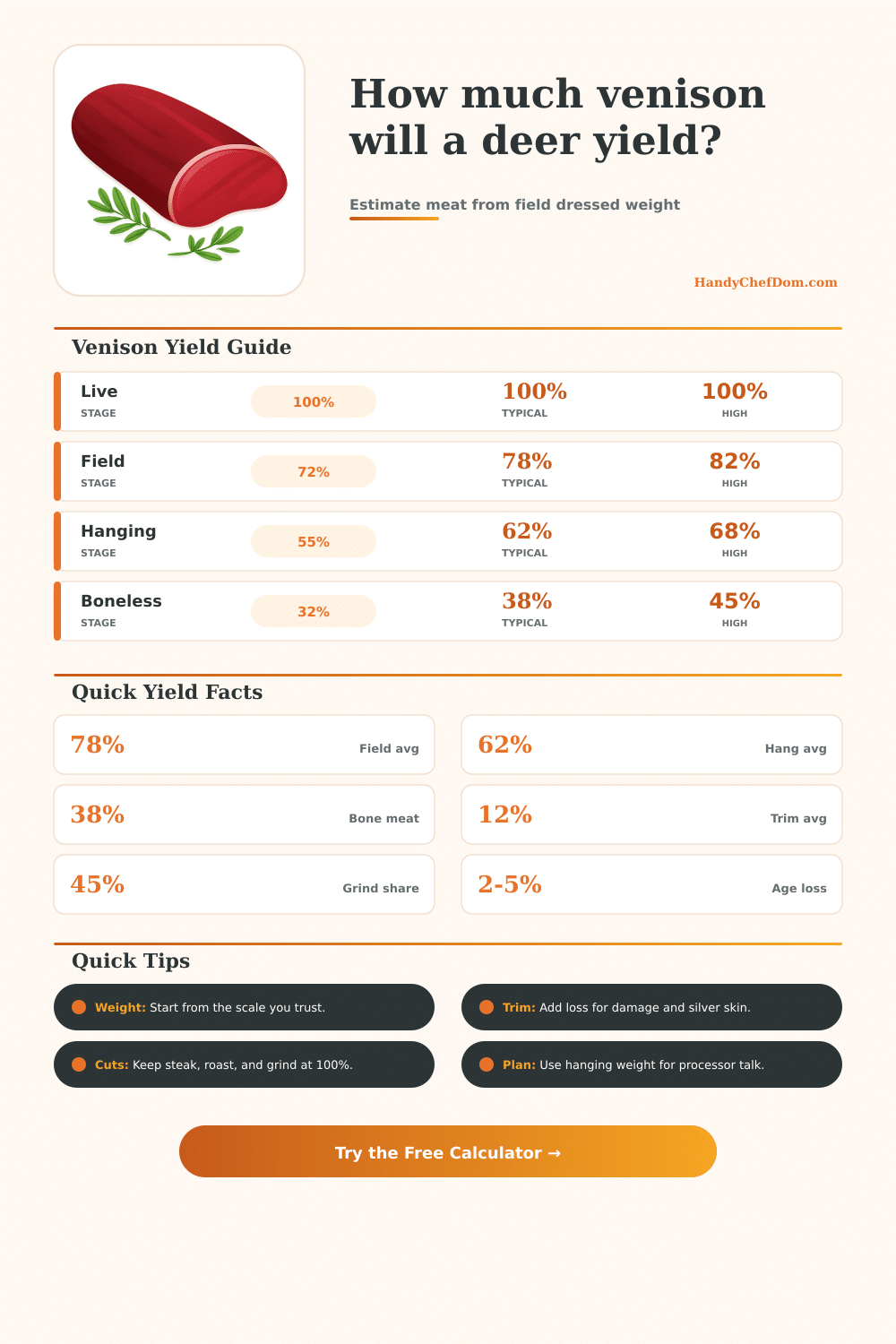
| Field dressed | Most hunter estimates | Gutted deer with hide, head, lower legs often included | 72% to 82% of live | Core starting point for yield math |
| Hanging carcass | Processor discussion | Skinned or cleaned carcass before deboning | 55% to 68% of live | Predicts boneless meat after trim |
| Boneless meat | Freezer planning | Final edible venison before packaging choices | 32% to 45% of live | Back-calculates earlier weights |
| Cut allocation | Grind | Steak | Roast | Best for |
|---|---|---|---|---|
| Balanced freezer | 45% | 30% | 25% | Most families and mixed meals |
| Steak forward | 35% | 45% | 20% | Backstrap, tenderloin, and clean hind cuts |
| Roast focused | 35% | 25% | 40% | Slow cooking, stew, and large family meals |
| Heavy grind | 65% | 20% | 15% | Burger, chili, sausage, and snack sticks |
| Processor style | 50% | 25% | 25% | Simple cut sheets and predictable packs |
| Clean boneless | 55% | 30% | 15% | Extra trimmed meat and fast weeknight use |
| Trim factor | Low loss | Typical loss | High loss | When to use |
|---|---|---|---|---|
| Aging or cooler | 1% | 3% | 6% | Dried surface, drip, and cooler time |
| Shot damage | 2% | 6% | 15% | Bloodshot shoulder or rib cleanup |
| Silver skin | 3% | 5% | 10% | Clean boneless cutting and fat removal |
| Field quartered | 4% | 8% | 14% | More exposed surfaces and bag cleanup |
| Bone-in retained | 0% | 8% | 25% | Adds packaged weight when bones remain |
Results are planning estimates for edible venison yield. Actual packaged weight changes with deer build, shot placement, hanging time, trim standards, and whether any bone-in cuts are kept.
A deer harvests begins in the field, but there are many different stages of processing that will determine the amount of deer meat that ends up in your freezer. Many deer hunters will take a moment to estimate the size of the deer that they harvested. However, the estimate of the size of that deer is often different than the amount of meat that that deer will provides to the table.
The process of turning a deer into deer meat involve several steps. The steps include field dressing the deer, skinnig the deer, aging the deer‘s hide and meat, and butchering the deer to produce primal and second cut of deer meat. Because there is some weight loss in each of these steps, it is important for deer hunters to understand the different weights of a deer at each step in the butchering process in order to ensure that they have enough cooler space to store all of the deer meat that will be produced.
How Much Meat Comes from a Deer
The weight of the deer after it has been field dressed is one of the most common measurement of the deer. Field dressed weight is the weight of the deer after the internal organs has been removed, but before the deer is skinned. Field dressed weight may include the hide and the lower leg of the deer.
However, the weight of the deer will decrease during the skinning process, the aging process, and during the butchering of the deer. For instance, during butchering, the hunter must remove the bones, the silver skin (which is the skin that adheres to the deer bones), and any damaged tissue from the deer. Thus, one way to determine the total amount of deer meat that will be produced is through the use of the calculator included on this page, which asks for the weight of the deer at various stages.
Another factor that may influence the amount of deer meat that is produced is the type of deer that is being killed. For instance, the body composition of a deer may not be the same for each deer that is harvested. For instance, a lean doe may contain less fat than a cornfed buck.
Thus, the amount of meat that can be produced from a lean doe may be less than the amount of meat that can be produced from a cornfed buck of the same weight. Additionally, a mature northern buck may contain more neck and shoulder meat than a young buck or doe, but the neck and shoulder meat may not be suitable for steaks, but for trim. The presets that are included in the calculator take these differences into account.
Another factor that will influence the amount of deer meat that is produced is the condition of the deer after it is shot. For instance, if the hunter gives the deer a lung shot, the deer will lose less trim (meat that is lost as a result of butchering) than if it were hit in the shoulder, or if it took the hunter a long time to track the deer to where it was shot. Additionally, if the deer was exposed to the outside air for long period of time, the deer meat may become bloodshot.
Bloodshot deer meat must be removed before the deer is butchered. Furthermore, aging the deer will result in some weight loss of the deer’s meat due to drying of the meat and drip loss of the deer while it is being hung. Thus, if the cooler in which the deer will be stored is warm, weight loss during the aging step will increase.
Additionally, the longer that the deer is aged, the more weight that will be lost due to the aging process. The butchering style will also influence the amount of each type of deer meat that is produced. For instance, a deer hunter may prefer that the hunter butchers the deer in a way that produces large amounts of steaks and tenderloins.
Alternatively, the hunter may prefer that the deer is butchered in a way that produces large amounts of roasts or stew meat. Additionally, if the hunter desires to produce sausage or snack stick out of the deer, more of the deer’s meat will be allocated to the grind portion. Thus, the hunter and his family can adjust percentages for each portion of deer meat in the calculator so as to reflect the types of meals that will be cooked.
The calculator uses these percentages to ensure that the total weight of the deer meat is realistic, even if some percentages is adjusted. Another factor that will influence the amount of deer meat that is produced is the size of the package in which the deer meat will be packaged, and whether fat will be added to the grind portion of the deer meat. For instance, one-and-a-half pound packages of meat are common package sizes for deer hunters to use as a means of avoiding having any deer meat left over after each meal.
Additionally, if fat is added to the ground meat portion of the deer, the texture of that meat will change. Furthermore, adding fat to the grind portion will also change the amount of meat that can be produced by the deer. Each of these factors may have an impact on the deer hunter after the deer is harvested and months after the harvest.
The reference tables on the page can provide information about the percentage of each type of deer meat that will be produced as a result of the butchering of the deer. These tables include information about the amount of deer meat that will be lost as a result of each of the different processing stages, from live deer to boneless deer meat. These tables make it possible for each deer hunter to view his or her results to ensure that they are within the normal expectations for deer meat yields.
Additionally, the comparison grid on the page can be used as a means of comparing the weight of deer meat yields to the other factors that may influence those weights, such as cooler size. Many deer hunters will make mistakes with the various stages of weight loss of the deer that has just been harvested. For instance, they may assume that the hanging weight of the deer is the same as the field dressed weight of the deer.
Additionally, they may assume that the amount of boneless deer meat will be similar to the hanging weight of the deer. Each of these assumptions may result in the deer hunter making an error of as much as twenty or thirty pounds in the estimation of the weight of deer meat that will be produced. Thus, it is best for the deer hunter to start with the weight of the deer that they actualy have, and use the calculator to determine how much of each type of deer meat will be produced during the butchering process.
Additionally, it is important to account for trim (the weight of the deer that will be lost during butchering), since ignoring the removal of silver skin and damaged meat will result in the estimated weight of boneless deer meat being heavier than the actual weight of meat that can be harvested from the deer. Several variables can impact the final weight of deer meat that is produced, which the calculator does not take into account. For instance, the warmer the cooler in which the deer is stored, the more the weight of the deer meat will decrease due to aging.
Additionally, if the knives that are used to remove silver skin and other damaged meat from the deer are not particularly sharp, more weight will be lost due to that trimming step. Both of these variables will impact the final weight of deer meat that is produced in a minor way. Thus, any deer hunter that uses the calculator will incorporate their knowledge of these factors into their planning of the deer butchering process.
The goal of any deer hunter is to ensure that the deer that is in the truck will become the various types of deer meat that will be prepared and cooked in the kitchen once it reaches the freezer. By understanding how field dressed weight and hanging weight differ, by accounting for trim, and by understanding how butchering style may impact the amount of deer meat that is produced by the harvested deer, the calculator could of been of assistance to each deer hunter.