🍞 Ingredients per Sourdough Bread Calculator
Scale sourdough bread ingredients by loaf count, flour weight, hydration, starter strength, salt, whole grain flour, add-ins, baked loaf target, and levain build.
Use flour mode when you already know the flour weight. Use baked loaf mode when you want the calculator to estimate flour from the finished loaf size.
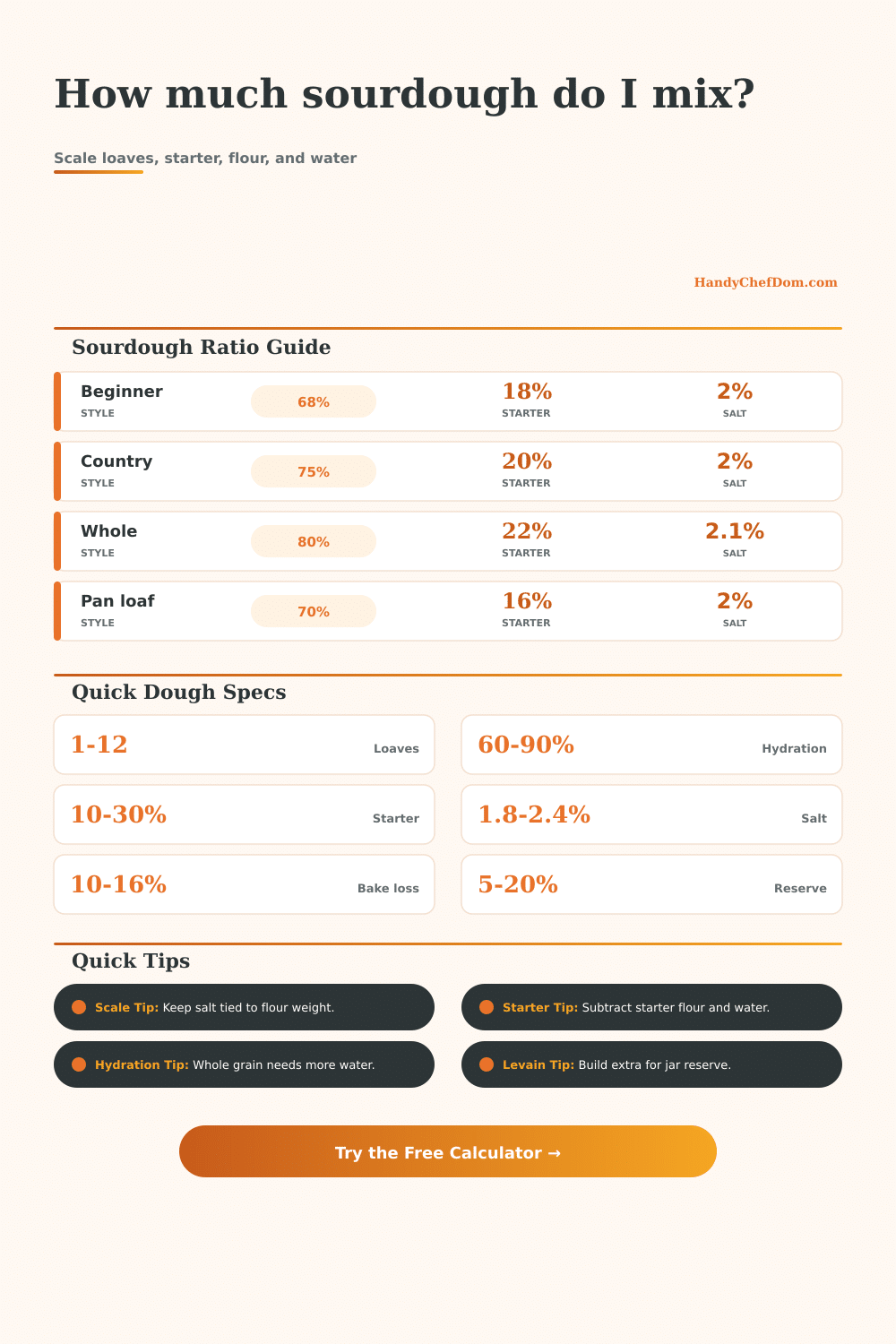
| Loaf Style | Hydration | Starter | Salt |
|---|---|---|---|
| Beginner boule | 65-70% | 15-20% | 2.0% |
| Country loaf | 72-78% | 18-22% | 2.0% |
| Open crumb batard | 78-85% | 18-25% | 2.0% |
| Whole grain loaf | 78-88% | 20-28% | 2.0-2.2% |
| Sandwich pan | 65-72% | 12-18% | 1.8-2.1% |
| Sourdough focaccia | 82-95% | 15-25% | 2.0-2.4% |
| Starter Level | Use When | Typical Rise | Dough Feel |
|---|---|---|---|
| 10-12% | Long cool proof | Slow | Mild acid |
| 15-18% | Overnight dough | Moderate | Balanced |
| 20-22% | Same day mix | Steady | Classic |
| 25-30% | Cool kitchen | Fast | Livelier |
| 35%+ | Quick schedule | Very fast | Watch sourness |
| Under 10% | Retarded dough | Very slow | Gentle |
| Flour Blend | Whole Grain | Water Cue | Best Fit |
|---|---|---|---|
| White bread | 0-10% | Lower | Open crumb |
| Country | 10-25% | Medium | Everyday loaf |
| Wheat forward | 30-50% | Higher | Hearty loaf |
| Whole wheat | 60-100% | High | Dense slices |
| Rye blend | 15-40% | Sticky | Deli style |
| Spelt blend | 20-50% | Soft | Tender crumb |
| Add-in Type | Percent | Prep Note | Dough Impact |
|---|---|---|---|
| No add-ins | 0% | Plain dough | Clean formula |
| Seeds | 8-18% | Soak if dry | Absorbs water |
| Olives | 15-25% | Drain first | Adds moisture |
| Nuts and fruit | 12-30% | Fold gently | Heavier dough |
| Cheese and herbs | 10-25% | Dice small | Rich texture |
| Cooked grain | 15-35% | Cool before mix | Very moist |
There’s no room for doubt: it’s time to make dough, and you’re not sure if there’s enough water, or even whether the starter is powerful enough. Now you stare into the bag of flour and then at the bubbling jar of yeast, and you think about how the kitchen suddeny feels like a science lab with no textbook.
In such a moment, a system beat talent. Simply input your hydration goal and number of loaves and let the calculator do the rest. You don’t need to guess about conversions and coefficients. Rather than a vague idea of a recipe, you now have something real, a list of weights you can rely off.
Why You Should Use a Baking Calculator
“Baker’s percentages are used for sourdough. These represent all ingredients as a percentage of the flour weight. That’s where folks gets tripped up. Professionals think in terms of percentages; most home bakers thinks in terms of cups or some arbitrary set of ratios. With an open crumb, for example, when you bump up your hydration, it isn’t just about adding water, you’re altering each ingredient’s ratio. It’s designed so you can switch between going by a fixed amount of flour at the outset, or building back from size of the baked loaf you want to create. I’ve found both methods useful. Building backwards from end result tends to be more intuitive, helping you plan how much you’ll lose in the oven.
Believe me, it is real and measurable. Flour is the anchor. Everything else hangs from the anchor of flour. The other ingredients cuts gluten strands and can absorbs water differently, depending on the whole grain content. That’s why the chart on the page demonstrate what happens when you change the percentages of white flour and whole grains. It’s not simply about adding bran.
Start by building confidence with lower hydration. Stick to white flour if you want; that is a wise decision. Higher hydration loaves is demanding and slippery. They ask for strong gluten development and a calm demeanor. If dough seems like wet concrete, add a little more time (for the flour to hydrate) or reduce amount of water used.
Where most people stumble with starters is managing them. It is not that they do not have a starter, but that they do not have enough live culture in their starter for their timeline. With this tool, you enter in what percent of a ripe starter you want in your final mixture (the higher the faster; the lower, the slower). On chilly days, I like my starters fast because they ferment quickly. But if I’m going for a longer, slow, cold proof with lots of time to develop more complexity, then I want a lower number.
There’s also the levain build to consider. That is when your starter gets a boost and rises before you mix it with rest of your dough. So how much seed starter should of you have to make that levain? Don’t overdo it. The tool does the math for you.
But salt: never leave home without it. It regulates fermentation speed and reinforces the gluten network. This is why using too little or skipping it makes the finished product bland and flat. Two percent are standard and a decent starting point. Tweak it a bit based off grain type; otherwise, keep it consistent.
Again, anything added as an add-in, say olives, seeds, changes things. These change the hydration ratio. They also add weight and moisture, which throws off your hydration balance. That’s where the calculator comes into play. It helps you remember that soaked seeds soak up some of the free water, which results in a dry loaf.
I print out the formula. I think that’s such a little thing but it makes all the difference. It takes thinking out of it for me. Weigh once, write it down, do it again. Repetition is half the art of baking. Inspiration is the other half.
But when you strip away the variables, you begin to observe. Your fermentations goes quicker in the afternoon because your kitchen is warmer then. Oh, my new bag of flour soaks up water differently than the previous bag. That’s what data does; it doesn’t only make us wiser intuitively, it also does that. And you adjust, the tool provides baseline.
In other words, at some point you just want to give up worrying about the numbers and let the dough tell you what to do. The calculator isn’t a crutch; it’s a training wheel. It helps you understand how different ingredients relates to each other. It helps you plan out your batches.
And then eventually, after enough time, you’ll be able to look at a bag of flour and a jar of starter and know exactly what to do. The math becomes muscle memory. When that happens, that’s when the real baking starts.