🥖 Dough in Freezer Chilling Time Calculator
Estimate freezer chilling time for pizza dough, cookie dough, pie pastry, enriched dough, and shaped batches using dough weight, thickness, starting temperature, freezer setting, wrap style, target firmness, and batch count.
Use this for short freezer chilling before shaping, slicing, rolling, or portioning. The estimate is based on how quickly the thickest part of the dough firms, so thickness matters more than total weight.
| Dough Type | Typical Form | Baseline Chill | Firmness Note |
|---|---|---|---|
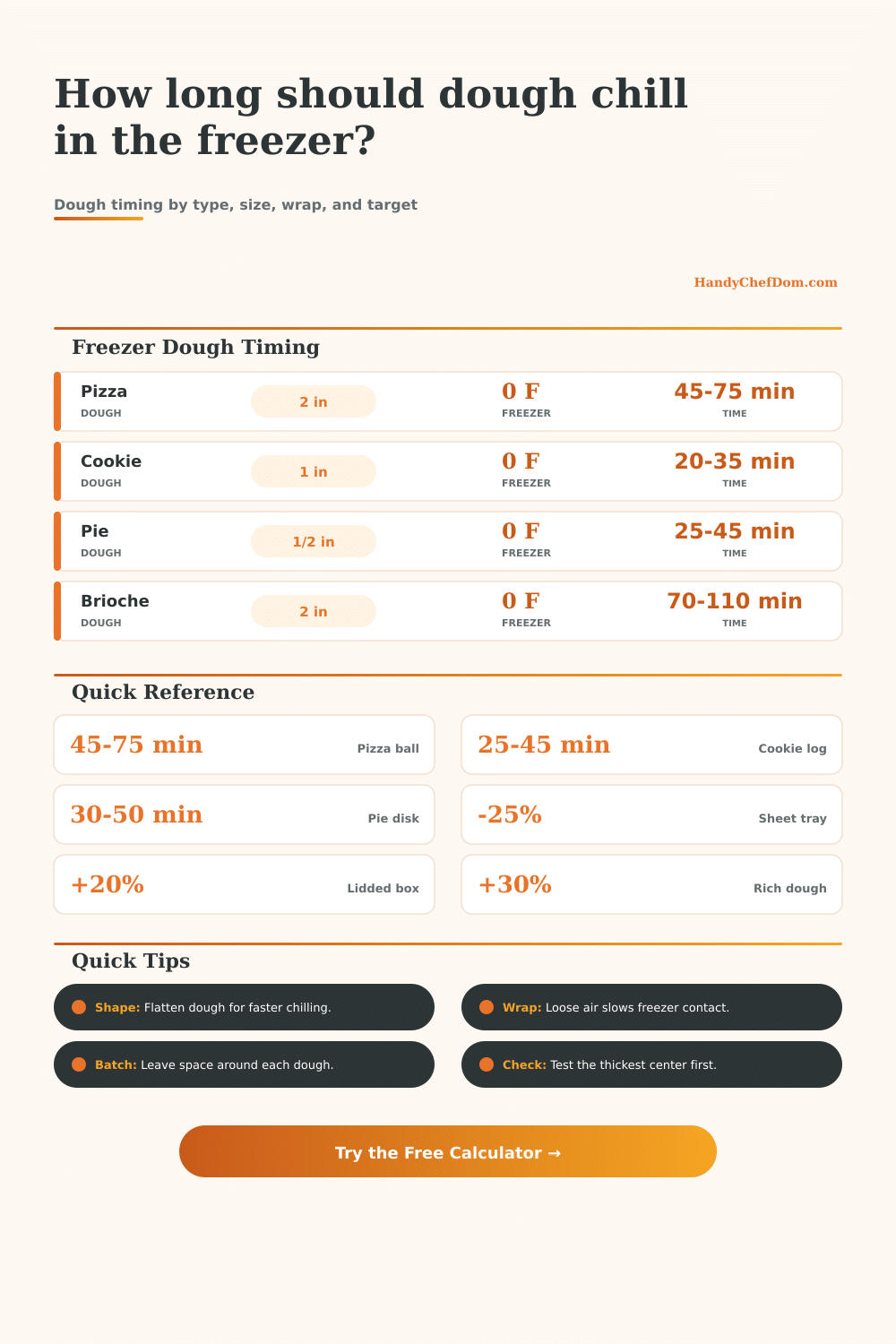
| Lean pizza or bread dough | 1 to 1.5 lb ball | 45 to 75 minutes | Often ready when the outside is tack-free and the center still bends. |
| High-hydration sourdough | Soft ball or tub portion | 55 to 90 minutes | Extra water keeps the dough flexible longer than standard bread dough. |
| Cookie dough | Log or portioned mound | 20 to 45 minutes | Fat firms fast at the edge, while sugar keeps the middle scoopable. |
| Pie crust or tart dough | Flat disk | 25 to 50 minutes | Thin disks firm quickly and are easier to roll evenly. |
| Brioche or challah | Enriched ball or rope | 65 to 115 minutes | Butter, eggs, and sugar add time before the center is shape-ready. |
| Laminated dough or butter block | Flat slab | 20 to 40 minutes | Thin slabs firm quickly, but too much time makes rolling brittle. |
| Wrap or Container | Timing Effect | Best For | Freezer Contact |
|---|---|---|---|
| Parchment on metal tray | About 8% faster | Disks, portions, slabs | Strong bottom contact with easy release. |
| Snug plastic wrap | Baseline | Balls, logs, disks | Good contact when air pockets are pressed out. |
| Freezer bag | About 5% faster | Small balls and flat dough | Works well when sealed flat with little trapped air. |
| Covered bowl | About 35% slower | Sticky dough that needs height | The air gap insulates the center. |
| Lidded plastic box | About 20% slower | Multiple dough balls | Useful for organization but slower than a tray. |
| Double wrapped | About 18% slower | Rich or aromatic dough | Extra layers reduce freezer contact. |
| Setting | Timing Bias | What It Feels Like | Common Use |
|---|---|---|---|
| Cool and less sticky | Shortest | Cool surface, still soft through the center | Quick handling before dividing or folding. |
| Firm enough to shape | Balanced | Holds a round edge without sagging quickly | Pizza balls, bread dough, enriched ropes. |
| Sliceable or scoopable | Longer | Clean knife or scoop path with soft center | Cookie logs, biscuits, portioning. |
| Stiff enough to roll cleanly | Longer | Flat dough moves without smearing fat | Pie crust, tart dough, laminated slabs. |
| Very firm, not frozen solid | Longest | Resists finger pressure but is not icy hard | Precise slicing or brief make-ahead staging. |
| Very rich dough | Add 25% to 40% | Edges firm before the center catches up | Brioche, sweet rolls, butter-heavy dough. |
| Thickest Point | Open Tray | Snug Wrap | Lidded Box | Best Check Point |
|---|---|---|---|---|
| 1/2 inch or 12 mm | 12 to 22 min | 15 to 28 min | 20 to 35 min | Check when edges feel firm. |
| 1 inch or 25 mm | 20 to 35 min | 25 to 45 min | 35 to 60 min | Check for a cool but flexible center. |
| 2 inches or 5 cm | 40 to 70 min | 45 to 80 min | 60 to 105 min | Press the center and rotate once. |
| 3 inches or 7.5 cm | 70 to 115 min | 80 to 130 min | 105 to 170 min | Plan a wider first-check window. |
| 4 inches or 10 cm | 105 to 165 min | 120 to 190 min | 155 to 240 min | Split into smaller pieces when possible. |
Then there’s the panic when you pull out a bowl of dough from fridge, only to find that it won’t hold its shape, it’s too sticky! You stretch it to make pizza; or maybe roll it into a pie shape, but snap, it recoil because it’s still too warm. To get it firm enough to manage, many bakers places their dough in the freezer instead. It may be a matter of minutes between a ruined batch of dough and workable dough.
That estimate makes all the difference, and that’s where the calculator above step in and does the math for you. You just need to know thickness of your dough (and the weight), and then it calculate how quickly your particular set-up will firm up.
Why Your Dough Needs Time in the Freezer
Home bakers assume the only thing that’s changing is time, when realy it’s thickness that dominate the way heat transfers. A big thick lump of brioche stay warm inside itself longer than a thin sheet of pasta dough, which chills down pretty much immediately. For this reason, the tool ask you how thick your dough is (not just how much there is) so it can handle that difference. So if you have a big ol’ sheet pan of thin stuff, it’ll get colder sooner then if you’re working with a little dense ball.
And that’s what most people miss; they see how many ounces they’ve got on the scale, but to the freezer it’s all about inches. This is where enrichment becomes tricky. Sugar and fat are insulators. A pizza dough made from flour, salt, and water is basically lean and thus allows cold to penetrate fairly rapidly. Butter and egg-laden brioche are another story; its rich ingredients form an insulation layer that slow cooling considerably. Notice how the calculator bump up the time accordingly for richer doughs?
It’s not simply a matter of food safety; it’s also one of mechanics. For example, trying to work with a too-warm, butter-rich pie crust will cause the fat to smear into the flour instead of staying in distinct flakes, which will ruin the structure. Bring that core temperature down and you prevent this kind of structural failure.
Dough needs a microclimate. Depending on what kind of container you use, this will either add or subtract a lot of time. A metal tray will conduct the cold right into the bottom of whatever’s in it; plastic wrap hold a layer of air, insulating that dough. If you leave your dough exposed to the air for the first few minutes (on a sheet pan, for example), it will form a skin that will help it hold its shape, but if left exposed longer, it will dry out. This chart from the page spells it all out, demonstrating just how much time a simple switch from a flat tray to a covered bowl can save you: a third or more off your wait time. A small thing, perhaps, but when you’re struggling to get dinner on the table at some reasonable hour, it does matter.
The other common error is packing your freezer too full. That will mess up these calculations because it limits airflow. It doesn’t matter how much cold air hit the dough. If everything is packed too tightly, the center will cool as slowly as the warmest thing next to it. The calculator accounts for this by adding extra time for batches that is stacked or next to each other. If you’re cooling down several different doughs, space them apart and you’ll find they all reach target firmness at roughly the same time. The best gauge is always the middle of the largest chunk. Once that’s ready, the others won’t be far behind.
In other words, chilling dough is not just about following the minutes in a recipe, but about understanding what is happening and when. You want that dough to get to the right state where the fat has firmed up and the gluten relax, without getting it so cold that it’s got a brittleness to it. You should of recognize that feeling in your hands and predict that moment based off everything else that’s affecting its temperature loss.
No matter if you’re shaping stout sourdough boules or feather-light laminated pastries, knowing your own dough’s chill tendencies gives you the confidence to work with it. When it feels too warm to shape, rather than dumping it in the icebox and hoping for the best, you’ll know precisely when to expect it to be ready (and most crucially), why.