🍕 Pizza Dough per Person Calculator
Estimate pizza dough for guests by pie size, crust style, dough ball weight, appetite, toppings load, slices per person, leftovers, and hydration.
Choose auto dough ball weight to follow the pizza size and crust style, or custom dough ball weight when you already know the gram or ounce target for each pizza.
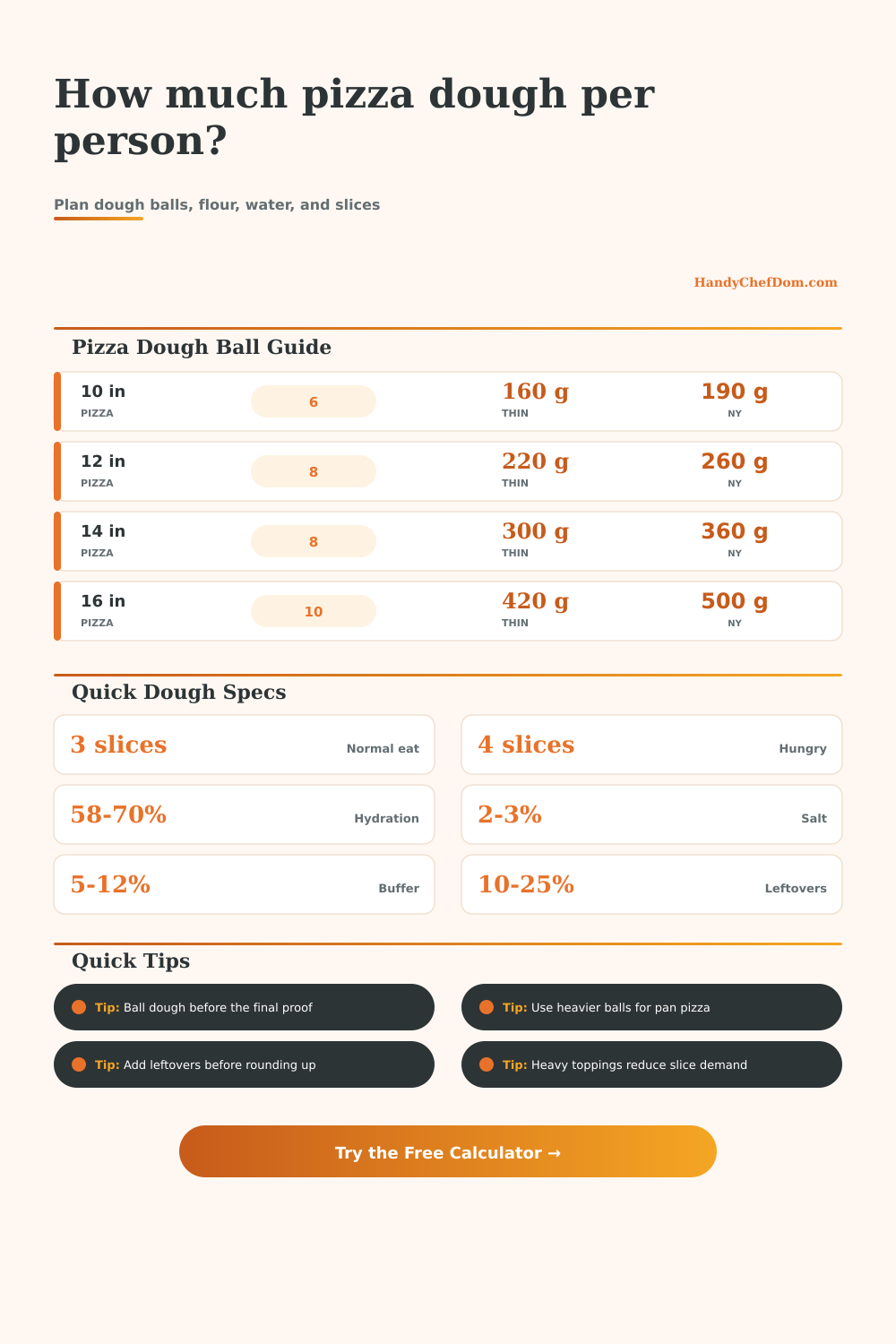
| Pizza Size | Slices | Thin Crust | NY Style | Pan Style |
|---|---|---|---|---|
| 10 inch personal | 6 | 150-170 g | 180-210 g | 230-270 g |
| 12 inch medium | 8 | 210-230 g | 250-285 g | 320-380 g |
| 14 inch large | 8 | 290-320 g | 340-390 g | 450-530 g |
| 16 inch extra large | 10 | 400-440 g | 480-540 g | 620-720 g |
| 18 inch party pie | 12 | 520-590 g | 630-720 g | 820-960 g |
| 13 x 18 sheet | 12 | 520-650 g | 680-760 g | 850-1100 g |
| Event or Style | Typical Slices | Dough Cue | Leftover Target |
|---|---|---|---|
| Light lunch | 2-2.5 per person | Thin crust works well | 0-10% |
| Family dinner | 2.5-3.5 per person | Medium crust is balanced | 10-15% |
| Game night | 3.5-4.5 per person | Use larger pies | 15-25% |
| Kids party | 1.5-2.5 per child | Smaller slices help | 10-20% |
| Buffet table | 3-4 per person | Mix thin and pan | 20-30% |
| Deep dish meal | 1.5-2.5 per person | Heavy dough per pie | 5-15% |
| Dough Style | Hydration | Salt | Oil | Dough Feel |
|---|---|---|---|---|
| Cracker thin | 52-58% | 2-2.5% | 1-3% | Firm and easy to roll |
| New York style | 58-64% | 2.3-2.8% | 1-3% | Elastic and foldable |
| Neapolitan | 60-68% | 2.5-3% | 0% | Soft with puffy rim |
| Artisan high heat | 65-72% | 2.2-2.8% | 0-2% | Tacky and extensible |
| Pan pizza | 65-78% | 2-2.6% | 3-8% | Soft and spreadable |
| Deep dish | 55-62% | 1.8-2.3% | 6-10% | Rich and sturdy |
| Guests | 12 Inch Pizzas | 14 Inch Pizzas | 16 Inch Pizzas | Total Dough Range |
|---|---|---|---|---|
| 2 people | 1 | 1 | 1 | 260-520 g |
| 4 people | 2 | 2 | 2 | 520-1040 g |
| 8 people | 4 | 3 | 3 | 1040-1620 g |
| 12 people | 5 | 5 | 4 | 1300-2160 g |
| 20 people | 9 | 8 | 6 | 2340-3240 g |
| 40 people | 18 | 15 | 12 | 4680-6480 g |
The calculator above takes your hunger and turns it into actual amounts of water and flour, i.e., tells you exactly how much dough to make. You’ve got a rough sense of how hungry your guests is going to be, and you’ve got all the right stuff in front of you (the ingredients). But without a way to accurately measure out the dough, you’re kind of up a creek. And that’s where the math come in. It gives you precision when what you really want is some sort of naturaly feel.
Don’t stare at the interface beyond the calculator because it will tell you. Just pay attention to the number and know what it means. Consider how many slices per person rather then whole pies. It’s a common error to base estimates on whole pizzas. But if cut well, a medium pie will feed as many people as a large. And the unit of consumption is actualy not the whole pie, it’s the slice.
How to Use the Pizza Calculator
Normally, three slices constitute a healthy appetite. However, if you load your pies up with meat and cheese, then people will only consume fewer slice. That’s why the calculator requests slices per person: it ensures an accurate count of the total amount of dough required. Otherwise, you may find yourself with far more crust than necessary, not to mention those unwanted leftovers.
Which type of crust? Because crust will affect the final weight of your dough balls. For example, a 12 inch pan pizza weigh significantly more than one made on thin crust, even if they are the same size, which is why this feature include a reference table. Depending on which type of crust (New York style, for instance) you want, you’ll see an exact weight per ball based off balancing structure and how well it folds.
Change the crust type to say, pan or Sicilian, and the weight go up to help hold its heavier, oiler crumb. Even when switching from a 16-inch thin crust pie to a 16-inch pan pizza, amount of dough can nearly double. It isn’t about changing the texture alone but rather about the volume of ingredients.
Hydration is actualy a measurement of the feel of your dough. How sticky and wet or stiff and easy-to-handle is it? That’s controlled by the hydration percentage in the calculator, which tell you exactly how much water to mix into the flour. For instance, a low-hydration dough is good for thin crusts, because they’re easier to form and shape. An artisan style has a high hydration dough, making for an airy, open crumb.
The calculator scales up the yeast, oil and salt depending on the level, keeping all those ratios correct. No need to memorize bakers’ percentages here, just know that a wetter dough = higher hydration. Knowing that will help you decide if you want to try a tricky dough at home when you are making something simple.
Include a buffer for leftovers and handling. This accounts for misshapen balls, tearing, dough scraps, etc. It’s a buffer for handling leftover dough after the cook. For a party, you may want leftovers so put that into the inputs as well. For a more calm evening meal, there is no need. Putting this at zero will save dough. Putting it at twenty percent guarantees everybody gets their fill.
This isn’t changing the recipe; this is changing how much of it to make. That is determined by the people; the recipe are dictated by the style. So start with weighing your flours. From then on, it’s all about the percentages; just make sure that the percentage of each ingredient matches your flour weight.
So why do you need a digital scale? Because if you “eyeball” your flour, the formula won’t work. And remember: The digital scale provides accurate targets in grams, but you have to bring the tension yourself. Carefully portion out your dough balls (any uneven weights mean different bake times). Burn = light ball; sogginess = heavy ball.
When making pizzas, though, precision is balanced by permission: Your oven will tell you when they’re finished; the math will tell you how many to make. Trust your eyes on the former, your numbers on the latter. After that, divide the dough correctly and the rest of the night goes smooth as butter. Plates empty fast, and all you need to keep measuring up are those empty plate.