🥧 Pumpkin Spice per Pie Calculator
Scale pumpkin pie spice for one pie or a full baking batch by pie size, filling cups, spice intensity, homemade blend ratio, teaspoons, tablespoons, grams, and leftover coverage.
A standard 9-inch pumpkin pie often holds about 4 cups of filling. This calculator starts with a per-cup spice target, then adjusts for pie size, filling volume, intensity, and the homemade blend ratio you prefer.
Pumpkin spice results will appear here.
Filling volume across the batch.
Selected dose divided by filling cups.
48 teaspoons make 1 cup.
Coverage from a 24 tsp spice jar.
Sweet base and main aroma.
Warm snap and brightness.
Custard-like bakery aroma.
Stronger accents kept smaller.
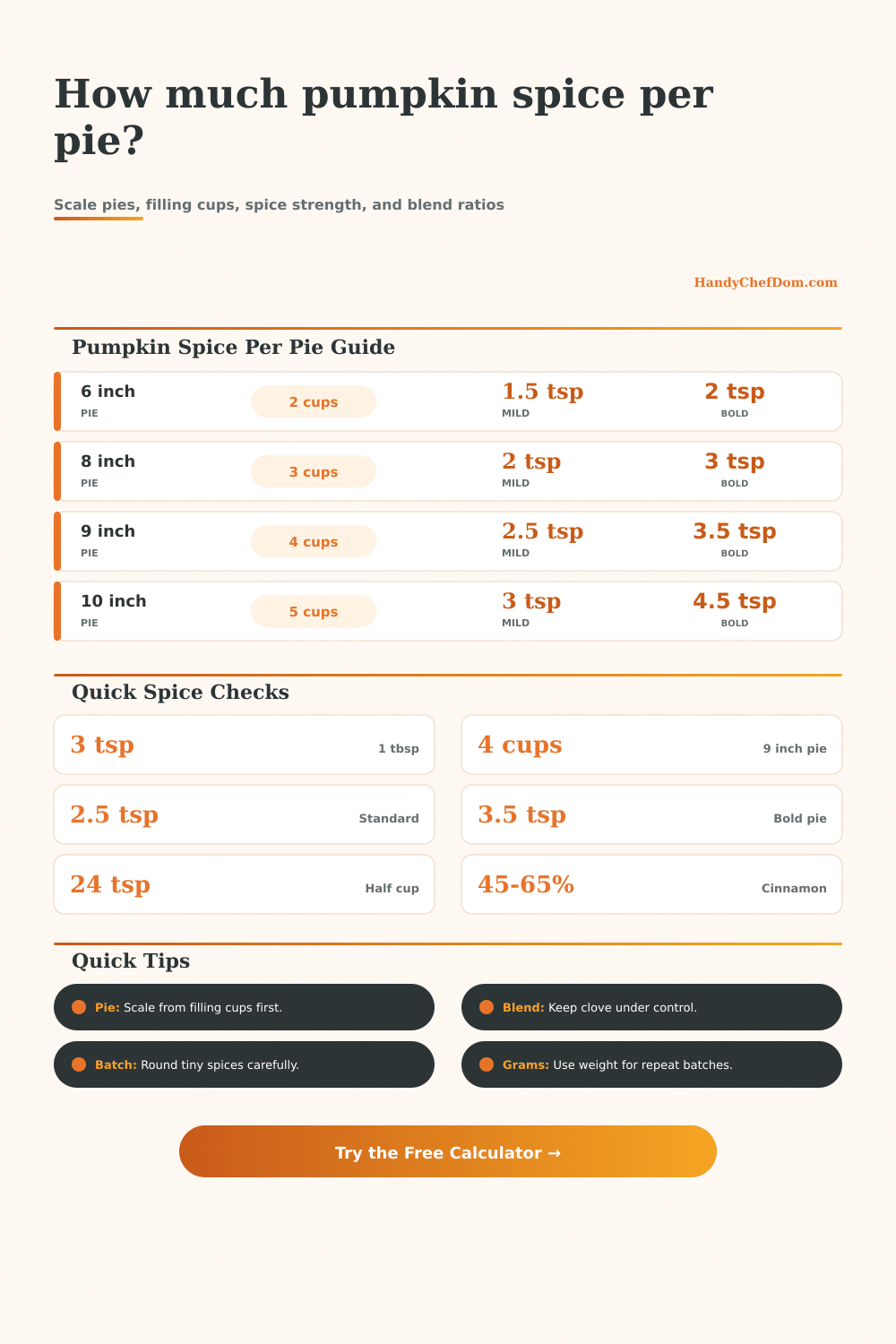
| Pie or pan size | Typical filling | Mild spice | Standard spice | Bold spice |
|---|---|---|---|---|
| Mini 4-inch pie | About 3/4 cup | 1/2 tsp | 0.6 tsp | 3/4 tsp |
| 6-inch pie | About 2 cups | 1.25 tsp | 1.5 tsp | 2 tsp |
| 8-inch pie | About 3 cups | 1.75 tsp | 2 tsp | 3 tsp |
| 9-inch standard pie | About 4 cups | 2 tsp | 2.5 tsp | 3.5 tsp |
| 10-inch pie | About 5 cups | 2.5 tsp | 3.25 tsp | 4.5 tsp |
| Sheet slab pie | About 8 cups | 4 tsp | 5 tsp | 7 tsp |
| Blend style | Cinnamon | Ginger | Nutmeg | Clove and allspice |
|---|---|---|---|---|
| Classic balanced | 8 parts | 4 parts | 2 parts | 1 part each |
| Cinnamon-forward | 10 parts | 3 parts | 2 parts | 0.5 to 1 part |
| Ginger snap warm | 7 parts | 5 parts | 2 parts | 1 to 1.5 parts |
| Low-clove mild | 10 parts | 3 parts | 1.5 parts | 0.25 to 0.75 part |
| Deep holiday | 7 parts | 3 parts | 1.5 parts | 1 to 2.5 parts |
| Measure | Teaspoons | Tablespoons | Approx blend grams | Kitchen use |
|---|---|---|---|---|
| 1 teaspoon | 1 tsp | 1/3 tbsp | About 2.3 g | Small pie or spice correction. |
| 1 tablespoon | 3 tsp | 1 tbsp | About 7 g | One bold 9-inch pie or mild 10-inch pie. |
| 1/4 cup | 12 tsp | 4 tbsp | About 28 g | Several pies or a small spice jar. |
| 1/2 cup | 24 tsp | 8 tbsp | About 56 g | Holiday baking batch. |
| 1 cup | 48 tsp | 16 tbsp | About 112 g | Large bakery jar estimate. |
| Batch plan | Filling volume | Standard spice | Tablespoons | Blend note |
|---|---|---|---|---|
| 1 standard pie | 4 cups | 2.5 tsp | 0.83 tbsp | Balanced pie warmth. |
| 2 standard pies | 8 cups | 5 tsp | 1.67 tbsp | Round to 1 tbsp plus 2 tsp. |
| 4 standard pies | 16 cups | 10 tsp | 3.33 tbsp | Use gram split for tiny accents. |
| 6 bakery pies | 24 cups | 15 tsp | 5 tbsp | Good size for a scale batch. |
| Sheet pie pan | 8 cups | 5 tsp | 1.67 tbsp | Treat like two regular pies by filling. |
A shot of spice in a pumpkin pie hits you like a hammer the first time you overspice it. More likely then not, that medicinal bite is clove, not cinnamon, nor even nutmeg. It’s strong stuff; it overwhelm the other flavors fast.
And no: most home cooks don’t screw up out of lack of care, they measure everything by eye, a pinch here, a dash there, hoping for something cozy-holiday-flavorful and not chemical-burny. Once you enter your favorite intensity level and volume of filling, the calculator do the conversion math so you can avoid guessing, and thus save yourself trip down disaster alley. It converts your fuzzy wishes to actually spoons.
How to Get the Perfect Pumpkin Spice Amount
To make pumpkin spice really scale, the trick isnt so much the size of the crust (i.e., the size of the pie tin), but the amount of that crusts contents: how much custardy goodness it contains. Even two otherwise identical-looking ten-inch pies; one being super-shallow and another deep-dish, contain far different quantities of filling. Scale based solely off the crust dimensions, and your deep dish will be watered-down pumpkin puree compared to your spice-bomb shallower pie.
Instead, tie your scaling to the number of cups of filling within each pie. Most recipes starts with four cups of filling for an average-size nine-inch pie. Adjust up or down from there. The tool recognize this variable and allows you to overwrite the default profiles, in case you want to bake mini pies or sheet pans to feed a crowd. In short, it gets you thinking about density instead of simply surface area.
There’s also intensity, something most cooks forget about until it’s too late. Different people don’t all want to be hit in the face as hard with aggressive spiciness in their desserts. They want either the mellow warmth of fall, or they want more pronounced flavor. That’s what the intensity multiplier in the calculator does: you can increase or decrease that without changing basic structure of your recipe. Use less than two teaspoons on a mild custard for example, and maybe go over 3 teaspoons for a bolder holiday one.
Why? Because this is where we separate out the spices from the taste of the actual pumpkin. You may like your pumpkin to taste really strong, but not get hit in the face by the spices. Or maybe you like really powerful spices, but the rest of the dish be very mellow in terms of pumpkin taste. The calculator guides you on how much to do that before you mix your batter.
Ratios is key when blending your own mix, too. Since premixed pumpkin pie spices are standardized and usually quite mild, they often uses extra cinnamon to make up for the lack of fresh, fragrant oils. Creating your own mix lets you dial in the flavor balance. A typical well-rounded combo will have 8 parts cinnamon and 4 parts ginger. It will also have 2 parts nutmeg and 1 part each of allspice and cloves. It’s a good formula; cinnamon adds body, not much kick, so allspice and cloves adds the high notes of holiday flavor.
Tweak the proportions. Use more ginger if you want some snap, or less clove if you prefer something more mellow. The overall amount of ground spices may stay the same but the experience of eating them is entirely different. The tool breaks down the amounts of each component, right down to the number of teaspoons needed per ingredient to achieve your desired final total.
This is where batch baking gets interesting… And dangerous. Doubling a recipe from one to two pies is easy: You double the ingredients. But if you go from one pie to six, that’s not enough. There’s more to scaling up than simple multiplication. Every time you measure anything, there’s some error built into the number. If you’re rounding off with fractions, it doesn’t make too much difference when you’re making a single pie, but those errors compound when you scale up to larger batches. But if you’re measuring out fifty grams of spice to bake six pies, all of those little errors add up.
Volume (e.g., tablespoons) isn’t precise enough; what matters is weight (e.g., grams). Grams are consistent; teaspoons arent (and neither are tablespoons), depending on how hard you tamp down the spice inside them. Because of this, the calculator lets you weigh your blends accurately using metrics, which converts for you if you prefer volume measurements. It also shows you visually how much a certain amount of spice will cover. This prevents waste and stops you from buying more jars than you actualy need for the holidays.
At the end of the day, getting pumpkin pie right requires precision and restraint. It’s all about letting the pumpkin shine through without being screamed at by spices. Using your spice mixture as a formula, instead of simply a suggestion, takes the guesswork out of baking. There are no more what-if questions, “Why didn’t my pie turn out the same this year as last?” “Was I supposed to add that extra pinch?” No. You get precise inputs and certain outcomes: a pie with the taste you wanted it to have.
Sometimes, half a well-measured teaspoon of ground clove makes all the difference between a great pie and a good pie. You should of used more if you wanted it stronger.