🍯 Honey to Sugar Substitute Converter
Convert a sugar amount into honey, liquid reduction, baking soda adjustment, sweetness balance, cup-to-gram equivalents, and oven temperature changes for cakes, cookies, breads, sauces, drinks, and no-bake recipes.
Start with the sugar in the original recipe. The calculator converts that sweetness into honey, then adjusts liquid, acidity, oven temperature, and batch multiplier for the recipe style.
| Sugar in recipe | Balanced honey | Honey weight | Liquid reduction | Baking soda |
|---|---|---|---|---|
| 1/4 cup sugar | 3 tbsp honey | 64 g | 1 tbsp less liquid | 1/16 tsp |
| 1/2 cup sugar | 6 tbsp honey | 128 g | 2 tbsp less liquid | 1/8 tsp |
| 3/4 cup sugar | 9 tbsp honey | 191 g | 3 tbsp less liquid | 3/16 tsp |
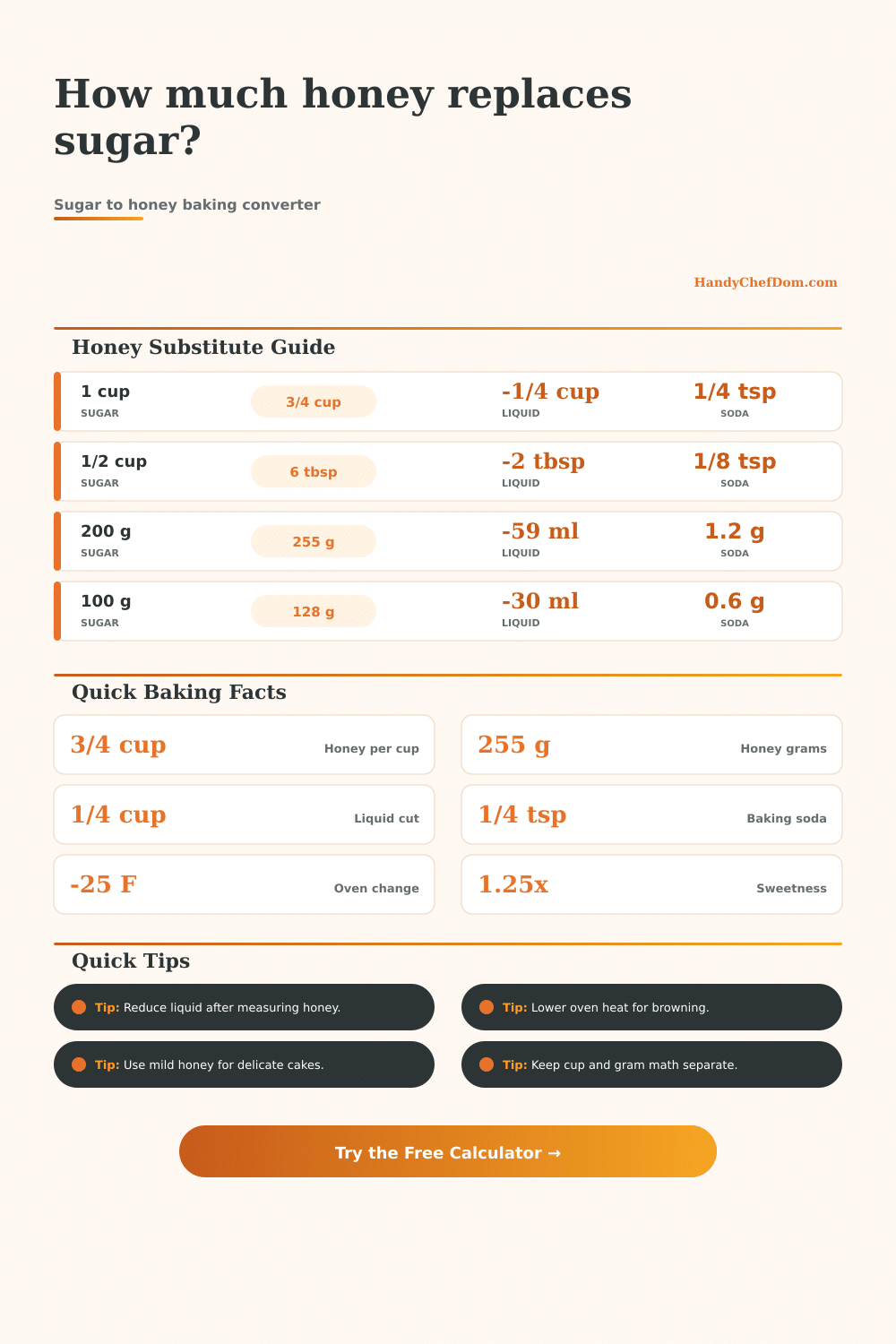
| 1 cup sugar | 3/4 cup honey | 255 g | 1/4 cup less liquid | 1/4 tsp |
| 2 cups sugar | 1 1/2 cups honey | 510 g | 1/2 cup less liquid | 1/2 tsp |
| Honey type | Flavor strength | Sweetness factor | Moisture note | Best recipe fit |
|---|---|---|---|---|
| Clover honey | Mild | 1.25x sugar | Standard liquid reduction | Cakes, muffins, tea |
| Wildflower honey | Medium floral | 1.28x sugar | Standard reduction | Quick breads and glazes |
| Orange blossom honey | Citrus floral | 1.27x sugar | Standard reduction | Citrus cakes and drinks |
| Buckwheat honey | Dark and bold | 1.32x sugar | Use slightly less | Rye, spice, barbecue sauce |
| Acacia honey | Light and clean | 1.22x sugar | Standard reduction | Delicate cakes and drinks |
| Raw or creamed honey | Variable | 1.20-1.25x | Warm gently before measuring | No-bake bars and fillings |
| Recipe type | Honey ratio | Liquid adjustment | Oven adjustment | Texture change |
|---|---|---|---|---|
| Cake or cupcake batter | 0.75 cup per cup sugar | Reduce liquid 1/4 cup | Lower 25 F | Moister crumb, faster browning |
| Cookies or bars | 0.67 to 0.72 cup | Reduce liquid lightly | Lower 15 to 25 F | Softer centers, more spread |
| Quick bread or muffins | 0.72 to 0.78 cup | Reduce liquid 1/4 cup | Lower 25 F | Tender, moist slices |
| Yeast bread dough | 0.70 to 0.75 cup | Hold back water first | Lower 15 F if dark | Soft crust, improved browning |
| Sauce, glaze, dressing | 0.75 to 1 cup | Usually no reduction | No oven change | Glossy body and floral flavor |
| Tea, lemonade, drinks | 0.65 to 0.75 cup | No reduction | No oven change | Dissolve in warm liquid first |
| Batch multiplier | 1 cup sugar becomes | Liquid reduction | Baking soda | Use case |
|---|---|---|---|---|
| 0.5x half batch | 6 tbsp honey | 2 tbsp | 1/8 tsp | Test loaf or small pan |
| 1x single batch | 3/4 cup honey | 1/4 cup | 1/4 tsp | Most home recipes |
| 1.5x larger batch | 1 1/8 cups honey | 6 tbsp | 3/8 tsp | Party pan or extra muffins |
| 2x double batch | 1 1/2 cups honey | 1/2 cup | 1/2 tsp | Two cakes or two trays |
| 3x triple batch | 2 1/4 cups honey | 3/4 cup | 3/4 tsp | Meal prep or bake sale batch |
Here’s how it goes: The recipe looks perfect on paper. You need three-quarters of a cup of milk and two cups of sugar. “I’ll use local clover honey,” you think, “for some of that golden, floral depth.” In it pours; stir it up; into the oven it goes. Out comes an overcooked, flat, dense puck that got burned on the bottom while middle cooked through.
What happened? Was it the honey? It does not happen often. Honey is not so much the problem. The issue is thinking of honey like regular old sugar. It isn’t. It is a complex ingredient with its own browning power, acidity, and water content.
How to Swap Sugar for Honey in Baking
After that, it asks what ingredients will be replaced by the honey. This is because honey are sweeter (and denser) than granulated sugar. For example, if a recipe says “one cup of sugar,” don’t use one cup of honey (use about three-quarters of a cup). That’s enough to make things nice ‘n’ sweet without making them structurally unstable or too sweet. Plug your own needs into the calculator above, and let it do the math for you, that way, no more guesswork with conversions and coefficients.
Volume is just half of it. By nature, honey are about twenty percent water by weight. Replacing dry sugar with wet honey is adding a lot of moisture to your batter. Unless you adjust something else in the recipe to compensate; meaning reducing other liquids in the recipe; you’ll end up with soggy cakes and cookies that spread out into thin, crispy discs. To do so, the tool calculates how much you should of reduced the other liquids in the recipe according to type of recipe. A lighter reduction may work if you’re making a sticky sauce, while a heavier one may be needed if you’re making a delicate sponge cake where you want the crumb to stay tender.
And then there’s the matter of acidity. Honey’s a little bit acidic.” Baking soda is alkaline. When replacing baking soda with something else (as a leavening agent), if you don’t tweak for this, the honey’s own acidity will actualy start to gobble up too much of the soda. Or, alternatively, the original soda may not have been sufficient to counterbalance the newly added acidity. Most standard substitutions calls for just a touch of extra baking soda to neutralize the pH and allow bread to rise properly. It is a subtle chemical adjustment, but it makes the difference between a light or a flat loaf.
Bakers face another surprise: heat. At a certain temperature, sugar caramelizes. Fructose and glucose (which are present in honey) brown and caramelize at lower temperatures different than sucrose (aka table sugar). That means if you use a sweetener like honey instead of sugar and then bake a cookie with the same temperature as before, the outer edge will get burnt while the interior stay raw. Decreasing the oven temp by twenty-five degrees Fahrenheit prevents outside from burning while giving center time to cook. It is an easy change, but it can save your dessert from turning into charcoal.
Another factor is the kind of honey. Mild light honeys such as clover or acacia are good for subtle applications, white breads or delicate cakes where you don’t want the honey to steal the spotlight. On the opposite end are dark, robust honeys with an earthy flavor (think forest honey or buckwheat). These types of honeys holds their own on rye bread, in barbecue sauce or spice cake. A bold honey in a vanilla cupcake will overpower the others. Think about the taste of the honey you plan to use before jumping in.
It also matters how big of a batch you’re trying to make. Doubling a recipe? Adjustments scale directly. Making one serving? Then the measurements becomes tricky. The tool really helps visualize what needs to change. Translate the abstract ratios into concrete: cups and grams. See exactly how much liquid to remove and how much soda to add.
At the end of the day, using honey instead of sugar is about translation. You are taking one ingredient, dry and crystalline, and translating its language into another’s: acidic and viscous. It is about moisture, heat, and chemistry. And once you get those variables, there’s no more guesswork. There’s no more baking blind. There’s baking with intent.
Next time you grab that jar of honey, think not only about how sweet it is, but also about its structure. Give it respect and in return your baked goods will thank you.