🦃 Salt per Turkey Brine Calculator
Estimate turkey brine salt from turkey weight, brine volume, salt type, wet or dry brine style, target salinity, brine time, and injected-bird adjustments.
For wet brine, salinity is based on liquid weight. For dry brine, salinity is based on turkey weight. Injected or pre-basted birds already contain salt, so the calculator reduces the added salt.
| Brine style | Typical salt target | Best turkey use | Calculator basis |
|---|---|---|---|
| Wet brine, mild | 3.5% to 4% | Small birds, longer rests | Salt per brine liquid weight |
| Wet brine, standard | 4.5% to 5.5% | Holiday whole turkey | Salt per brine liquid weight |
| Wet brine, bold | 6% to 7% | Short brine or smoked bird | Salt per brine liquid weight |
| Dry brine, light | 0.55% to 0.7% | Turkey breast or parts | Salt per turkey weight |
| Dry brine, standard | 0.75% to 0.9% | Whole turkey or spatchcock | Salt per turkey weight |
| Dry brine, firm | 0.95% to 1.1% | Large birds with short time | Salt per turkey weight |
| Salt type | Approx g per cup | Approx g per tbsp | Why it matters |
|---|---|---|---|
| Diamond Crystal kosher | 135 g | 8.4 g | Large flakes measure light by volume |
| Morton kosher | 240 g | 15 g | Denser crystals need fewer spoonfuls |
| Table salt | 288 g | 18 g | Fine grains pack tightly in cups |
| Fine sea salt | 280 g | 17.5 g | Close to table salt by volume |
| Coarse sea salt | 225 g | 14.1 g | Irregular crystals leave more air gaps |
| Pickling salt | 292 g | 18.3 g | Fine and additive-free, but compact |
| Turkey shape | Wet brine time | Dry brine time | Salt adjustment cue |
|---|---|---|---|
| Whole turkey, 10 to 14 lb | 12 to 18 hours | 24 to 36 hours | Standard calculation usually fits |
| Whole turkey, 15 to 22 lb | 18 to 24 hours | 36 to 48 hours | Use a mild target for long timing |
| Turkey breast | 6 to 12 hours | 12 to 24 hours | Use less salt for lean white meat |
| Spatchcock turkey | 8 to 16 hours | 18 to 36 hours | Exposed surface seasons faster |
| Turkey parts | 4 to 8 hours | 8 to 18 hours | Shorter time prevents oversalting |
| Smoked turkey | 10 to 18 hours | 24 to 36 hours | Choose moderate salt before smoke |
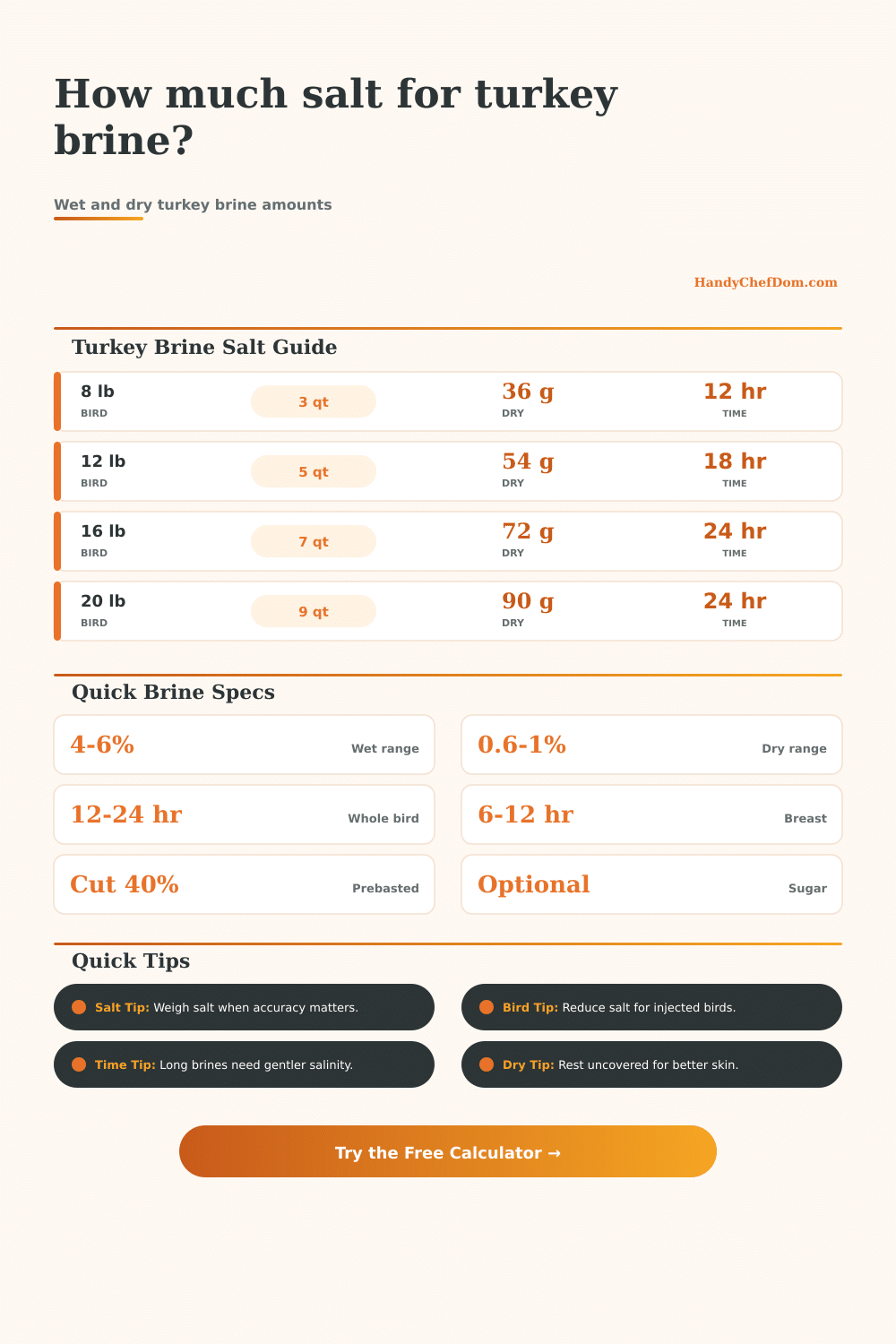
| Turkey weight | Wet brine volume | Standard wet salt | Standard dry salt |
|---|---|---|---|
| 6 to 8 lb breast | 2.5 to 3.5 qt | 118 to 166 g at 5% | 22 to 29 g at 0.8% |
| 10 to 12 lb turkey | 4 to 5 qt | 189 to 237 g at 5% | 36 to 44 g at 0.8% |
| 14 to 16 lb turkey | 6 to 7 qt | 284 to 331 g at 5% | 51 to 58 g at 0.8% |
| 18 to 20 lb turkey | 8 to 9 qt | 379 to 426 g at 5% | 65 to 73 g at 0.8% |
| 22 to 24 lb turkey | 10 to 11 qt | 473 to 521 g at 5% | 80 to 87 g at 0.8% |
| Extra cooler space | Add 10% to 20% | Calculator buffer handles this | No change for dry brine |
There’s nothing worse then being at your wit’s end with an unbrined turkey on your hands. You’ve got all the necesary ingredients; you’ve even got the bird. What do you do? The usual wisdom found online leave you confused. “A cup.” “A handful.” “Some salt.” This is no help.
Volume is relative. A cup of kosher salt won’t weigh as much as a cup of table salt which is why using volume measurements without knowing type can be a recipe for disaster. How is this information suppose to help us? That’s where the calculator comes into play. Plug in your preference, then your bird size. Saves you from guessing it connects precision and intuition.
How to Brine Your Turkey Perfectly
The biggest input? Salt type. Table salt and Morton kosher salt are dense. Diamond Crystal kosher salt is light and airy. Use cup measurements and you’re in trouble. Substitute one for another and the bird may be bland or worse, inedible. Weighing the salt in grams removes that variable. Regardless of brand, the salt percent remain the same.
In wet brine, you dunk the bird in saltwater. You target typically four to six percent. At first, this pulls moisture out. Next, the meat absorbs the solution again. It seasons from the inside out.
With dry brine, you rub salt right on skin. Leave it uncovered. Let it sit. Water dissolves the salt and then re-absorbs it. The result is crispy skin. No need for a massive cooler.
These variables adjust the tool. Wet brine targets are high. Salt’s diluting in water. Dry brine targets is low. The salt directly contact the flesh.
The other is time. A twenty pound bird require more time than a small turkey breast. Brining smaller pieces of meat for too long will turn them into ham. For that reason, the calculator factors in bird size and brine duration.
Spatchcocking a turkey multiply its surface area. Salt penetrates faster on such an altered bird.
Pre-basted birds? The tool also takes them into account. With many of today’s turkeys, they are enhanced, infused internally with saline solution. Putting full-strength brine on top of a bird that’s already been salted is all-too-common a misstep. The tool lower the suggested salinity level. That way there’s no danger of over-salting.
Sugar is optional but recommended. It balances the salt. It helps it brown while roasting. We give options for how much sugar to use. Do you want light, balanced, or sweet? Customize your flavor.
Don’t sweat over the ratios. Herbs and other aromatics such as garlic are part of the mix too. Mostly, they’re there for flavor. Balance accordingly if you’ll be loading up on a big aromatic load. Are you thinking of a robust bouquet garni?
Use reference tables as a sanity check. These will tell you what is typical by style. So if your calculation come out higher than expected, reference it against this table. That tells you if you did something right and the inputs was sane. It also allows you to determine the strength of the brine solution. Do a longer soak with a milder brine? Should you do a shorter soak with a stronger brine?
Brining is about control. You control how much salt goes into your food. Control over how long it does so. The tool simplifies the chemistry. It lets you focus on the cooking instead.
If you want to wet brine, then yes, you’ll have to rinse the bird. Dry brine? Then you’ll need to dry off skin. Those are important steps too, just like the salt.
The biggest variable gets removed. You walk into the kitchen confident. You know that you’ve seasoned the bird correctly. That’s the difference between a plan and a guess. It should of been easyer but now it is simple.