🍎 Apples Per Bushel Calculator
Estimate apple count, usable pounds, sliced cups, and fresh, pie, sauce, or cider yield from one or more bushels.
Use this for bushel planning: it starts with bushel weight and fullness, then adjusts apple count, pounds, cups, and finished yield by apple size and intended use.
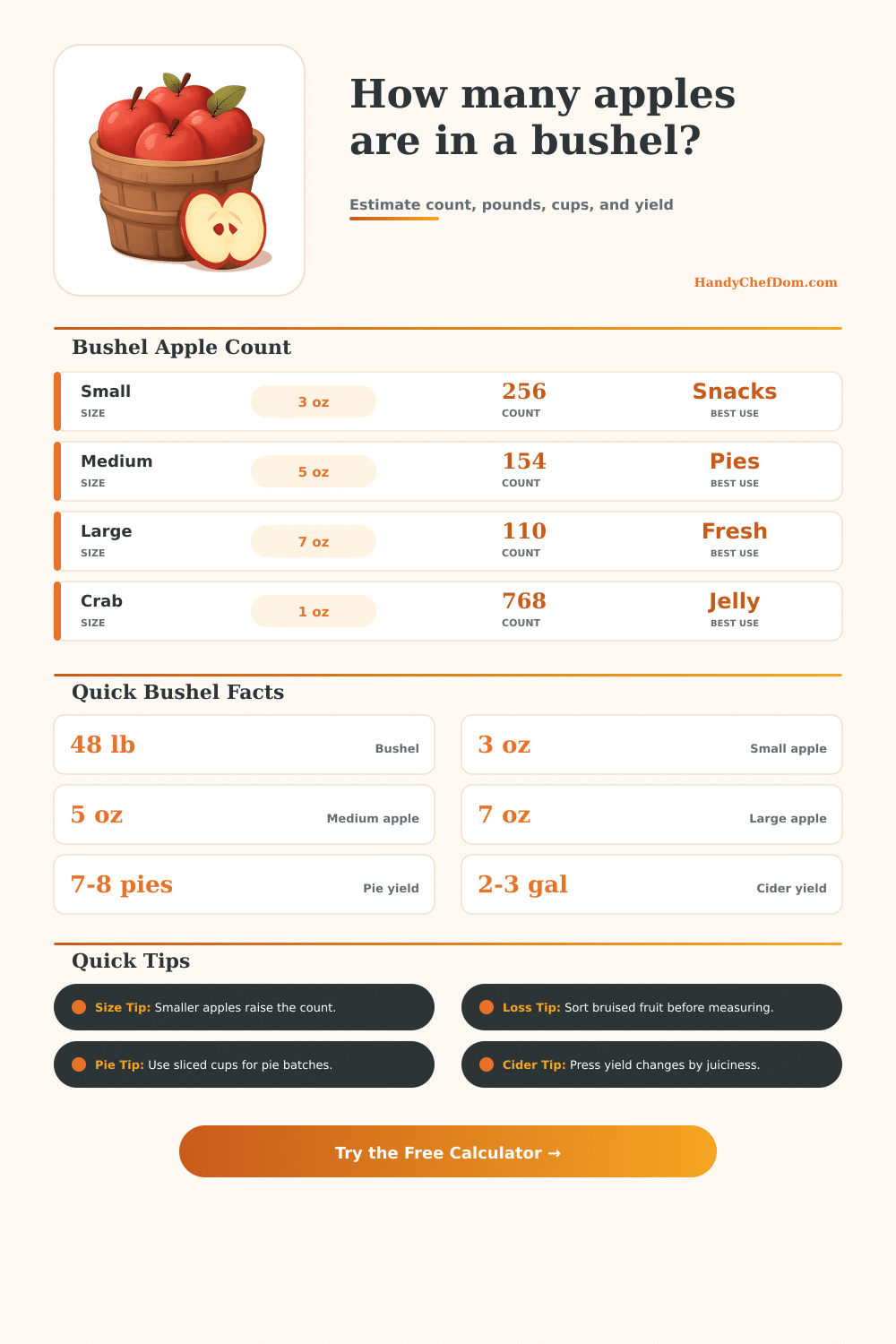
| Apple Size | Average Weight | Apples Per 48 lb Bushel | Best Planning Use |
|---|---|---|---|
| Crabapple | 1.2 oz | 640 apples | Jelly, sauce, cider blend |
| Small lunchbox | 3.5 oz | 219 apples | Snacks, school portions |
| Medium market | 5.0 oz | 154 apples | Pies, sauce, fresh eating |
| Large premium | 6.8 oz | 113 apples | Fresh eating, slicing trays |
| Extra large | 8.0 oz | 96 apples | Display fruit, large slices |
| Use | Usable Measure | Typical 48 lb Yield | Calculator Rule |
|---|---|---|---|
| Fresh eating | Pounds | 130 servings | 0.33 lb per serving |
| Pie filling | Sliced cups | 7 to 8 pies | 6 cups per pie |
| Applesauce | Cooked cups | 30 to 34 quarts | 2.75 cups per lb |
| Cider pressing | Juice gallons | 2.5 to 3 gallons | 0.06 gal per lb |
| Mixed kitchen | Split yield | Pies plus snacks | Half cups, half servings |
| Variety | Average Size | Cups Per Pound | Yield Note |
|---|---|---|---|
| Gala | 5.2 oz | 3.0 cups | Balanced fresh apple |
| Honeycrisp | 7.0 oz | 2.8 cups | Large and juicy |
| Fuji | 6.8 oz | 2.8 cups | Dense sweet slices |
| Granny Smith | 5.5 oz | 3.1 cups | Firm pie structure |
| McIntosh | 4.8 oz | 3.0 cups | Soft sauce texture |
| Rome | 6.0 oz | 3.2 cups | Reliable baking yield |
| Fruit Condition | Loss Range | Good For | Planning Note |
|---|---|---|---|
| Fresh picked | 3 to 6% | Fresh eating | Minimal trimming |
| Market mixed | 7 to 12% | Pies and sauce | Peel and core loss |
| Storage apples | 12 to 18% | Sauce | Sort soft spots first |
| Orchard seconds | 20 to 30% | Cider or sauce | Trim bruised areas |
| Crabapples | 15 to 25% | Jelly and cider | More stems and cores |
Bought a bushel of apples? Not sure what’s in there until you open it? Panic sets in as you hold a bag containing forty-eight pounds of fruit and stare at the recipe calling for nine-inch pie. How many of these are we going to get, anyway? Will it all dissapear between now and baking time, or be enough to see us through the holidays?
The answer involves only one factor. No one ever discusses it enough, but it makes all the difference for your kitchen logistics: size. A bushel is measured by volume and weight (not count). Whether it’s filled with three hundred tiny crabapples or one hundred giant Honeycrisps, a bushel always weigh around forty-eight pounds.
How to Use a Bushel of Apples
The other thing most home cooks think: “I’d better count just how many apple there are in the bag.” No, no. You’re only counting how much usable apple you actualy get after peeling, coring, and trimming away bruises or damaged spots. That’s why understanding loss is so important: Freshly picked fruit may lose 2 or 3 percent of its weight from bruises and stems. But if you purchased an orchard second or some stored market apples (which tend to soften at their edges), you’ll want to trim a lot more. When you purchase a bushel of storage apples with softening around the edges, you are paying for bruised tissue and air space that will go in the compost, not your pie. This page’s calculator lets you adjust the loss percentage to reflect actual condition of your fruit, and help you guess at how much usable weight is inside that bag.
Take, for example, making cider versus making sauce. With sauce, you’re peeling and coring each individual apple. That’s a heck of a lot of work! When you press your cider, much of that goes away; all you do is wash, crush, and then press. Depending on which variety you use, the amount of juice you get from the apples can vary like crazy. A juicy red delicious will give much more liquid by weight than a hard, dry gala. So when it comes to making a batch of cider, it won’t matter how many slice you have (you want to know how many gallons). But if you’re baking, you’ll need to know how many cups of sliced apples you have. For a basic nine-inch pie, you need roughly six cups of filling. Get this math incorrect and your pie will be either a sinkhole of a middle or an empty crust.
The type of apple you use will dictate the structure and texture of your finished result. If you’re looking for something that keeps its shape well when heated (like in a pie where visual appearance matters), then firm apples such as Granny Smiths is your go-to choice. For example, softer apples such as McIntosh cook down quickly, which is great if you’re making sauce but not so much for sliceable pie. While many folks stick to just one type of apple, more experienced bakers know to mix things up and enjoy the best of both worlds. You’ll want some soft fruit to break down and make that rich, syrupy filling, while still having some firmer fruit to keep everything together. This creates a balanced flavor and prevents any slouching once you finally cut into your creation.
The size of your apple will also affect how convenient this is. Each individual, big apple take longer to core and peel. Tiny apples may go quicker, but then again, you’ll need to make multiple passes to the cutting board with their cores and stems. For events like a big party, purchasing a batch of uniformly sized (but still medium) fruit will save you a ton of time in the kitchen. No need to fret over those wonky-shaped, extra-large ones that mess with all your measuring cups. When you’re racing against the clock, consistency counts.
In conclusion, planning with apples is best done by taking care of the apples themselves. Weigh them first and remove the rotten ones. This gives you a firm starting point so you can use simple math to estimate how many you’ll get. Knowing what 48 pounds of apples actually represents for your kitchen, whether you’re making pies for friends or stocking up on autumn snacks, is reassuring. It saves you time, money, and stress, because now you know exactly how much space 48 pounds of apples will take up in your kitchen. You should of known it is nothing more and nothing less.