🥩 Baking Soda to Tenderize Meat Calculator
Estimate a small baking soda dose for meat tenderizing, then get slurry water, timing, rinse cues, and a taste guard before stir-fry, grill, or stew prep.
Baking soda tenderizing is strongest on the surface. Use small amounts, especially when pieces are thin or ground, because too much can leave a soapy taste.
Best when the meat surface is already damp and you want less added water in the bowl.
Useful for sliced stir-fry meat because water helps distribute the tiny soda amount.
Most helpful after medium or high doses so the finished meat does not taste alkaline.
Only works well when the dose is very small and the meat will be seasoned after mixing.
| Cut type | Best shape | Dose tendency | Kitchen note |
|---|---|---|---|
| Beef flank or skirt | Thin strips | Standard | Good candidate for quick stir-fry tenderizing. |
| Chicken breast | Thin slices | Gentle | Use a lighter dose because the meat is already tender. |
| Pork loin or cutlet | Cutlets or strips | Gentle | Slurry spreads more evenly over lean pork pieces. |
| Chuck or stew meat | Small cubes | Moderate | Keep pieces small; thick centers will not tenderize deeply. |
| Ground meat | Loose mince | Very light | Mix gently and avoid a long hold so texture stays natural. |
| Shrimp or seafood | Small pieces | Very light | Use a short timing window and rinse well if the dose rises. |
| Preparation | Conservative rate | Upper practical rate | Soapy taste risk |
|---|---|---|---|
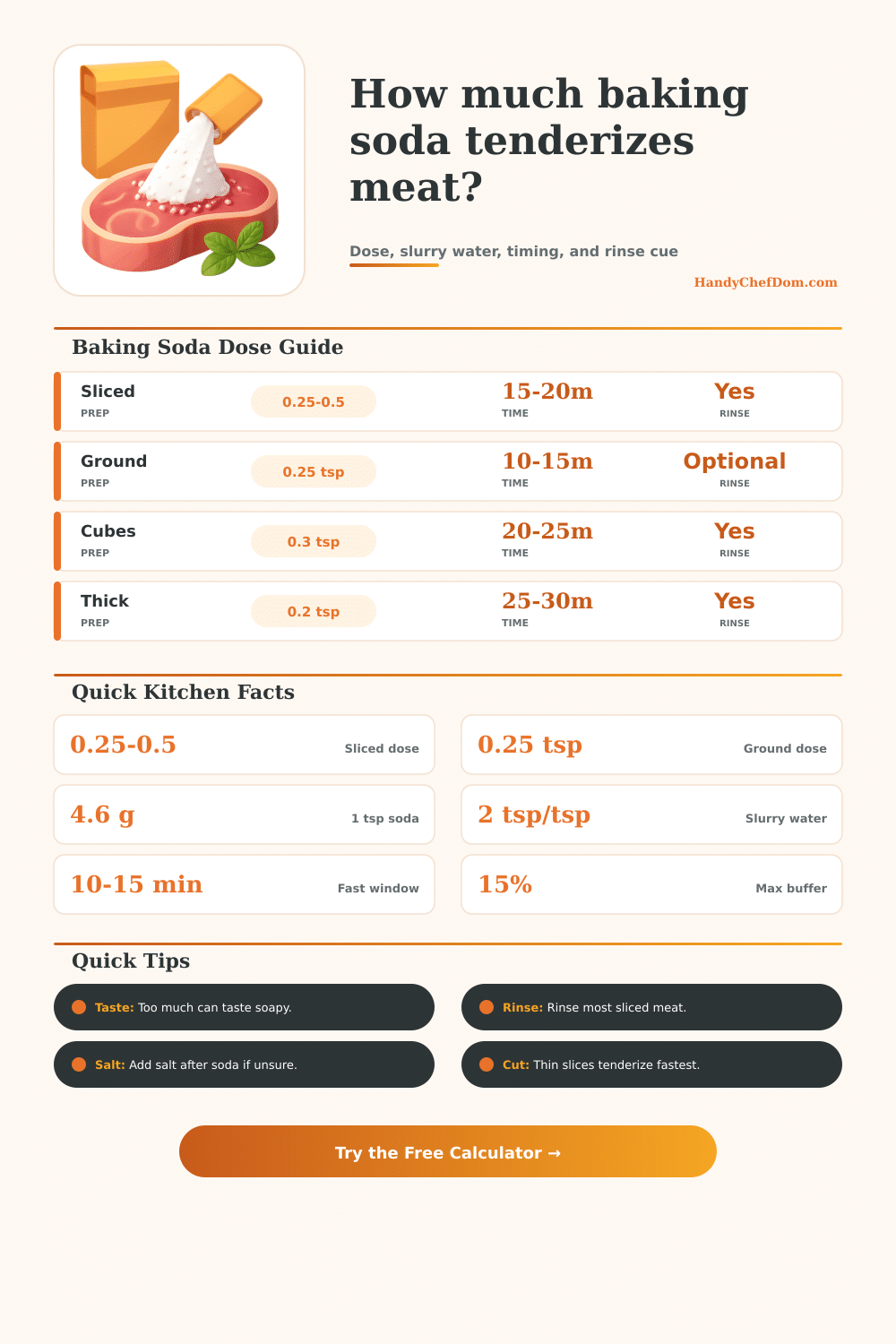
| Thin sliced beef | 1/4 tsp per lb | 1/2 tsp per lb | Rises above 1/2 tsp per lb. |
| Chicken or pork slices | 1/4 tsp per lb | 3/8 tsp per lb | Rises if held too long. |
| Ground meat | 1/8 tsp per lb | 1/4 tsp per lb | Rises when mixed heavily. |
| Small stew cubes | 1/4 tsp per lb | 1/3 tsp per lb | Rises if not rinsed. |
| Thick pieces | 1/8 tsp per lb | 1/4 tsp per lb | Surface can taste alkaline. |
| Shrimp or seafood | 1/8 tsp per lb | 1/4 tsp per lb | Rises quickly after 10 minutes. |
| Method | How to apply | Water guide | Best for |
|---|---|---|---|
| Dry rub dusting | Sprinkle, toss, and rest | None | Small batches and damp surfaces. |
| Slurry coating | Dissolve soda in water, then toss | 2 tsp water per 1 tsp soda | Even coating on sliced meat. |
| Light no-rinse method | Use the lowest rate and season later | Optional few drops | Ground meat or very small doses. |
| Rinse-and-dry method | Rinse after rest, then pat dry | Cold water rinse | Stir-fry, grill, and higher doses. |
| Piece style | Target minutes | Do not push past | Finish cue |
|---|---|---|---|
| Very thin slices | 8 to 12 | 20 minutes | Rinse or wipe, then pat dry. |
| Standard sliced strips | 15 to 20 | 30 minutes | Rinse for clean flavor. |
| Ground meat | 10 to 15 | 20 minutes | Mix gently and season after. |
| Small cubes | 20 to 25 | 35 minutes | Rinse if using standard dose. |
| Thick pieces | 25 to 30 | 40 minutes | Expect mainly surface tenderizing. |
| Shrimp or seafood | 5 to 8 | 12 minutes | Rinse promptly and dry well. |
Baking soda work as a meat tenderizer because baking soda raises the pH levels on the surface of the meat. The increase in pH level cause the proteins in the meat to loosen. When the proteins in the meat is loosened, they will not tighten up while the meat is being cooked.
The effect of baking soda mostly remain on the surface of the meat unless the piece of meat are thin. To account for the fact that the effect of baking soda remains on the surface of the meat, a person must use a small amount of baking soda. If a person use too much baking soda, the meat may have a soapy taste that remains in the dish when the meat is eaten.
How to Use Baking Soda to Make Meat Tender
If a person uses too little baking soda, the baking soda will not change the texture of the meat. The calculator determine the amount of baking soda that is necessary based on the weight, the cut, and the shape of the meat that is to be treated with baking soda. The weight of the meat will be one of the factor that is considered in the calculation of the amount of baking soda that should be used.
Thin meats, like flank strips, will react differently to the baking soda than ground beef or beef that is cut into thick pieces. Thin pieces of meat has more of the surface area exposed to the baking soda. Therefore, thin pieces of meat will absorb the baking soda more quick.
Ground meat has already been broken down into smaller piece so the baking soda will have more contact with the meat. Large pieces of meat will take more time for the baking soda to react on the surface of the meat so that the effect will be transmitted throughout the meat. However, the baking soda treatment will not affect the center of large pieces of meat.
A person must know the type of meat that will be treated with baking soda in order to determine the correct length of time that the meat will be treated. Another decision that a person must make is whether or not to rinse the meat after it has rested for a period of time after treatment with baking soda. Most meats that are sliced will require a rinse after resting because the slice of meat will have absorbed the baking soda.
Removing the baking soda from the meat will prevent the meat from having an bitter and soapy flavor. Ground meats and meats that have only been treated with a light dose of baking soda can often be skip over this step. Again, a person should only use this option if the dose of baking soda that is used are conservative.
The calculator will tell a person if a meat rinse is necessary after treatment with baking soda. The salt that is added to the meat will affect how much baking soda is require. The salt can make the proteins in the meat tighten.
Therefore, cooks will often add salt to meat after it has been rinsed with baking soda. Baking soda is best use in foods that cook very quickly, such as stir-fries and grilled strip of meat. Stir-fries and grilled strips cook very quick.
The heat does not have time to break down the connective tissue of the meat. However, if a person treats the meat with baking soda before it is cooked, the proteins will loosen such that the meat will be tender when it is cooked. Foods that require long cooking times, such as stews and braises, have less value from the addition of baking soda.
Large pieces of meat will require long cooking time to ensure the meat is cooked throughout. The calculator will allow a person to adjust the dose of baking soda that will be used in the meat based on the cooking method that will be used to prepare the meat. A very common mistake when using baking soda as a tenderizer is leaving the meat in the baking soda for too long.
The reaction of the baking soda happen quickly on the surface of the meat. Using baking soda on meat for long period of time will make the meat worse in flavor. Another very common mistake when using baking soda is to skip drying the meat after rinsing the meat with baking soda.
If the meat is not dried, the meat will steam while cooking. Steaming meat instead of searing it will prevent the meat from browning. Browning meat is necessary to give the meat a good flavor.
A person must dry the meat with towels after rinsing it with baking soda. This method of using baking soda is target to the outer layer of the meat. A person does not want to change the entire muscle of the meat.
A person only wants to change the outer layer of the meat. If a person uses baking soda according to conservative numbers, the meat will be tender. However, if a person uses baking soda according to conservative numbers, the meat will not have an added taste.
This method of tenderizing meat with baking soda is very useful because the meat will be tender when eat yet will maintain its flavor.