BAC Drink Calculator
Estimate a possible blood alcohol concentration from pour size, ABV, drink count, body weight, sex-based water factor, drinking window, food, and metabolism. Use it as an education tool only, not as proof that anyone is safe or legal to drive.
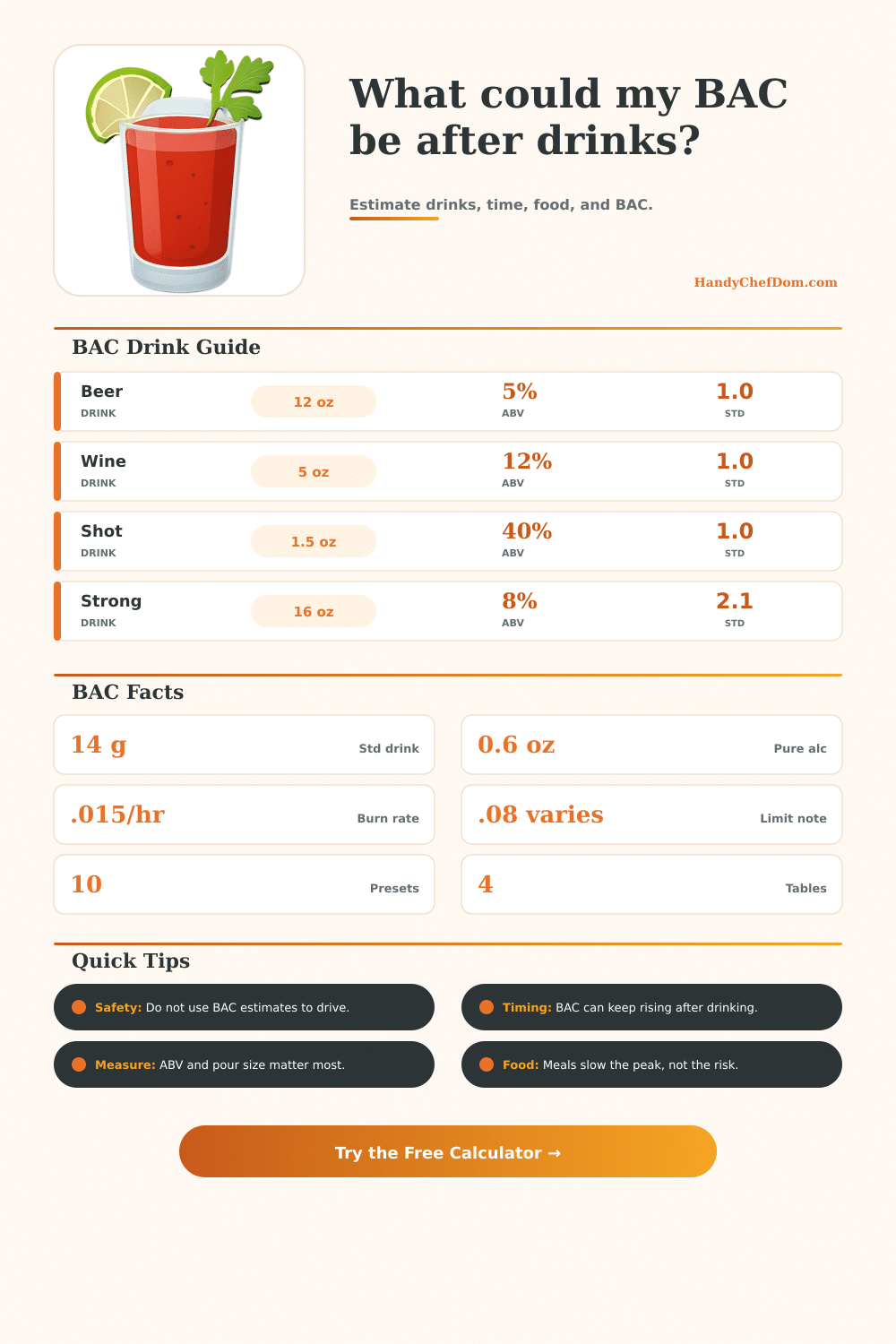
Start with a common scenario, then adjust the pour. A U.S. standard drink contains about 0.6 fl oz or 14 g of pure alcohol. Real BAC varies by biology, medication, fatigue, food timing, and measurement error.
Your BAC drink estimate
Higher near-term estimate when alcohol absorbs quickly.
Food may slow the rise, but does not make driving safe.
Projection using the selected burn-off rate.
Distance from the selected reference threshold.
| Drink type | Typical serving | Typical ABV | Standard drink estimate | Planning note |
|---|---|---|---|---|
| Regular beer | 12 fl oz | 5% | 1.0 drink | A tall can or pint can be more than one drink. |
| Craft beer or IPA | 16 fl oz | 7% to 9% | 1.9 to 2.4 drinks | ABV matters more than whether it is called beer. |
| Table wine | 5 fl oz | 12% | 1.0 drink | Large restaurant pours often exceed 5 oz. |
| Fortified wine | 3.5 fl oz | 17% | 1.0 drink | Small pours can still carry a full drink equivalent. |
| 80-proof spirit | 1.5 fl oz | 40% | 1.0 drink | Measure home pours; free-poured cocktails vary widely. |
| Mixed cocktail | 6 to 10 fl oz | Varies | 1 to 3+ drinks | Count spirit ounces, liqueurs, and high-ABV additions. |
| BAC range | What may happen | Driving caution | Calculator interpretation |
|---|---|---|---|
| 0.01 to 0.02 | Subtle mood and attention changes may appear. | Impairment can begin before a legal threshold. | Treat as alcohol present, not as a green light. |
| 0.03 to 0.05 | Judgment, tracking, and divided attention can worsen. | Many people feel more capable than they are. | Use a non-driving plan. |
| 0.06 to 0.08 | Coordination, reaction time, and perception decline. | Common U.S. adult legal reference is 0.08, but laws vary. | Do not drive or operate machinery. |
| 0.09 to 0.14 | Balance, speech, memory, and control may be impaired. | Crash and injury risk rise sharply. | Stay with trusted help and avoid more alcohol. |
| 0.15 or higher | Severe impairment and medical risk become more likely. | Driving is extremely dangerous. | Seek medical help for vomiting, confusion, slow breathing, or unconsciousness. |
| Factor | Can raise estimate | Can lower estimate | Why it matters |
|---|---|---|---|
| Body size | Lower body weight | Higher body weight | The same alcohol distributes through a different amount of body water. |
| Distribution ratio | Lower water factor | Higher water factor | Widmark uses a ratio, but individuals vary. |
| Food | Empty stomach | Meal before or during drinks | Food mainly delays and flattens the peak; it does not cancel alcohol. |
| Time | Short drinking window | Longer elapsed time | Metabolism subtracts gradually, often estimated near 0.015 BAC per hour. |
| Pour accuracy | Large home pours or high ABV | Measured servings | Small ABV and ounce errors compound across multiple drinks. |
| Scenario | Common hidden issue | Better input choice | Safety-first response |
|---|---|---|---|
| Happy hour | Short pours and strong cocktails are hard to judge. | Enter liquor ounces, not glass volume, when possible. | Plan transportation before the first round. |
| Dinner with wine | Glasses refill before anyone tracks ounces. | Count bottle fractions or measured 5 oz pours. | Food slows timing, but use a sober ride if drinking. |
| Craft beer tasting | Small samples can be very high ABV. | Use total ounces and weighted average ABV. | A tasting flight can equal several standard drinks. |
| Wedding or party | Drinks spread over hours, then peak near departure. | Use hours since first drink and possible peak mode. | Do not make departure decisions from an estimate. |
| At-home cocktails | Free pours are often larger than 1.5 oz. | Measure spirit ounces with a jigger. | Stop early and arrange no-driving plans. |
How this BAC drink calculator thinks
The calculator first converts each serving into pure alcohol: drink ounces multiplied by ABV. It then divides pure alcohol by 0.6 fl oz to estimate U.S. standard drinks, a common definition also described as about 14 grams of pure alcohol.
For the BAC estimate, it uses a Widmark-style equation with alcohol ounces, body weight, and a body-water distribution ratio, then subtracts the selected hourly metabolism rate for elapsed time. The food setting adjusts the near-term peak estimate to reflect slower absorption, but the page intentionally keeps the safety message conservative because a real person can be impaired below any selected reference threshold.
Estimating blood alcohol concentrations is a method that can be used to calculate the amount of alcohol that is in a persons bloodstream. Many people uses the estimation of blood alcohol concentration because this can provide a number that represents the amount of alcohol in there system. However, calculating blood alcohol concentration estimates dont provide the exact amount of alcohol in a persons system, but does rely upon several different variable to provide that estimate.
Two of the variables that affect the estimate of blood alcohol concentration are the size and the strength of the drink that is consumed. For instance, a twelve-ounce beer will contain less alcohol than a twelve ounce spirit. Thus, consuming a twelve ounce beer and a twelve ounce spirit will lead to different blood alcohol concentration level.
Estimating Blood Alcohol Level and Why It Is Not Exact
To calculate blood alcohol concentration, you must enter the size of the drinks and the strength of those drinks into the calculator that is used for making these estimates. If the size or strength of the drinks are underestimated, the estimate of blood alcohol concentration will be incorrect. Two of the variables regarding the effect that blood alcohol concentration has upon the body are the weight and sex of the individuals.
An individual that weighs less than another individual will have a more higher blood alcohol concentration than the individual that weighs more. This is due to the fact that the amount of water in the body dilutes the alcohol and an individual that weighs less will have less water in there body. Additionally, the sex of the individual can affect their blood alcohol concentration due to the amount of water in their body.
Two of the variables that impact how alcohol affect an individual is the time and food that is consumed. Alcohol leaves the body at a steady rate regardless of need. Additionally, food does not remove alcohol from an individual’s system, but food can impact the absorption of alcohol.
If an individual consumes food prior to drinking alcohol, the body will absorb the alcohol at a slow rate. Though the calculation of blood alcohol concentration can be helpful for individuals to understand there system, the calculation is only of that moment and does not provide guarantee for an individual’s safety. The estimate of blood alcohol concentration is reliant upon the numbers that is provided by individuals and calculations.
Though many individuals understand that a blood alcohol concentration below the legal limit is an indication that an individual is safe, this is not always true as alcohol can impair an individual’s reaction time, judgment, and divided attention. Many individuals make the mistake of believing that if they space out their drink, they will maintain a low blood alcohol concentration. If the total amount of alcohol is high enough, the body will not be able to leave that alcohol from the system fast enough to avoid high level of alcohol in the blood.
Additionally, individuals may lose count of how many drink they have had. If an individual loses count of the number of drinks that they have consume, the estimate of their blood alcohol concentration will not be accurate. Though the calculator contains various setting to show the effect that the various factor can have upon the estimate of blood alcohol concentration, these settings are only estimates.
The user can adjust the food that is consumed in the calculator. The user can adjust the number of servings in the calculator. Though these settings can be helpful for planning drinks, they are only estimates of what may occur.
To ensure that an individual does not become a danger to others on the road, individuals should of always use rideshare or designated driver to ensure they dont find themselves driving while drinking alcohol.