Baking Soda Sodium Calculator
Estimate sodium from baking soda by teaspoons, tablespoons, grams, recipe servings, leavening amount, batch scaling, label sodium, daily limit, and baking powder substitution comparison.
1Baking Soda Sodium Presets
2Amount, Servings, Batch Scale, and Sodium Inputs
Choose teaspoons, tablespoons, or grams. The calculator converts the baking soda amount, applies batch scaling, estimates sodium milligrams, divides by recipe servings, and compares a baking powder substitution.
Baking soda sodium result
Choose a recipe amount, then calculate.
3Live Measure, Substitution, and Sodium Grid
4Baking Soda Measure and Sodium Table
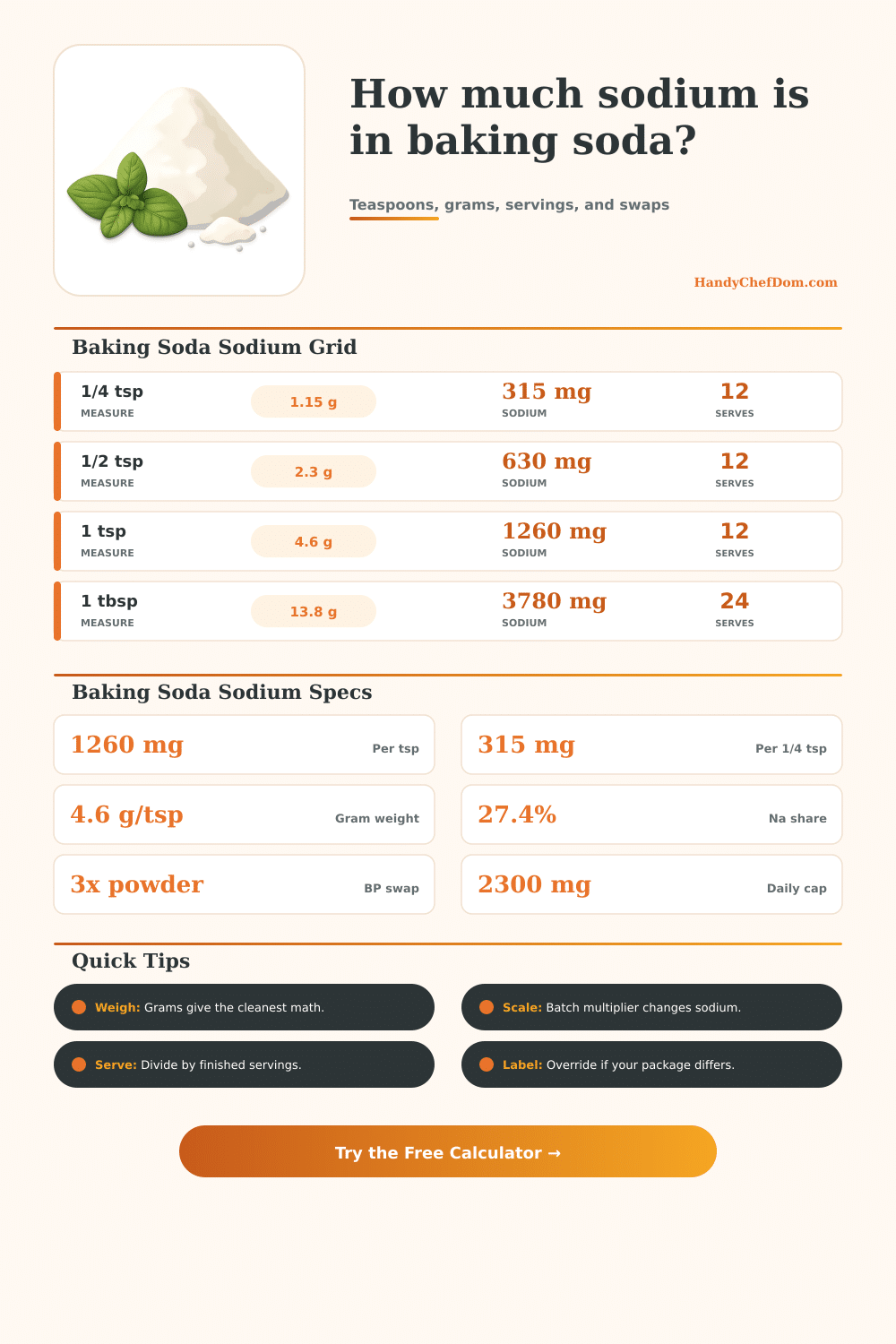
| Baking soda measure | Approx grams | Approx sodium | Per 12 servings | Per 24 servings |
|---|---|---|---|---|
| 1/8 teaspoon baking soda | 0.58 g | About 158 mg | About 13 mg each | About 7 mg each |
| 1/4 teaspoon baking soda | 1.15 g | About 315 mg | About 26 mg each | About 13 mg each |
| 1/2 teaspoon baking soda | 2.3 g | About 630 mg | About 53 mg each | About 26 mg each |
| 3/4 teaspoon baking soda | 3.45 g | About 945 mg | About 79 mg each | About 39 mg each |
| 1 teaspoon baking soda | 4.6 g | About 1260 mg | About 105 mg each | About 53 mg each |
| 1 tablespoon baking soda | 13.8 g | About 3780 mg | About 315 mg each | About 158 mg each |
5Batch Scaling and Serving Sodium Table
| Recipe scenario | Base soda amount | Batch multiplier | Total sodium | Per serving example |
|---|---|---|---|---|
| Small cookie tray | 1/2 tsp | 1x | About 630 mg | 26 mg each across 24 cookies |
| Muffin pan | 1 tsp | 1x | About 1260 mg | 105 mg each across 12 muffins |
| Half batch | 1 tsp recipe | 0.5x | About 630 mg | 105 mg each across 6 servings |
| Double batch | 1 tsp recipe | 2x | About 2520 mg | 105 mg each across 24 servings |
| Large sheet pan | 1 tbsp | 1x | About 3780 mg | 158 mg each across 24 servings |
| Scaled prep batch | 2 tsp | 3x | About 7560 mg | 126 mg each across 60 servings |
6Baking Powder Substitution Comparison Table
| Comparison | Amount for 1 tsp soda | Sodium setting | Total sodium | Difference from soda |
|---|---|---|---|---|
| Baking soda baseline | 1 tsp baking soda | About 1260 mg per tsp | About 1260 mg | Baseline |
| Classic powder swap | 3 tsp baking powder | 488 mg per tsp | About 1464 mg | About 204 mg higher |
| Lower-sodium powder label | 3 tsp baking powder | 300 mg per tsp | About 900 mg | About 360 mg lower |
| High-sodium powder label | 3 tsp baking powder | 600 mg per tsp | About 1800 mg | About 540 mg higher |
| Same-teaspoon comparison | 1 tsp baking powder | 488 mg per tsp | About 488 mg | Not equal leavening strength |
| Sodium-free powder entry | 3 tsp baking powder | 0 mg per tsp | 0 mg | About 1260 mg lower |
7Daily Limit Percent Table
| Per-serving soda sodium | Share of 1500 mg limit | Share of 2000 mg limit | Share of 2300 mg limit | Typical source |
|---|---|---|---|---|
| 25 mg | About 2% | About 1% | About 1% | Small cookies or mini muffins |
| 50 mg | About 3% | About 3% | About 2% | Half teaspoon across 12 servings |
| 105 mg | About 7% | About 5% | About 5% | One teaspoon across 12 servings |
| 158 mg | About 11% | About 8% | About 7% | One tablespoon across 24 servings |
| 250 mg | About 17% | About 13% | About 11% | Small batch with few servings |
| 500 mg | About 33% | About 25% | About 22% | Large soda amount, small portions |
8Baking Soda Sodium Mode Comparison
Best when a recipe lists baking soda as teaspoons or fractions of a teaspoon.
Best for large prep batches where leavening is measured in tablespoons.
Best when a formula is weighed. The calculator converts grams through your density setting.
Best for checking how a baking powder label changes sodium versus baking soda.
9Two Practical Baking Soda Sodium Tips
The white powder goes into your bowl of batter; you’re preparing quick bread or muffins. “Oh,” you say, “I need one teaspoon of baking soda.” No big deal: Just another leavening agent. But that teaspoon have more than a thousand milligrams of sodium. That detail tends to vanish until you look at the nutrition label after the fact.
Even veteran home bakers trying to curb their salt consumption gets tripped up by the hidden sodium in their recipes. Table salt may be out of bounds, but not so the chemical leavener: Sodium bicarbonate gets added to the body count.
The Hidden Salt in Baking Soda
It’s simple chemistry. A normal tablespoon hold roughly four point six grams of baking soda, which consists mainly of sodium atoms (sodium bicarbonate is chemical name for baking soda). That’s because sodium accounts for roughly twenty-seven percent of baking soda’s overall weight. Since the molecules aren’t changing shape, that gram-to-tablespoon ratio are straight-up sodium, every time.
Brands don’t change too much, it’s not like table salt, whose variations depends on grain size and density. If you know your weights, you knows how much you’ve got. And since the app knows your spoons, it know your milligrams (with no need to study chem). What do you think? You won’t find many recipe that discuss the minerals in leaveners. They provide texture and rise, but not nutrition, so you just has to leave that to chance.
This becomes even more important when scaling a recipe. Double a cookie-batch recipe, and you double the sodium tucked into baking soda alone. Split the resulting cookies into fewer servings, and the sodium-per-portion skyrocket. When you work in sticks of butter and cups of flour, it’s too easy to forget about milligrams of minerals. That’s where the tool comes in, breaking out the per-serving amount from the total-batch figure. Before you pour in some broth or top with some cheese, you’ll know just how far into your day’s allotment you’ve gone.
Another one that comes up often is substitution: Can I substitute baking soda for baking powder? Many bakers does this because too much soda adds a metallic flavor to the finished product, especially in thicker batter. Baking powder also contains sodium, typically as sodium aluminum sulfate or something like that, which isn’t necessarily better. A teaspoon of soda has a lot of sodium, yet swapping soda for three teaspoons of baking powder just add a new ingredient to the mix. Depending on what kind of powder it is, the overall sodium could be roughly equivalent, or maybe slightly lower. Low-sodium versions exist, and there are pretty high ones, too. Best to check the label.
But it should of helped to know that this swap isn’t always an easy choice for your health. This input view change the way you think about baking. It’s not just about air; it’s also about chemistry and nutrition when it comes to leavening. Use this reference table from page. You can visualize how small differences in measurements scale out for various servings, including total sodium content. That quarter teaspoon doesn’t sound like much by itself, but multiplied through 12 muffins, it’s the equivalent of a significant portion of your recommended daily intake.
The key is knowing what you’re measuring. Don’t let the convenience sneak up on you with unwanted nutritional consequences. Sodium is one element of baking chemistry, which is half science, half taste. Don’t throw out your baking soda, though: Just be aware of it. Measure with care, or better yet, weigh your dry ingredient… And reclaim power over your own recipes.
Sodium becomes something you can account for rather than an unknown factor. And the next time you scoop some white powder out of the box, recall that there are two things it’s doing for you in your muffins or quick bread. One, it’s lifting; one, it’s salty. Both should factor into calculating the real cost of rising up.