🌾 Barley Straw Per Acre Pond Calculator
Estimate straw pounds, bale count, acre-feet, gallons, timing, and placement zones from pond surface area and depth.
Use surface acreage for straw sizing, then use depth to calculate acre-feet and water volume. The straw should stay loose, distributed, and easy to retrieve.
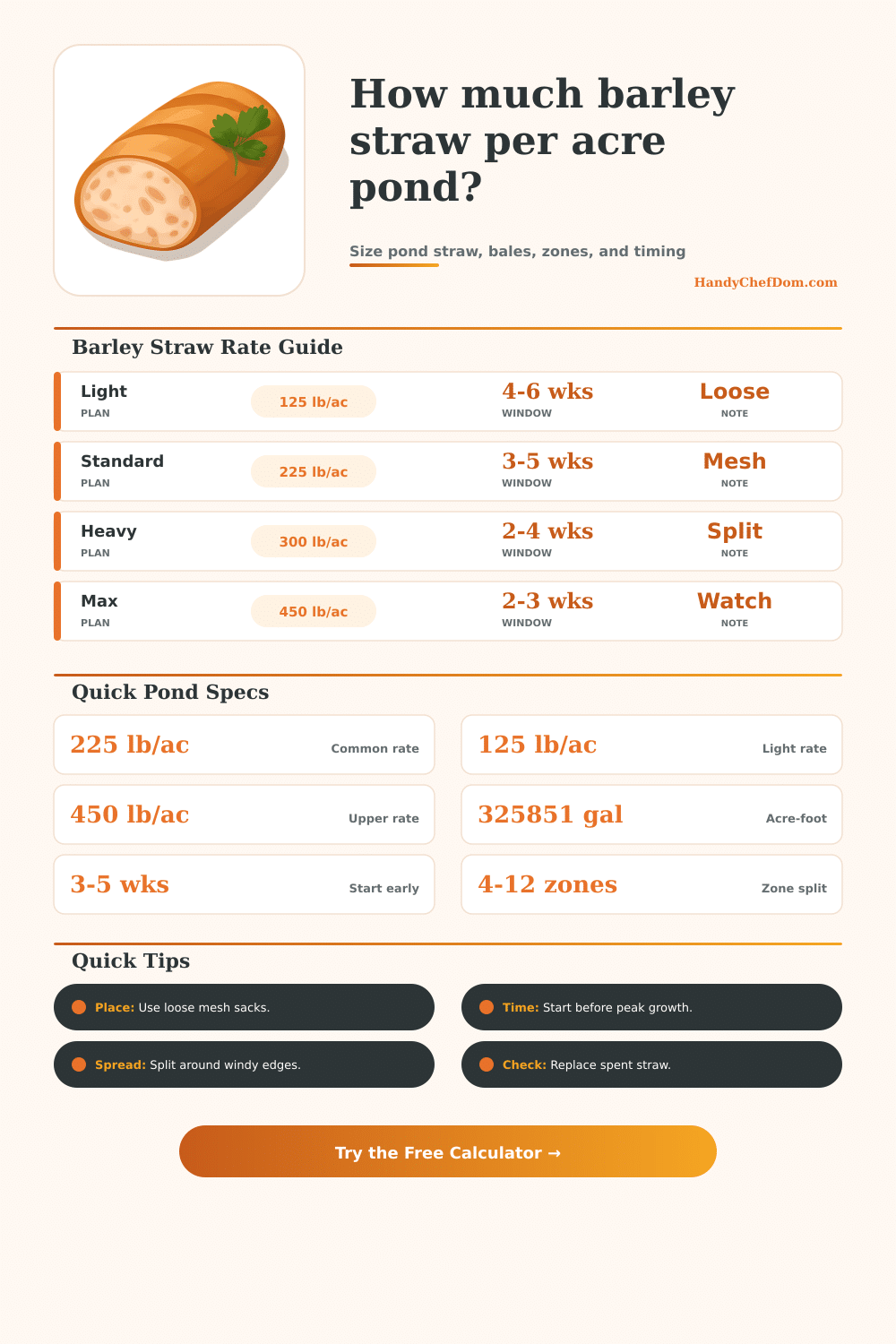
| Rate Plan | Straw Rate | Best Fit | Placement Note |
|---|---|---|---|
| Light preventive | 125 lb per acre | Clear pond with early seasonal planning | Use several light bundles before peak growth. |
| Standard pond plan | 225 lb per acre | Common farm, fishing, and ornamental ponds | Split around windward edges and shallow shelves. |
| Heavy organic load | 300 lb per acre | Leafy ponds, high runoff, or dense shoreline plants | Increase zones so no bundle becomes a heavy mat. |
| Upper planning cap | 450 lb per acre | Short-term conservative planning only | Watch oxygen stress risk and avoid compact piles. |
| Area Method | Formula | Imperial Conversion | Metric Conversion |
|---|---|---|---|
| Known surface area | Use mapped pond area | 1 acre = 43,560 sq ft | 1 hectare = 2.471 acres |
| Rectangle or oval | Length × width, oval adjusted | sq ft / 43,560 | sq m × 10.7639 / 43,560 |
| Round pond | 3.1416 × radius × radius | sq ft / 43,560 | sq m × 10.7639 / 43,560 |
| Acre-feet | Acres × average depth | 1 acre-ft = 325,851 gal | 1 acre-ft = 1,233.5 cu m |
| Pond Size | 125 lb/ac | 225 lb/ac | 300 lb/ac |
|---|---|---|---|
| 0.10 acre | 13 lb | 23 lb | 30 lb |
| 0.25 acre | 31 lb | 56 lb | 75 lb |
| 0.50 acre | 63 lb | 113 lb | 150 lb |
| 1.00 acre | 125 lb | 225 lb | 300 lb |
| 2.00 acres | 250 lb | 450 lb | 600 lb |
| 5.00 acres | 625 lb | 1125 lb | 1500 lb |
| Placement Zone | Good Location | Use When | Practical Check |
|---|---|---|---|
| Windward edge | Side where wind pushes surface water | Most ponds with one dominant wind direction | Anchor sacks so they do not beach. |
| Inlet area | Near incoming water but outside debris jams | Runoff brings leaves, silt, or nutrients | Keep straw clear of pipes and screens. |
| Shallow shelf | 1 to 3 ft water beside easy access | Small farm or backyard ponds | Leave retrieval rope visible. |
| Floating raft | Open water with secure tether | Steep banks or limited shoreline access | Use loose cages, not compressed blocks. |
| Coves | Quiet corners and shaded pockets | Irregular ponds with dead zones | Split bundles smaller and inspect often. |
There’s a hush-hush secret in the pond-ownership world about barley straw. You throw a few bales in the water and hope something happens. It depends more on acres of surface area than the gallons beneath it. Your thinking begins at the point where sunlight hits: acres caught in its rays, which determine how much straw you need; hence the need for understanding depth to know your volume. Knowing that will alter what you thinks about doing.
It zeroes in on growing zone. After entering your pond’s average depth and surface area, the calculator do the math for you. Your inputs convert to total gallons and acre-feet; then they’re converted with your desired straw rate; next, you’ll choose how quickly your straw will move (flowing water vs. A sheltered cove); finally, a modest buffer percentage offset any loss from bale wetness and retrieval.
How to Use Barley Straw in Your Pond
The resulting plan is realistic, not optimistic. Choose options based off your circumstances. Your rate selections depends on pond condition. Choose a lighter preventive level if water remains clear. Use a normal rate for most farm ponds with moderate organic load. Use a higher setting closer to leafy bank runoff areas. The upper cap is a conservative limit, not a goal. It is more important to match your rate selection to existing conditions different than to try to guess high just in case.
So it’s not how much weight but where you put your placements; no need for a big mat of straw through which the water just passes. Instead, break up the straw into smaller bundles that is anchored on both sides (at inlets/outflows) and along windward edges, ensuring continued contact. To help recovery, use mesh bags, allowing for water flow with containment of the straw.
The same principle applies for timing; plan to drop your straw 3-4 weeks prior to when the growth will be peaking… It takes time for the process to get going, then algae will react once warm. Depending on your load and system temperature, you will need to replace it sooner in warm ponds with lots of leaf fall than in cooler systems that break down more slow. Simply observing how fast the straw degrades and turns dark signals the end. You’d of not needing to fully restart the plan; just swap out old bundles for new ones.
So how do you apply those numbers to your pond? The good news is that you will now be able to understand what they mean for you. The number of acres matters because that’s what your pond covers. That’s where sun shines to start growing things. The depth doesn’t change the per acre figure; it simply puts it into a more understandable volume context.
Then there are factors like wind that affect movement. These require buffer adjustments. All of these factor into the calculations but can be managed.