🥛 Milk Liter to KG Converter
Convert milk volume (liters, cups, gallons) to weight (kg & lbs) using accurate milk density values
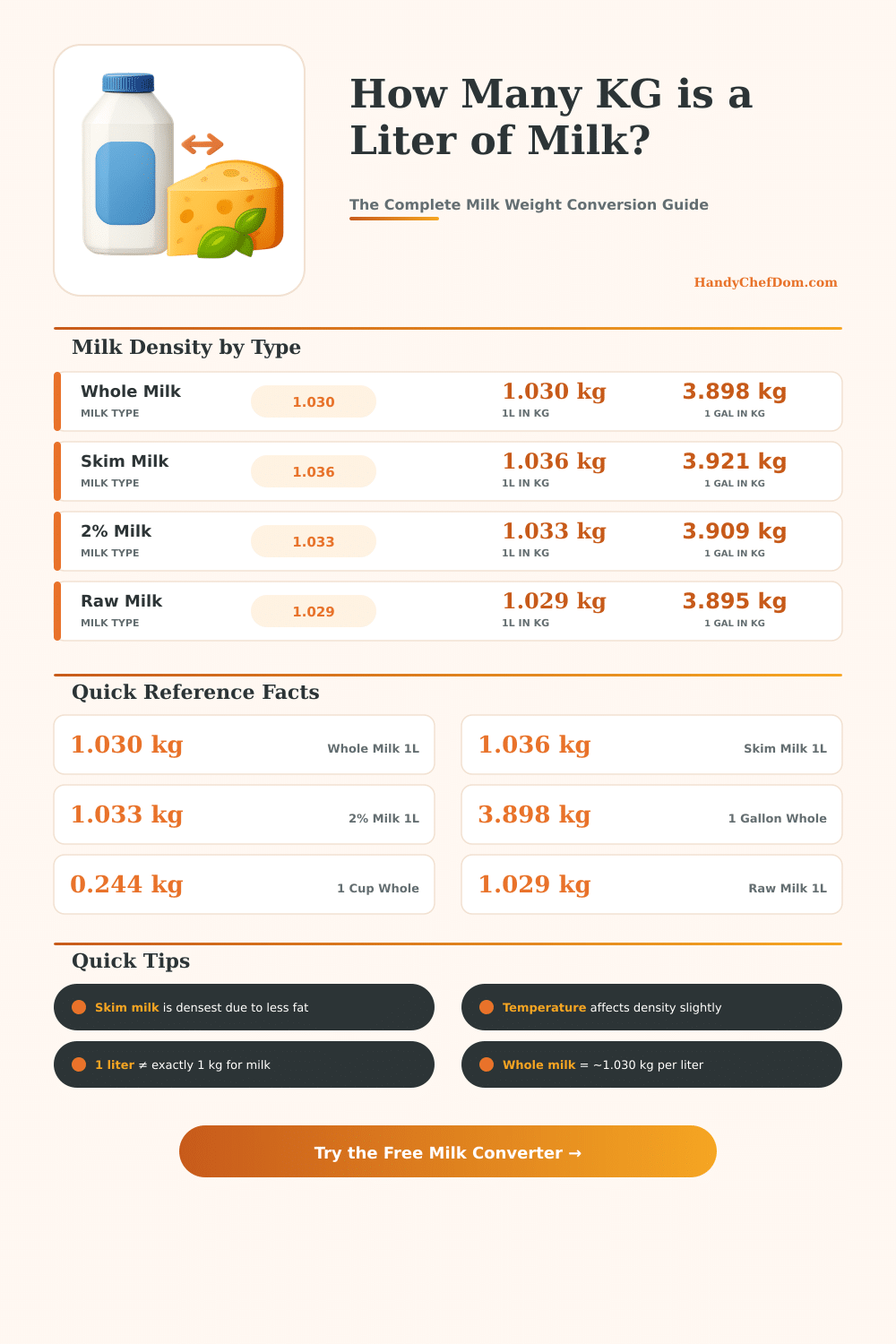
| Milk Type | Density (g/mL) | 1 Liter = KG | 1 Liter = Lbs | 1 US Gallon = KG |
|---|---|---|---|---|
| Whole Milk (3.25%) | 1.030 | 1.030 kg | 2.271 lbs | 3.898 kg |
| 2% Reduced Fat | 1.033 | 1.033 kg | 2.277 lbs | 3.909 kg |
| 1% Low-Fat | 1.034 | 1.034 kg | 2.280 lbs | 3.913 kg |
| Skim / Non-Fat | 1.036 | 1.036 kg | 2.284 lbs | 3.921 kg |
| Raw Milk | 1.029 | 1.029 kg | 2.269 lbs | 3.894 kg |
| Evaporated Milk | 1.066 | 1.066 kg | 2.350 lbs | 4.034 kg |
| Buttermilk | 1.033 | 1.033 kg | 2.277 lbs | 3.909 kg |
| Oat Milk | 1.030 | 1.030 kg | 2.271 lbs | 3.898 kg |
| Almond Milk | 1.020 | 1.020 kg | 2.249 lbs | 3.860 kg |
| Soy Milk | 1.025 | 1.025 kg | 2.260 lbs | 3.879 kg |
| Volume Unit | In Liters | Whole Milk KG | Skim Milk KG |
|---|---|---|---|
| 1 Milliliter (mL) | 0.001 L | 0.00103 kg | 0.00104 kg |
| 1 US Cup (240 mL) | 0.240 L | 0.247 kg | 0.249 kg |
| 1 US Pint (473 mL) | 0.473 L | 0.487 kg | 0.490 kg |
| 1 US Quart (946 mL) | 0.946 L | 0.974 kg | 0.980 kg |
| 1 US Gallon (3.785 L) | 3.785 L | 3.899 kg | 3.921 kg |
| 1 Fluid Ounce (29.6 mL) | 0.0296 L | 0.0305 kg | 0.0307 kg |
| 1 Liter | 1.000 L | 1.030 kg | 1.036 kg |
Milk usually is white liquid food, although it can have shades of yellow, cream, pink or brown. Mammals produce it with their mammary glands. It feeds young children until they can handle solids.
Milk is rich in many nutrients, also calcium. Babies best tolerate breast milk during their digestive organs mature.
Milk: Types, Nutrition and Uses
Among available foods milk belongs to the most versatile, because it gives daily nutrients for good health. One normal ration of 8 ounces milk delivers abundant amounts of thirteen basic nutrients, so it ranks among the densest nutritions. It carries protein, calcium, potassium, phosphorus and iodine, together with vitamins B2 and B12. Milk accompanies us from birth until death.
It has full proteins, fat and carbohydrates, and you easily strengthen or enrich it.
Everyday drinking of milk can give more ruged bones, more fullness, better muscle repair and more efficient hydration. Normal ration is one cup, so around 8 fluid ounces. Adults should not lack 3 cups of milk or alike products daily.
One cup of milk matches one ration.
For babies until 2 years old you advise whole-fat milk. That is the milk like this it spills from the cow, with natural amount of cream. When you remove a bit of cream, you receive low-fat or fat-free milk.
Thin variants however lose more natural nutrients than cow milk has. For help healthy blood sugar, choose milk with low carbohydrates, without added sugar and enough protein.
Non-dairy milks have advantages and disadvantages. Cow and soy milk store a lot of protein, but almond and oat milk little. Coconut milk almost does not have protein.
Lactose-free milk helps those who do not tolerate regular milk. In lactose-free whole milk you simply added the enzyme lactase.
Milk works well in baking work. In bread making you commonly use it instead of water. Some recipes require dried milk powder for better texture.
Try to substitute water partially with milk. For cappuccino or latte you use cold milk, to avoid that it cooks. Milkshake you do mixing two or three scoops of vanilla ice cream with whole milk, that covers the ice cream, and chocolate syrup…
Everything mingles well. Evaporated milk does not match reduced milk, because you do it by means of vacuum in low temperatures, while boiled milk causes protein to clump.
Evaporated milk is not the same as milk reduced on the boiler, because evaporated milk is done with vacuum at low temperatures, while hot milk with heat makes the protein pocket and curdle.