🍺 Beer Cans per Pound Calculator
Estimate beer can count from total weight, can size, material, full or empty status, beer density, residue, and packaging weight.
Use the weight on your scale, choose whether the cans are full, empty, or partly full, then subtract packaging so the count is based on the cans themselves.
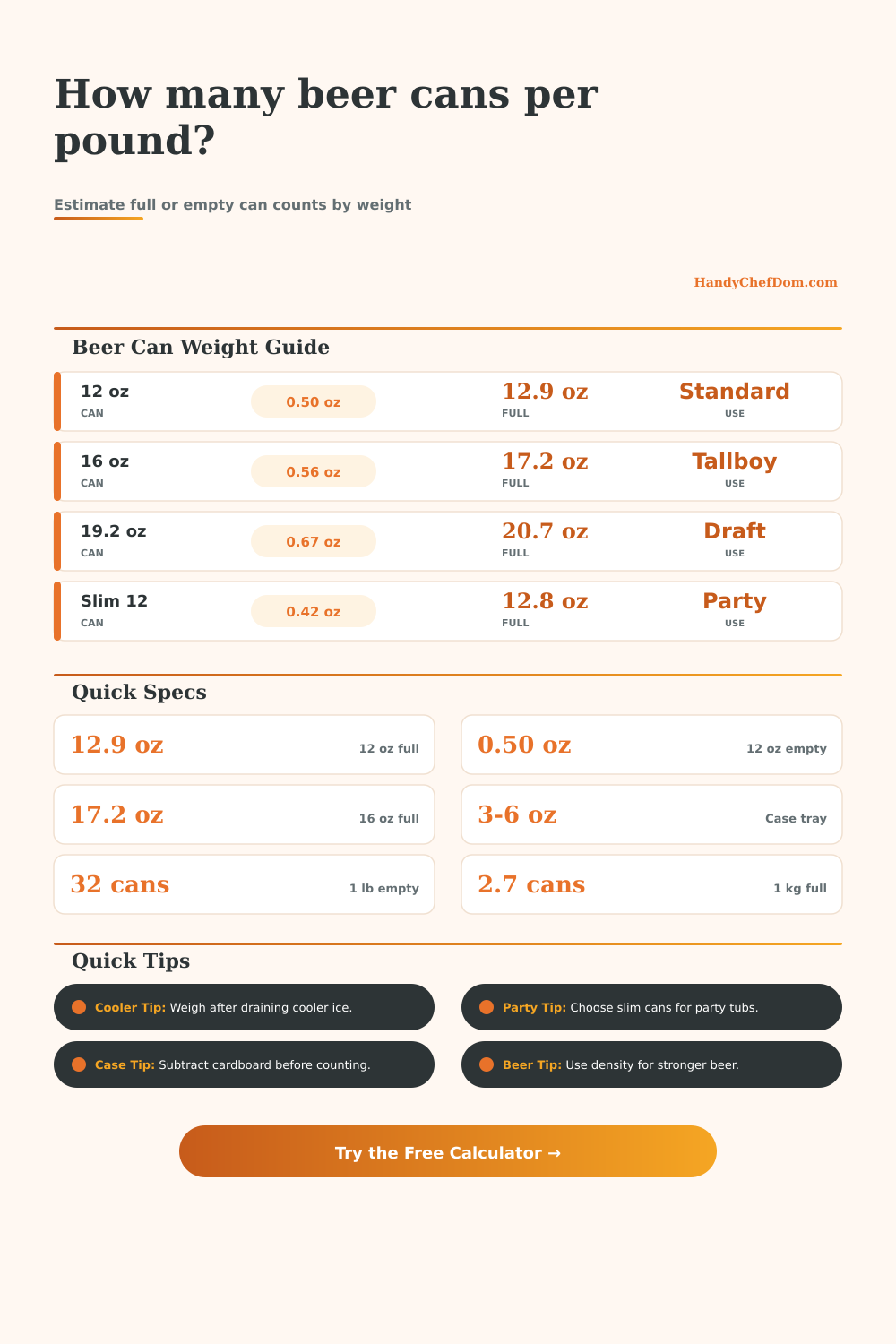
| Beer Can Size | Typical Empty Can | Typical Full Can | Best Use In Calculator |
|---|---|---|---|
| Standard 12 fl oz aluminum | 0.48-0.52 oz | 12.8-13.0 oz | Domestic cases, coolers, recycling bags |
| Slim 12 fl oz aluminum | 0.40-0.45 oz | 12.7-12.9 oz | Party tubs, seltzer-style beers, slim cans |
| Stubby 11.2 fl oz aluminum | 0.48-0.54 oz | 12.0-12.2 oz | Import packs and small-format craft cans |
| Tallboy 16 fl oz aluminum | 0.55-0.62 oz | 17.1-17.3 oz | Craft four-packs and tailgate coolers |
| Import 16.9 fl oz aluminum | 0.58-0.66 oz | 18.0-18.3 oz | Metric 500 ml style cans |
| Stovepipe 19.2 fl oz aluminum | 0.65-0.74 oz | 20.6-20.9 oz | Single-serve venue cans and large coolers |
| Large 24 fl oz aluminum | 0.76-0.88 oz | 25.7-26.0 oz | Big singles, tubs, and mixed party bins |
| Material Or Format | 12 oz Empty Tare | Adjustment Pattern | When To Pick It |
|---|---|---|---|
| Standard aluminum beer can | 0.50 oz | Baseline | Most domestic beer cans and regular packs |
| Lightweight aluminum can | 0.45 oz | Slightly more cans per pound | Modern thin-wall cans and light recycling loads |
| Heavier craft aluminum can | 0.56 oz | Slightly fewer cans per pound | Craft cans, sturdy labels, larger tops |
| Slim aluminum party can | 0.42 oz | More empty cans per pound | Slim coolers, party tubs, seltzer-style formats |
| Steel or tinplate import can | 1.15 oz | Far fewer empties per pound | Older import cans or magnetic cans |
| Mixed recycling bin average | 0.54 oz | Blends dents and sizes | Unsorted bins with tabs, crushed cans, residue |
| Fill State | Liquid Fraction | Added Weight For 12 oz | Counting Note |
|---|---|---|---|
| Full unopened cans | 100% | About 12.5 oz beer | Use for cases, cooler inventory, and sealed packs |
| Empty drained cans | 0% | No beer weight | Use for recycling estimates after draining |
| Rinsed empties | Residue only | 0.01-0.05 oz | Use when cans were rinsed but not dried |
| About 25% remaining | 25% | About 3.1 oz beer | Use for party cleanup with partly full cans |
| About 50% remaining | 50% | About 6.3 oz beer | Use for unfinished table or tub estimates |
| About 75% remaining | 75% | About 9.4 oz beer | Use for nearly full cans after sorting |
| Scenario | What To Weigh | Packaging To Subtract | Expected Range |
|---|---|---|---|
| Empty 12 oz aluminum bag | Bag of drained cans | Bag weight if included | 28-34 cans per lb |
| Full tailgate cooler | Cans after draining ice water | Cooler tare and loose ice | 1.1-1.3 cans per lb |
| Tallboy case weight | Sealed 16 oz four-packs | Tray, wrap, carrier | 0.9-1.0 cans per lb |
| Recycling bin estimate | Bin after removing liquids | Bin tare and liner | 24-32 cans per lb |
| Craft 16 oz pack | Four-pack or case stack | PakTech or carrier | 0.9-0.95 cans per lb |
| Mixed can tub | Sorted tub without ice | Tub tare and cardboard | Depends on size mix |
So here’s your situation: You’ve got a cooler full of cans, you’ve got a big hunk of ice keeping them cold, and you want to know, without tipping out the trickle of melt water, how many beers you’re holding.
Enter physics, and goodbye intuition. The force acting on your scale isn’t just the weight of cardboard carton plus the weight of aluminum plus the weight of some liquid plus the weight of some ice; it’s the fluctuating combo of all those elements fighting for control. And most of us figure a dozen cans must be like any other dozen. But life is much more detailed then that.
How to Count Your Cans by Weight
An empty aluminum shell will tip scale at about half-an-ounce; fill it with a standard 12-ounce can, and that weight go up to roughly 13 ounces. That swing alters everything: Your coolers hold barely a single can per pound whereas your empty recycling bag is stuffed with a dozen, or maybe two dozen?, depending on if you’re thinking light beer vs. Your coolers hold barely a single can per pound, whereas your empty recycling bag holds thirty-two cans per pound.
After plugging in your own variables into the calculator above, it figure out the math so you don’t have to guess between “This heavy bag might hold twenty cans” and “Or maybe it’s got forty.” It’s largely about knowing how much it is you’re weighing.
Most people thinks they’re buying beer when they buy a six-pack. In reality, they are paying for beer but carrying around a lot of extra weight, like cardboard carriers, plastic rings, and trays used to prevent can slippage. All of this add weight without adding flavor. If you don’t subtract that packaging tare from your estimate, you’ll be way off. That’s where this thing comes in: It allows you to enter that additional weight as an adjustment so whatever number comes out on the other end is just the beer, no padding.
Recyclers hope to get every last ounce out of their bins, and tailgaters want to see if they have room for another round. For them, knowing the total weight of a shopping trip isn’t nearly as helpful than knowing the actual weight of all that canned goodness.
Finally, there’s the matter of materials. Most folks don’t think about this too much but regular ol’ aluminum beer cans is designed to be as light as possible: They contain only as much strength as is necessary to maintain shape under pressure and hold product, no more, no less. That means craft cans, with their more complex designs or perhaps thicker walls, tend to have greater tare weights.
There are also those super-skinny cans that is all the rage for party drinks and seltzer-like beverages. Because they use less aluminum per can, they affect the overall per-can average if you throw both into the same bin (i.e., mix a bag of slim cans with a crate of regular domestic). The calculator adjusts for this factor, and lets you choose the format you’re sorting by (it’ll even do steel imports, which weigh much more than aluminum). A pound of steel cans will get you so many units compared to a pound of aluminum, something that throw off plenty of recyclers.
There is also beer density, though it is less obvious and still somewhat important. High-gravity beers like a barleywine or stout will have higher specific gravity (think: thicker) compared to something like a light lager, which hovers around water-specific gravity. In other words, one full can of lager would weigh less than a full can of stout, assuming both are equal in size. A little thing, perhaps, but if precision is your goal then yes, this matters. To account for this, the tool provides style-specific density factors, recognizing that all beer does not weighs equally.
As such, the result isn’t a guess; it’s a calculation built from the physical properties of what you’re measuring.
The last variable is residue. When you take those empty cans out of the recycling bin, they’re not entirely dry. There’s some beer clinging to the inside walls, and it adds fractions of an ounce to weight of every can. This may seem minor, but if you’re dealing with a big bin full of empties, all that residue add up. Recycling in the real world isn’t always squeaky clean. The calculator includes a spot where you can include drip allowance. Your cans aren’t going to be perfectly dry and perfectly clean. Include the residue, and the count reflects actual conditions based off a perfect lab setting.
Ultimately, it’s all about control. Whether you’re trying to plan out a party spread, organize your bar’s inventory, or figure out how many more trips to the recycling center will maximize your profit, it pays to know the weight so that you can avoid any costly mistakes. You should of checked before, but now is fine. It may be a small difference in ounces between two beers, but when you’re talking about cases instead of just individual cans, those numbers add up fast. No more guesswork, now you know. Even if it seems like the cooler should weigh less, the numbers don’t lie.