🍷 Bottles per Boxed Wine Calculator
Convert any boxed wine size into standard bottles, glasses, event servings, and a chilled serving plan.
Enter the box volume, bottle size, pour size, guest count, serving target, and chilled box capacity. Non-drinkers are removed before the buffer is added.
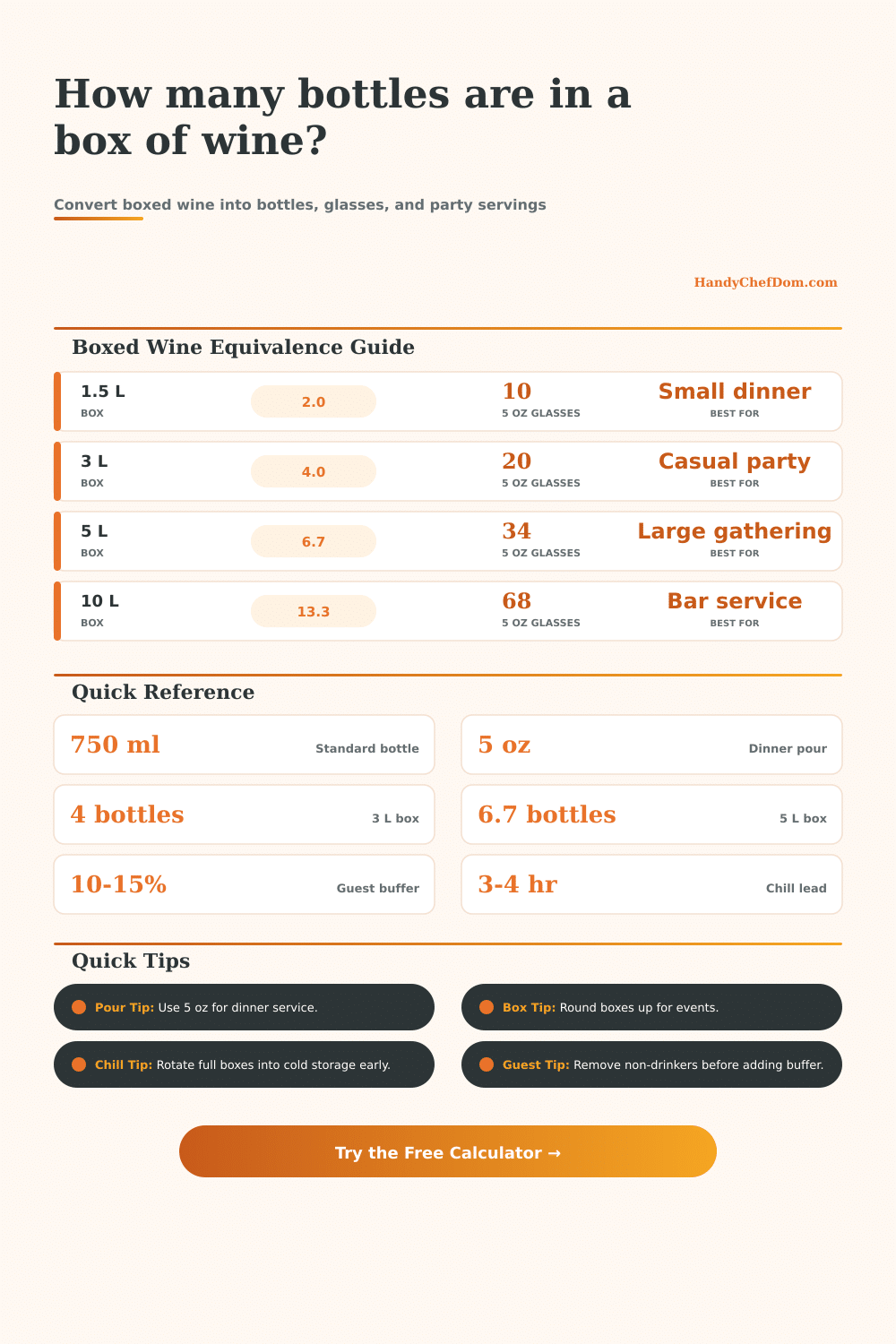
| Box Size | Milliliters | 750 ml Bottles | 5 oz Glasses |
|---|---|---|---|
| 1.5 L | 1500 ml | 2.0 | 10 |
| 3 L | 3000 ml | 4.0 | 20 |
| 5 L | 5000 ml | 6.7 | 34 |
| 10 L | 10000 ml | 13.3 | 68 |
| Pour Size | Use | 3 L Box | 5 L Box |
|---|---|---|---|
| 3 oz | Tasting | 34 pours | 56 pours |
| 4 oz | Light reception | 25 pours | 42 pours |
| 5 oz | Dinner glass | 20 pours | 34 pours |
| 6 oz | Generous pour | 17 pours | 28 pours |
| Volume Conversion | Metric | US Volume | Serving Note |
|---|---|---|---|
| Standard bottle | 750 ml | 25.4 fl oz | About five 5 oz pours |
| Half bottle | 375 ml | 12.7 fl oz | About two to three pours |
| One liter | 1000 ml | 33.8 fl oz | About six to seven pours |
| One gallon | 3785 ml | 128 fl oz | About twenty-five 5 oz pours |
| Chilled Serving Plan | Lead Time | Best Move | Service Note |
|---|---|---|---|
| 1 to 2 boxes | 3 hr | Chill all boxes | Open one at a time |
| 3 to 5 boxes | 4 hr | Chill first wave | Rotate backups in |
| 6 to 9 boxes | 5 hr | Split across coolers | Label red, white, rose |
| 10+ boxes | 6 hr | Stage by service hour | Keep a room temp reserve |
Instead of panicking that you’ll run out of wine during a party, think about wine as fuel instead of some magical thing that will dissapears by magic. The math is simple, but there are plenty of variables to consider. But there are a lot more variables. The good news is the math is straightforward, though.
Boxed wine are a smart choice for big parties. It is not just cheaper per ounce, but it also last longer once opened. Because bag flattens when you pour from it, the wine doesn’t oxidize.
How to Plan Wine for Your Party
You might still find yourself having trouble translating a three-liter box into something that makes sense for your headcount, but with our handy dandy calculator up top, we’ve done math for you. First, how much do you have? What’s size of the wine? And here’s where I think we can all agree: most wine come in standard sizes (most boxes) and a standard 750-milliliter bottle equals about five five-ounce pours. So basically you’ve got four of those in a three liter box. That’s the equivalent, and it’s the number around which you’ll plan.
For a dinner, you’re generally looking at two servings per drinking guest, though if you’re having more of a cocktail hour that sort of runs into dinner, maybe you can stretch that out to three or four. (And yes, you can tweak those numbers, so you don’t need to rely on any one rule of thumb.)
The mistake of forgetting about the non-drinking guests is also fatal to your wine budget. If you don’t remember to take these folks out of the equation, then the buffer percentage doesn’t mean anything; and if you assume that everyone’s a drinker, then you’ll end up buying more than you need. To make sure that you get this right, calculator prompts you for this number first. Then, it uses this percentage to take the non-drinkers out of the denominator and add the buffer/spill margin back in the equation.
The reason this matters? Your buffer rate should be a percentage of actual drinkers. A ten percent buffer on a gross guest count is a waste of money. A ten percent buffer on the drinkers is a safety net.
Finally, there’s temperature: Most hosts don’t think of it until after the wine has come out lukewarm. Rosé and white wine should be served cold, and will not chill fast at room temp. There’s a section on the tool that lets you plan for the amount of space your chiller (be it a refrigerator or a bucket of ice) provides. If you’ve got enough space for only two box, you’ll have to stage the others. Plan for the first wave to go in early and back up with empties when the openers run dry. That way no one’s drinking warm stuff, and you’re not trying to make twenty boxes of wine all chilly in a small apartment fridge at once.
The tables of reference also tells you how much wine comes in each container, so you know exactly what to expect. For instance, a five-liter box holds thirty-four five-ounce pours. Just figure out the flow.
Planning wine is all about managing expectations. You need just enough to ensure everyone gets their share, but not so much that it gets wasted as it flattens on table. Enter the numbers. Know your friends. Will there be a bunch of sippers? Or quick-drinkers? Is this a party or more of a tasting event? Adjust sliders and answer those questions. Then go into your event confident that you have the numbers.
The most effective party plan: no one notices. Guests shouldn’t see math. They should only notice that the wine never ran out.