🍷 Bottles per Wine Case Calculator
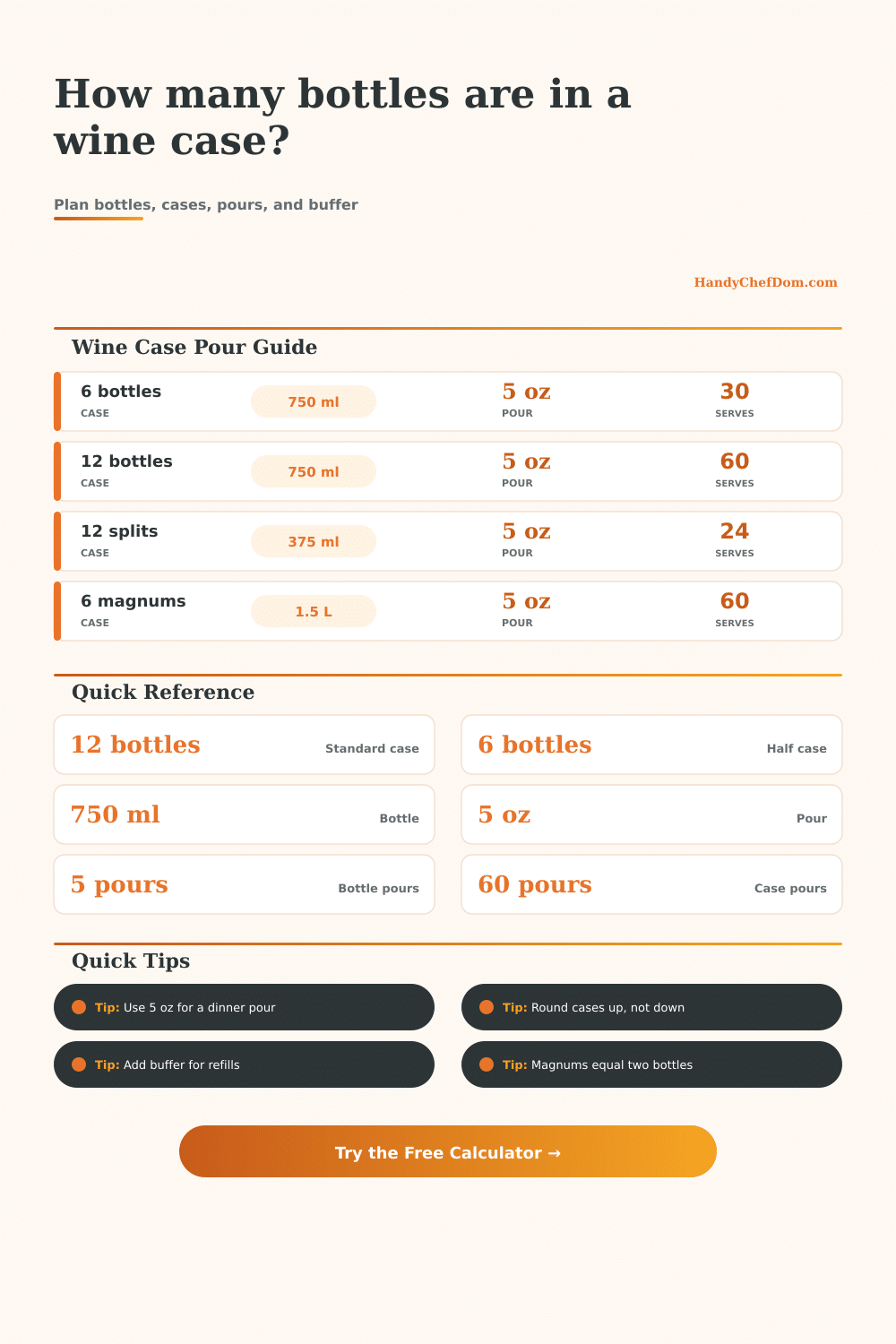
Estimate wine bottles, full cases, pours per bottle, total servings, metric volume, event demand, and buffer from case size, bottle size, pour size, guests, and event duration.
| Bottle Size | Metric Volume | US Fluid Ounces | 5 oz Pours | 12-Bottle Case Pours | Best Use |
|---|---|---|---|---|---|
| Split / Piccolo | 187.5 ml | 6.3 fl oz | 1.3 exact, plan 1 | 15 exact, plan 12 | Single toast or dessert wine. |
| Half Bottle | 375 ml | 12.7 fl oz | 2.5 exact, plan 2 | 30 exact, plan 24 | Small tables and mixed selections. |
| Standard Bottle | 750 ml | 25.4 fl oz | 5.1 exact, plan 5 | 60.9 exact, plan 60 | Default dinner and event planning. |
| Liter Bottle | 1000 ml | 33.8 fl oz | 6.8 exact, plan 6 | 81.2 exact, plan 72 | Larger-format casual service. |
| Magnum | 1500 ml | 50.7 fl oz | 10.1 exact, plan 10 | 121.7 exact, plan 120 | Parties, banquets, and displays. |
| Pour Size | Metric Equivalent | 750 ml Exact Pours | Practical Count | 12-Bottle Case | Use Case |
|---|---|---|---|---|---|
| 2 oz tasting pour | 59 ml | 12.7 pours | 12 pours | 144 pours | Tasting flight or sampling. |
| 3 oz small pour | 89 ml | 8.5 pours | 8 pours | 96 pours | Reception with light glasses. |
| 4 oz modest pour | 118 ml | 6.3 pours | 6 pours | 72 pours | Lunch or controlled service. |
| 5 oz dinner pour | 148 ml | 5.1 pours | 5 pours | 60 pours | Standard wine serving estimate. |
| 6 oz generous pour | 177 ml | 4.2 pours | 4 pours | 48 pours | Casual pours and larger glasses. |
| Event Scenario | Guests | Duration | Pace | Base Pours | 12-Bottle Cases at 5 oz |
|---|---|---|---|---|---|
| Dinner with other drinks | 12 | 3 hours | 0.60/hr | 22 pours | 1 case with buffer |
| Classic dinner party | 24 | 3 hours | 0.75/hr | 54 pours | 2 cases with buffer |
| Reception | 75 | 4 hours | 1.00/hr | 300 pours | 6 cases with buffer |
| Toast service | 120 | 1 hour | 0.25/hr | 30 pours | 1 case with buffer |
| Fundraiser | 200 | 3.5 hours | 0.75/hr | 525 pours | 11 cases with buffer |
| Reference Item | Metric | Imperial | Formula | Planner Note |
|---|---|---|---|---|
| One standard bottle | 750 ml | 25.36 fl oz | 750 / 29.5735 | Used as the default bottle size. |
| One 5 oz pour | 147.87 ml | 5.00 fl oz | 5 x 29.5735 | Common dinner serving size. |
| Servings per 750 ml bottle | 750 / 147.87 | 5.07 pours | Bottle ml / pour ml | Round down to 5 clean pours. |
| One 12-bottle case | 9000 ml | 304.33 fl oz | 12 x 750 ml | About 60 clean 5 oz pours. |
| One magnum | 1500 ml | 50.72 fl oz | 2 x 750 ml | Counts like two standard bottles. |
When you plan your next wedding reception, or dinner party, hosts commit a silent error: they estimate the number of drinks their guests will consume, based off the number of people attending. That’s the point where glasses run empty and budgets start blowing up.
Here’s why; the standard industry assumption is that one 750 milliliter bottle yields exactly five pours at five ounces each. Technicly, though, there are only slightly more than five five-ounce pours in a bottle. If you realy wring the dregs, you can get half a glass more. But you can’t pour that into someone else’s glass.
How to Count Bottles for Your Party
Because planners care about service efficiency, not exact math, they rounds downward to an even five glasses per bottle, or sixty per case. But here’s where the calculator (above) does all the volume math for you, and doesn’t require any mental addition-subtraction-multiplication-division while staring at your watch. First, it ask for some simple data such as pour volume and size of bottle.
If it’s the standard 750 milliliter bottle, most folks will pick that choice; if there are half bottles or magnums at an event, that can realy change the math. Magnums aren’t just bigger bottles. They contains two standard bottles’ worth, or roughly a tenth more by volume than what we’re used to. This makes a difference when considering storage and keeping bottles cold: big ones cool faster, but also warm up slower after being popped open. Choose right format and the tool recalculate the number of pours to match. This ensures your case count represent how much liquid you’ll actualy get in each one instead of simply how many glass container are inside the box.
What most beginning planners struggle with is timing of service pace. Do you plan heavy service at a cocktail party or light sipping at an appetizer hour? A typical pace assume roughly one glass every hour and twenty minutes per guest (for dinners). That’s a lot. Multiply that by a four hour reception. Those are the pace coefficients used in the calculator.
Then, we add on some safety buffer to cover the inevitable live service variables. Someone spills a glass. A late arriving guest want two drinks. The sommelier doesn’t realize he’s overpoured just a bit. Fifteen percent added onto your base calculation accounts for all of these things, without having to hide an emergency case under the table.
So what’s with all those reference tables below breaking out full receptions vs. Tasting flights? Those are meant to show you how pouring size impact the economics of your event. Pouring a taste (two ounces) will get you a dozen servings out of each bottle; and that sounds good until you realize that average guest wants to try multiple types of wine. If each guest tries five bottles, then you’ve offset the “efficiency” gained by using a smaller pour. The reference table can help you visualize the tradeoff.
A small pour may help you serve less liquid during each interaction, but it also tends to result in higher overall consumption as guests sample across a wider range of options. For example, serving a large amount (six ounces) at a relaxed backyard BBQ will only give you four glasses per bottle, though guests generally consume fewer varieties in such a context.
Planners who source wine internationaly (or have automated dispensing machines measured in milliliters) will also find themselves tripped up by metric conversions. The converter is able to smoothly translate between milliliters and fluid ounces, avoiding the pitfalls of mixing measurement systems. For instance, there are about 148 milliliters in one 5 ounce pour. That’s an important link to understand, as bottle volumes are produced using only metric measurements but service remains largely imperial in most places. It can be difference of a few percent throughout a big event if your ordering is underestimated.
Take the total of all the items on that list and round them up to the next whole number (to cover any overages from your buffer), then you have the rounded off quantity of cases that you can bring home. Most places where you buy in bulk do not sell half-cases. For example, most retail or wholesale outlets don’t offer fractional cases either. They’re only doing whole cases. Rounding up guarantees that you’ll have sufficient supply.
You might even get an extra case, which is a nice cushion for when the last few people wants another drink long after the plates were removed from the table. Better to have some surplus stashed away to use later as part of another meal, rather than having it gone before everyone has stopped speaking. With some practical pours and reasonable buffers, what could of been a guess becomes a manageable task.