🍞 Bread Slice Calorie Calculator
Estimate calories, carbs, protein, and fiber by bread type, slice thickness, weight, and toast or sandwich portions.
Use a standard slice size or enter a measured slice weight. Toasting removes water, so calories stay tied to the pre-toast bread weight.
| Bread Type | Standard Slice | Calories | Carbs | Protein | Fiber |
|---|---|---|---|---|---|
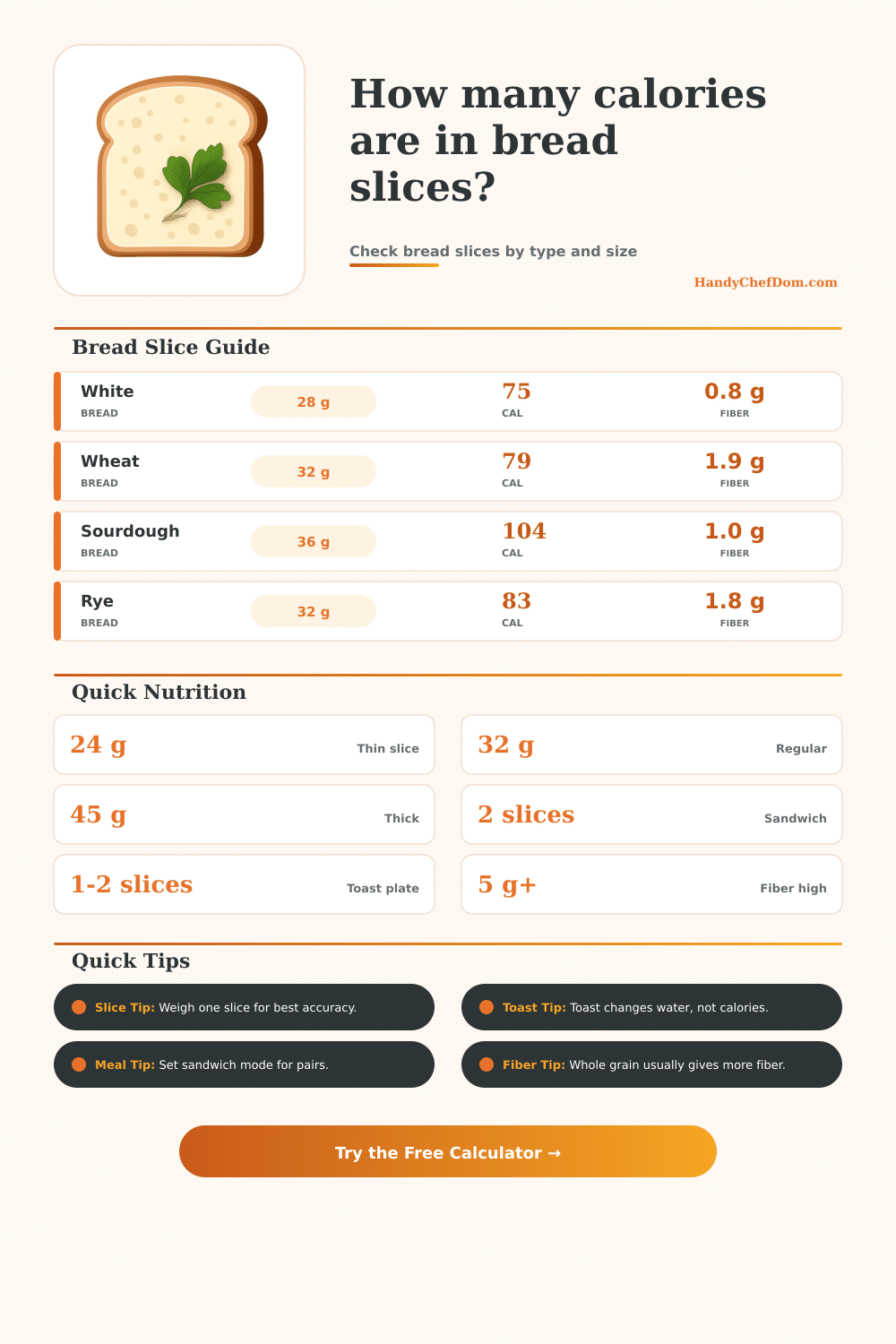
| White sandwich | 28 g | 75 kcal | 13.8 g | 2.5 g | 0.8 g |
| Whole wheat | 32 g | 79 kcal | 13.2 g | 4.1 g | 1.9 g |
| Sourdough | 36 g | 104 kcal | 20.0 g | 4.3 g | 1.0 g |
| Rye | 32 g | 83 kcal | 15.4 g | 2.7 g | 1.8 g |
| Multigrain | 34 g | 93 kcal | 16.1 g | 3.9 g | 2.5 g |
| Baguette | 24 g | 68 kcal | 13.6 g | 2.2 g | 0.6 g |
| Brioche | 38 g | 110 kcal | 18.5 g | 3.1 g | 1.0 g |
| Pita | 60 g | 165 kcal | 33.0 g | 5.5 g | 2.4 g |
| Gluten free | 30 g | 78 kcal | 14.7 g | 1.2 g | 1.1 g |
| Slice Thickness | Weight Factor | Best For | Portion Note |
|---|---|---|---|
| Thin slice | 0.82x | Light toast | Lower calorie slice |
| Regular slice | 1.00x | Everyday sandwiches | Label-style estimate |
| Thick slice | 1.28x | French toast or toast | Heavier single slice |
| Texas toast cut | 1.55x | Large toast plates | Count as generous bread |
| Custom weight | Manual | Bakery slices | Weighed slice overrides |
| Portion Style | Slices | Example Use | Calculator Result |
|---|---|---|---|
| Toast plate | 1 slice | Breakfast toast | Per toast serving |
| Sandwich portions | 2 slices | Classic sandwich | Pairs slices together |
| Half sandwich portions | 1 slice | Lunch half | Shows half portions |
| Side bread portions | 0.5-1 slice | Soup or salad side | Flexible portions |
| Open-face portions | 1 slice | Avocado toast style | Single base slice |
| Bread Type | Calories/100 g | Carbs/100 g | Protein/100 g | Fiber/100 g |
|---|---|---|---|---|
| White sandwich | 266 | 49.4 g | 8.9 g | 2.7 g |
| Whole wheat | 247 | 41.3 g | 12.9 g | 6.0 g |
| Sourdough | 289 | 55.5 g | 12.0 g | 2.8 g |
| Rye | 259 | 48.3 g | 8.5 g | 5.8 g |
| Multigrain | 273 | 47.5 g | 11.4 g | 7.4 g |
| Baguette | 283 | 56.7 g | 9.2 g | 2.5 g |
| Brioche | 290 | 48.7 g | 8.1 g | 2.7 g |
| Pita | 275 | 55.0 g | 9.1 g | 4.0 g |
| Gluten free | 260 | 49.0 g | 4.0 g | 3.5 g |
It feels like a tedious addition to a hectic morning when I has to actualy weigh each slice of bread, but it’s also the best tool against making a guesstimate of my carb consumption. Maybe you think a slice is a slice, whether that slice comes from an artisanal boule shaped by hand at neighborhood bakery or an industrially produced sandwich loaf? If so, you’re mistaken, and the consequences arent small.
A typical white bread slice may provide roughly seventy-five calories (and weigh around twenty-eight grams), whereas a fat, hearty hunk of sourdough could reach one-hundred calories or more (thirty-six-plus grams). It’s not just about flavor and consistency. It is also about calorie content. This will affect your calories if you track macros to maintain weight or improve performance.
Why Weighing Your Bread Helps
After plugging in your own slice setup and bread type, the calculator above figures out all the rest, eliminating the need to fiddle with conversions and coefficients yourself. It factors in things most nutrition labels will never consider: the style of your portion; whether you trimmed any crust; et cetera. If I took the crust off, say, there isn’t much difference in calories, but there’s a small shift in the fiber profile (the bran is more dense around the edges). You can tweak the app for generous bakery cuts versus light trims, understanding that real life doesn’t always fit neatly to a thirty-gram model. That’s what makes it a useful tracker rather than a source of frustration.
There’s also the matter of toast, which is an intuitive failure all of us have at some point: “Oh, I toasted my bread! It shrank down and dried up, so there can’t be many calories in that, right?” Wrong. You just lost water weight; you didn’t subtract any fat or carbs. Calories are bound to the pre-toasted weight of your bread. So when you crunch down on a thick, black hunk of sourdough toast, you’re chewing the exact same amount of energy you started with, back when the bread was squishy in your hand. This can help avoid mistake many people make when they underestimate how much they’ve eaten for breakfast because their food has shrunken down on the plate.
Beyond taste, type of bread matters. Fiber-rich varieties such as whole wheat and multi-grain tend to be digested more slowly, resulting in lower spikes of blood sugar different than processed white varieties. A typical 100-calorie slice of whole wheat have almost twice as much fiber as an equal amount of white bread (about two grams versus fewer than one). The additional fiber bulks up volume without too many extra calories, keeping you full longer. But beware: Not all “brown” breads is made equally. To achieve a rustic appearance, some companies will add caramel color to their bleached flours; always read the label or refer to a trusted estimator tool.
Instead of thinking about macros by individual slices, think in meals. For example, if you’re eating a sandwich, that’s two slices. You just doubled your carb intake right there. There’s a sandwich mode on the calculator where it will pair up the two slices and provide you with a total for all of that meal structure, making it easy to see the full picture rather than getting caught up in the details of each slice individually. That way, if you’re having open faced avocado toast, you might only be using one slice as a base, so you change your input to reflect what you’re really going to eat (so it doesn’t add up into bigger tracking errors).
Sliced bread at the bakery is all over the place. A hand-cut piece of ciabatta or a rustic rye loaf can vary wildly in weight from one end of the board to the other. A slice of simple rye will feel different than a hand-cut ciabatta. That’s when it pays off to use your kitchen scale. Weigh your bread once (or maybe twice) so you have an idea of what your average slice weighs in your own house. After that, you don’t have to weigh every piece forever, but you now have some data to base your estimates on. Guesswork becomes informed approximation.
In the end, it’s all about caloric density and volume of your furnitures. That big fluffy piece could have fewer calories then that small but dense piece. You see the difference? How do we account for that? These products allow you to have information on each type of bread as well as different thicknesses. Whether your meal is complex or your breakfast is simple, you’ll know the exact ingredients in your bread and can make smart choices without losing enjoyment. Knowing is freeing and you’ll confidently enjoy food instead of anxiously consume it. You should of used a scale sooner.