🍭 Frosting per Cake Pops Calculator
Estimate frosting binder for cake crumbs, coating allowance for dipped shells, drizzle or decor add-ons, and servings from crumb weight, pop count, diameter, and moisture.
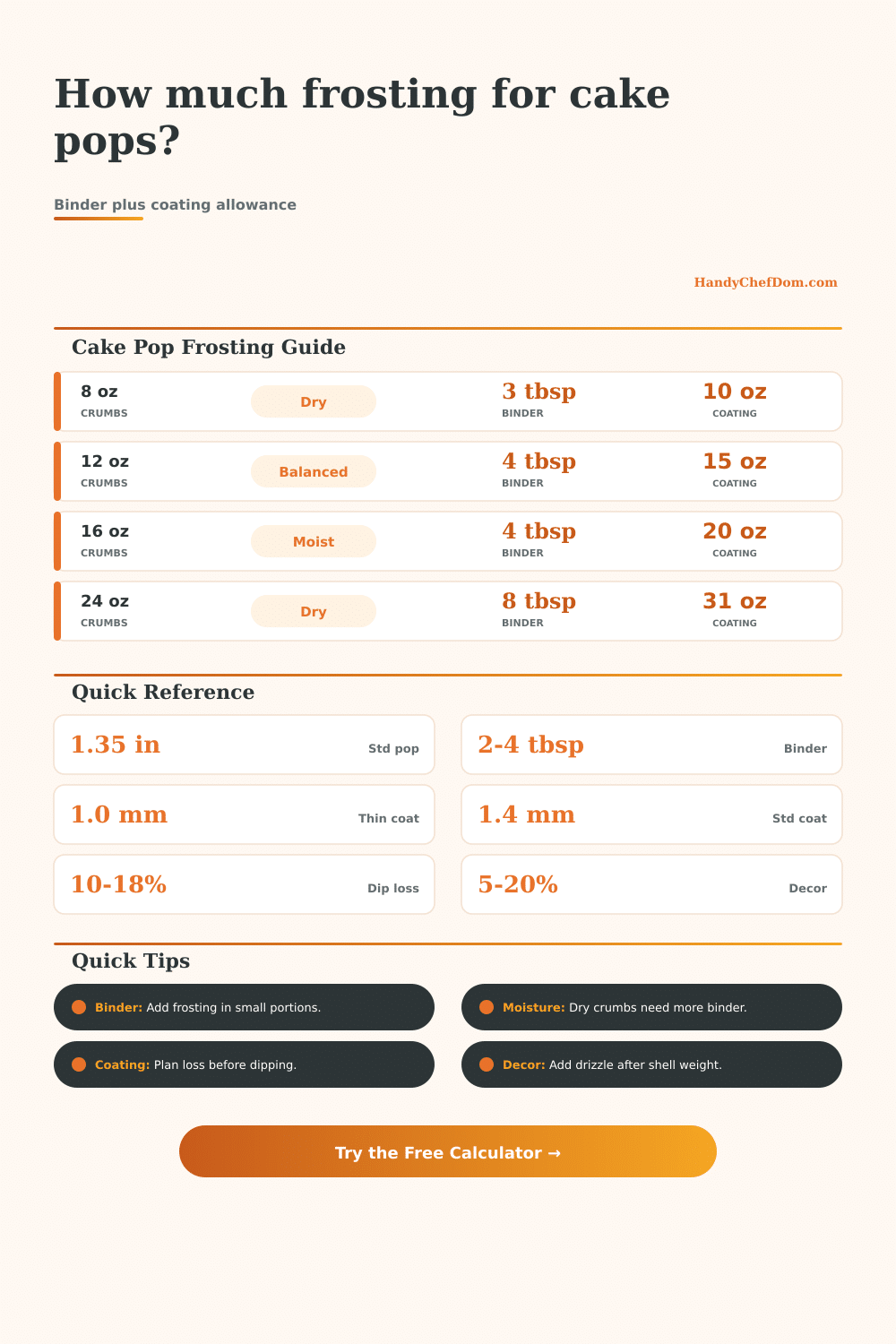
Start with the weighed cake crumbs. The binder estimate adjusts for crumb style, crumb moisture, and frosting type, then the coating estimate adds shell thickness, dip loss, drizzle, and decor allowance.
| Crumb Style | Moisture Read | Binder Per 8 oz | Best Frosting Binder |
|---|---|---|---|
| Vanilla layer cake | Balanced | 2 to 3 tbsp | American buttercream |
| Chocolate cake | Balanced to moist | 2 to 2.8 tbsp | Chocolate buttercream |
| Red velvet cake | Moist | 1.8 to 2.5 tbsp | Cream cheese frosting |
| Light sponge cake | Dry | 3 to 4 tbsp | Swiss buttercream |
| Gluten free cake | Often dry | 3 to 4.5 tbsp | Cream cheese frosting |
| Brownie crumbs | Dense | 0.8 to 1.8 tbsp | Ganache binder |
| Pop Diameter | Thin Shell | Standard Shell | With Decor Add-On |
|---|---|---|---|
| 1.0 inch mini | 0.16 to 0.22 oz | 0.22 to 0.28 oz | Add 5% to 15% |
| 1.25 inch small | 0.26 to 0.34 oz | 0.34 to 0.44 oz | Add 8% to 18% |
| 1.35 inch standard | 0.32 to 0.42 oz | 0.42 to 0.54 oz | Add 10% to 20% |
| 1.5 inch bakery | 0.40 to 0.53 oz | 0.53 to 0.68 oz | Add 10% to 25% |
| 1.75 inch large | 0.55 to 0.75 oz | 0.75 to 0.95 oz | Add 12% to 28% |
| 2.0 inch jumbo | 0.72 to 0.95 oz | 0.95 to 1.22 oz | Add 15% to 30% |
| Conversion | Imperial | Metric | Calculator Use |
|---|---|---|---|
| Cake crumbs | 8 oz | 227 g | Small batch base |
| Frosting binder | 1 tbsp | 15 ml | Add in portions |
| Buttercream weight | 1 tbsp | 14 g | Binder weight check |
| Coating weight | 1 oz | 28.35 g | Melted shell total |
| Pop diameter | 1 inch | 2.54 cm | Size conversion |
| Cup volume | 1 cup | 237 ml | Frosting volume |
| Batch Signal | Binder Move | Coating Move | Tool Check |
|---|---|---|---|
| Crumbs fall apart | Add 10% to 25% | No change | Mixing bowl scraper |
| Crumbs smear | Reduce 15% to 35% | Chill before dip | Sheet pan and liner |
| Pops crack on sticks | Increase binder slightly | Use thinner shell | Cookie scoop |
| Shell feels heavy | No change | Lower thickness | Deep narrow cup |
| Decor is heavy | Use firm target | Add decor percent | Drizzle bag |
| Large transport batch | Use firm target | Add reserve | Foam drying block |
Never run out of coating again when creating your cake pops! Simply enter weight of your crumbs, the style of your cake, and thickness of your dip. It’ll do all the math for you to determine exactly how much frosting binder you need to use to keep it in place. It also calculates how many chocolate or candy melt you need to melt for each pop.
So here’s what you need to know about those variables: First, there’s the binder ratio. Most recipes tells you how many cups of frosting to use per cup of cake. This assumes all bakes behaves the same way, which isn’t true. Moist cakes such as chocolate fudge brownies tend to fall apart if too much fat is added. Meanwhile, a dry vanilla sponge will require more moisture to bind together. To account for this, we allow you to select your crumb style and moisture level.
How the Cake Pop Calculator Works
For example, the calculator know that overbaked or day-old crumbs have lost their steam; it therefore raises required binder amount to match. Under-bonded pops tend to come apart, falling off the stick in a crumble. When you add too much, they’re dense doughy balls that aren’t particularly airy (plus they just taste like frosting). It’s this delicate balance between these two extremes that yield the ideal treat.
Most folks go wrong with coatings. They estimate how much weight they need based off what’s on top. There’s a loss rate during the dip process. You need to account for several things. You must consider coating that clings to the side of your dipping bowl, the amount you drag out on your stick when you remove it from liquid, and the amount you tap off to create a smooth surface.
To do this, the calculator has both a reserve factor and a dip loss percentage. The reserve factor ensures you have enough liquid coating left at the end to give each final pop a full dip rather than just a thin skim. The latter also takes into account decorative and drizzle allowances. If you’re going to use elaborate heavy sprinkle designs, those will adds weight. This weight is not considered by simply figuring surface area.
There’s also a handy table of references on the page that you can use as a sanity check for your inputs. It breaks down range of typical binders for various kinds of cakes, and it shows what size coating you need based off the diameter of your pops. For example, a small mini pop will need far less coating then a big bakery-style sphere. The math isn’t linear because the surface area to volume ratio changes how formula works. Fortunately, the tool accounts for all those geometric details without making you try to visualize sphere volumes in your head.
Depending on whether you’re using imperial or metric units, you can switch back and forth between them. That comes in handy if you’re adapting a British recipe for an American audience, for example, or vice versa.
The input/output process isn’t complete without understanding what comes out. After all, this is the number that tells you how much coating to melt and how much binder to stir up. A high number? Run through calculation again to see if your loss percentage is correct, and make sure your shell thickness isn’t set too high. A thick shell needs more of the stuff and increases the likelihood of cracks if it’s not kept cold enough. A thin one won’t protect as well during travel, but will be forgiving if a few pieces break off. Before you even begin melting that chocolate, calculator makes these trade-offs come alive and allows you to see them. It transforms instinct into information. Do I have enough chocolate (or do I need to purchase an additional bar)? Should I use an extra sprinkle or two (and how will it affect my final yield)?
Cake pops are half art and half science. Temperature matter. Weight matter. Structure matter. The beauty of baking is half art form and half science. The beauty of Cake Pops is entirely science. This is why removing the guessing game from the preparation process allows us more time to enjoy what comes next: the decoration.
Nobody wants to turn into a math whiz, they just want their cakes to taste good and for their hard work not to go to waste by being stuck with a half-batch of partially baked cakes. A prepped out batch will result in perfectly coated cakes. No cake goes uncloaked. Everyone gets a fair chance at some frosting, and nobody ends up with a bare belly.
The best kind of cake is a batch that starts as crumbs and finishes as a thing that stays intact throughout the whole eating experience. From first to last bite, the cake stay connected by the binder, and pretty as a picture thanks to the coating.