🧈 Butter in a Cup Calculator
Convert butter cups into tablespoons, sticks, grams, ounces, and butterfat while adjusting for melted, solid, whipped, or clarified measuring styles.
Use cups as the anchor or enter another butter measure. The calculator normalizes the amount, applies recipe scaling and bowl loss, then reports the cup measure in the selected butter state.
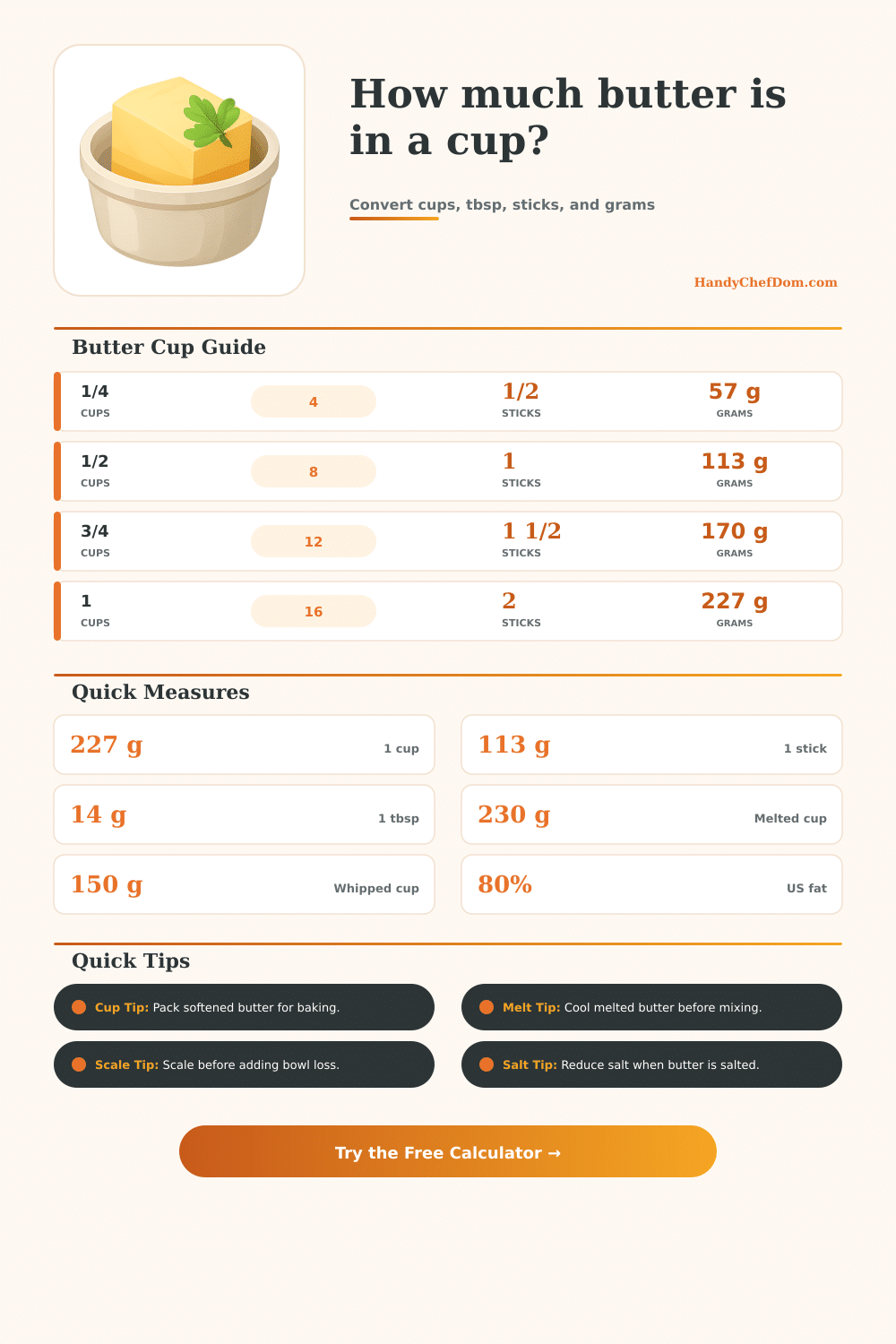
| Cup Amount | Tablespoons | Sticks | Grams |
|---|---|---|---|
| 1/8 cup | 2 tbsp | 1/4 stick | 28 g |
| 1/4 cup | 4 tbsp | 1/2 stick | 57 g |
| 1/3 cup | 5 1/3 tbsp | 2/3 stick | 76 g |
| 1/2 cup | 8 tbsp | 1 stick | 113 g |
| 2/3 cup | 10 2/3 tbsp | 1 1/3 sticks | 151 g |
| 3/4 cup | 12 tbsp | 1 1/2 sticks | 170 g |
| 1 cup | 16 tbsp | 2 sticks | 227 g |
| Measure Style | g per Cup | Best For | Use Note |
|---|---|---|---|
| Solid packed | 227 g | Most baking | Level the cup |
| Melted pour | 230 g | Brownies | Cool first |
| Softened level | 225 g | Cakes | Press lightly |
| Cold cubed | 205 g | Pie dough | Air gaps count |
| Whipped butter | 150 g | Spreads | Less weight |
| Clarified | 218 g | Sauces | Water removed |
| Recipe Scale | 1/2 Cup Becomes | 1 Cup Becomes | 2 Cups Become |
|---|---|---|---|
| Half batch | 1/4 cup | 1/2 cup | 1 cup |
| 1.5 times | 3/4 cup | 1 1/2 cups | 3 cups |
| Double batch | 1 cup | 2 cups | 4 cups |
| Triple batch | 1 1/2 cups | 3 cups | 6 cups |
| Party batch | 2 1/2 cups | 5 cups | 10 cups |
| Test batch | 2 tbsp | 1/4 cup | 1/2 cup |
| Butterfat Style | Fat % | Fat in 1 Cup | Kitchen Note |
|---|---|---|---|
| US unsalted | 80% | 182 g | Standard baking |
| US salted | 80% | 182 g | Reduce salt |
| European | 82% | 186 g | Richer doughs |
| High-fat baking | 83% | 188 g | Firm texture |
| Browned finish | 84% | 191 g | Less water |
| Ghee | 99% | 225 g | Pure fat feel |
Conversions use the common US butter standard: 1 cup equals 16 tablespoons, 2 sticks, 8 ounces, or about 227 grams. Cup-style weights are practical kitchen estimates.
Butter is ingredient that requires precise measurements because the physical state of the butter can change the total volume and weight of the butter that is to be used in a given recipe. For instance, the amount of butter that fill a cup will differ based off the temperature of the butter. A cup of cold, cubed butter will contain more air gaps than a cup of melted butter.
Therefore, the weight of the butter will be different for each type of butter based upon its different density. Thus, a person must account for the type of butter that will be used in the recipe in order to ensure accuracy of the recipe. The calculator will ask for information about the butter to be used in the recipe.
How to Measure Butter for Baking
For instance, the person will have to select a measuring style; solid butter and liquid butter has different weights. Additionally, the person will have to select a butterfat style; European style butter contain more fat than American butter; therefore, it will impact the baking good that is produced. Additionally, if a person will use salted butter, the person will have to use the salt mode because the salt will impact the amount of salt that is contain in the end product.
If a person does not account for this in the recipe, they may find that the final product contain too much salt. The physical state of the butter will impact the texture of the baked good that is produced. For instance, if the butter is creamed, it will contain air bubbles.
Those air bubbles helps the baked good to rise. If the butter is melted, the air bubbles will dissapear, and it will coat the protein in the flour. The role setting in the calculator asks for the role that the butter will play in the baking good; this will determine what physical process will be perform in the butter.
Additionally, the overage percentage determine the portion of butter that is lost in the butter bowl or butter wrapper; this is important to take into account when baking recipes that are to be prepared in larger amount than the original recipe. There are various mistake that may be committed when using butter in recipes. For instance, a person may assume that a cup of cold butter is the same then a cup of softened butter; however, because the density of the two type of butter is different, the weights will be different.
Thus, the type of butter will impact the texture of the baked good. In addition to this, a person may not account for the fact that salted butter contains salt. Thus, if a person does not account for the salt that is contained in the butter in the recipe, the baked good may end up being too salty.
The calculator allows a person to see each of these variables in the recipe; thus, a person can decide whether a person should of use unsalted butter instead of salted butter. Another factor in the calculation of butter for a recipe is the temperature of the butter. Butter that will remain cold will help to create layer in the pastry.
Butter at a room temperature will easily incorporate with other ingredient in the recipe. Melted butter is used in certain recipes, like brownies. However, if the butter is too cold, it can cause the chocolate to seize.
Another feature within the calculator is the portion count feature. This feature will allow a person to determine how much butter to use in each serving of the recipe. This feature is helpful for those who are preparing meal or recipes for multiple people.
For instance, if a person would like to double or halve a recipe, the portion count will help a person to ensure that the recipe maintain the same consistency. By using the calculator to determine the amount of butter that is needed for the recipe, a person ensures that the recipe contains the correct amount of butter by weight and volume. Finally, by understanding each of the different type of butter and the physical state in which a person will use it, a person can ensure that it will create the desired result within the baking good.