🍗 Buttermilk for Fried Chicken Calculator
Estimate buttermilk cups, quarts, salt grams, hot sauce, egg addition, soak timing, and dredge balance for fried chicken batches.
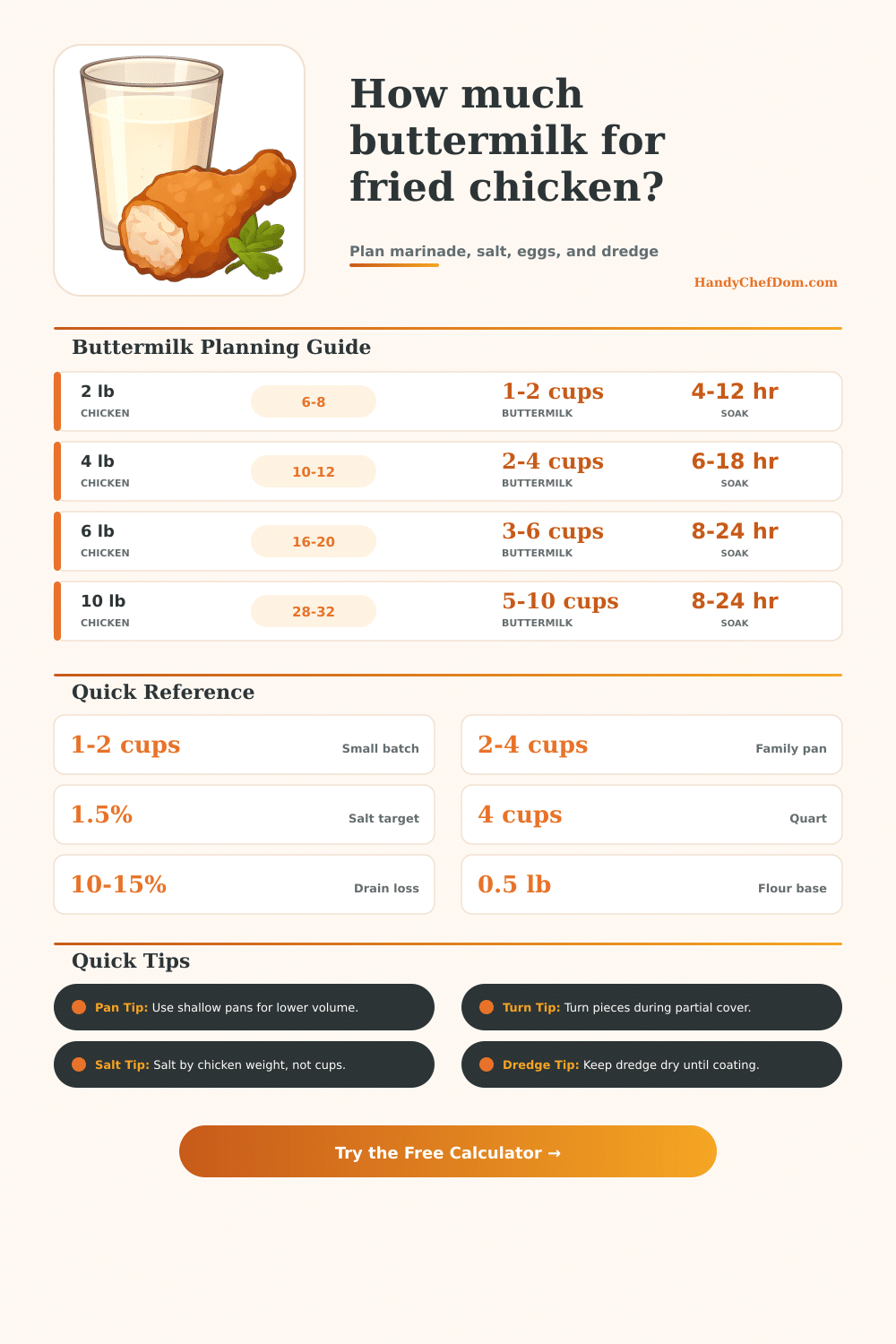
Use enough buttermilk to surround the chicken. A shallow pan may need about 1 cup per 2 lb for partial coverage, while full coverage can approach 2 cups per 2 lb.
| Chicken cut | Typical weight | Pieces per lb | Serving planning |
|---|---|---|---|
| Bone-in thighs | 5 to 7 oz each | 2 to 3 | 1 to 2 pieces |
| Drumsticks | 4 to 5 oz each | 3 to 4 | 2 pieces |
| Split breasts | 10 to 14 oz each | 1 to 2 | 1 piece |
| Whole wings | 3 to 4 oz each | 4 to 5 | 4 to 6 pieces |
| Tenders | 1.5 to 2 oz each | 8 to 10 | 4 to 6 pieces |
| Mixed fryer | 3 to 8 oz each | 2 to 4 | 2 to 3 pieces |
| Coverage level | Buttermilk per lb | Best container | Planning note |
|---|---|---|---|
| Light coat | 0.50 cup | Zip bag | Turn pieces often |
| Partial cover | 0.65 cup | Shallow pan | Good default |
| Mostly covered | 0.85 cup | Wide pan | Less turning |
| Fully covered | 1.00 cup | Tight tub | More buttermilk |
| Deep bowl | 1.10 cups | Bowl | Needs extra depth |
| Pressed bag | 0.45 cup | Zip bag | Lowest volume |
| Chicken style | Short soak | Balanced soak | Upper limit |
|---|---|---|---|
| Bone-in pieces | 4 hours | 8 to 18 hours | 24 hours |
| Boneless thighs | 2 hours | 4 to 12 hours | 18 hours |
| Tenders | 1 hour | 2 to 6 hours | 8 hours |
| Wings | 2 hours | 4 to 12 hours | 18 hours |
| Large breasts | 4 hours | 8 to 16 hours | 24 hours |
| Heavily salted | 1 hour | 2 to 8 hours | 12 hours |
| Dredge style | Flour per lb chicken | For 4 lb chicken | Use case |
|---|---|---|---|
| Thin seasoned flour | 0.20 lb | 0.8 lb | Light crust |
| Single dredge | 0.28 lb | 1.1 lb | Classic crust |
| Double dredge | 0.38 lb | 1.5 lb | Thicker crust |
| Craggy coating | 0.45 lb | 1.8 lb | Extra texture |
| Wings | 0.24 lb | 1.0 lb | Small pieces |
| Tenders | 0.32 lb | 1.3 lb | More surface |
Frying chicken for a crowd presents an odd problem. The question that trips people up isn’t the seasoning or the oil temperature. Nor even an oil-temperature problem: those are easy. What’s tricky is knowing how much buttermilk to add.
Add too little and meat gets dry. Add too much and you’re wasting it. The liquid does double duty: it helps loosen surface so the flour will stick, and it carries salt into the meat. Get volume of liquid wrong, and both tasks is ruined.
How to Brine Chicken for Frying
Salt is measured by feel (not weight) for most home cooks, but it makes a big difference. For example, if your chicken weigh X pounds, you want roughly 1½ percent of its weight in salt. This achieves a solid amount of seasoning that doesn’t make the meat chalky.
Enter your desired salt-to-chicken ratio and total pounds on the calculator, and it’ll do the math for you. It will even factor in a drainage allowance so you don’t come up short at the end once the pieces has been slicked with marinade.
It turns out that container shape matters far more than I thought. Pieces stacked in a deep bowl require more liquid then a zip bag spread flat (which covers a wider surface). To make up for this, the tool’s coverage selector takes into account these differences and prevents you from guessing whether partial coverage will cover all sides.
For example, turning the chicken a time or two during the soak help when the level is low. But ultimately, the fix are matching the suggested volume to the container.
There are two risks in the soaking time. Less than 4 hrs and the salt won’t have enough time to do its thing. More than 24 hrs and things start to get soft in a way that no amount of dredging can hide. Piece size and salt level will adjust this safe range. That’s why the tool makes a note based off how many hours you plan to let it rest.
A heavy salting of the batch lets you dial down the soaking time without hurting taste. Large pieces with a light brining benefit from more soak time. But there are still small changes to be made, such as hot sauce and eggs.
Adding a few tablespoons of hot sauce will add some acid that brightens the finished dish, but too much can raise the liquid above what you’d expect. Same with adding an egg per three pounds of chicken, this is plenty of protein to help in setting the crust without overwhelming the marinade. To account for this, the calculator considers these tablespoons as part of the overall volume instead of an afterthought.
This leaves only one thing: dredging plans. How many passes do you want to make (one vs. Do you want a double-dredged option for added crunch? double-dredged for added crunch)? You’ll scale accordingly. Depending on how much flour you have compared to the surface area, the calculator will let you know if it’s time to add another half cup and remove the chicken from its bath; otherwise, there’s no place left for that final piece but in a sopping-wet bowl.
Planning is just a way to get things done. It’s a way to eliminate the brainpower needed for calculation, which frees you up to think about chicken. After figuring out your ratios, times and volumes, everything else falls into place easy. Salt goes in, the crust sticks, and the meal gets plopped onto your plate with all the desired chewiness.
It should of been simple. You will recieve the best results when you follow these steps naturaly for a luxurios meal.