Buttermilk Substitute Calculator
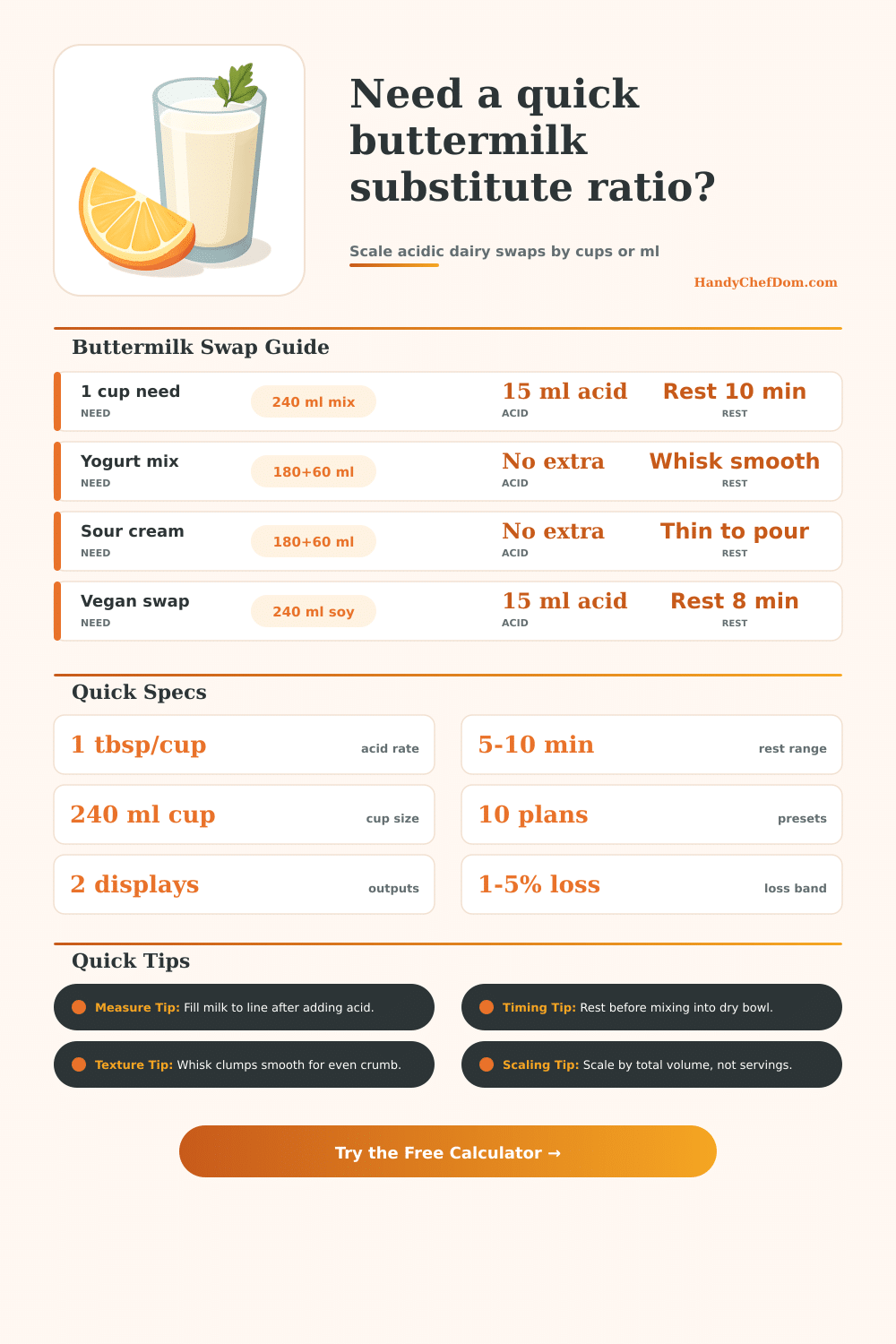
Scale buttermilk replacements by volume, substitute profile, tang target, and thickness so your batter and dough hydration stay predictable across small bakes and large prep runs.
| Profile | Per cup blend | Rest target | Best fit |
|---|---|---|---|
| Milk + lemon juice | 225 ml milk + 15 ml lemon | 8 to 10 min | Cakes and muffins |
| Milk + white vinegar | 225 ml milk + 15 ml vinegar | 8 to 10 min | Biscuits and pancakes |
| Yogurt + water | 180 ml yogurt + 60 ml water | 2 to 3 min whisk | Dense batters |
| Sour cream + water | 180 ml sour cream + 60 ml water | 2 to 3 min whisk | Rich quick breads |
| Plain kefir | 240 ml kefir | No wait | Pourable batters |
| Cream of tartar + milk | 240 ml milk + 4 g tartar | 5 to 6 min | Low liquid acid use |
| Evaporated milk blend | 120 ml evap + 105 ml water + 15 ml acid | 8 to 10 min | Pantry backup |
| Soy milk + lemon | 225 ml soy + 15 ml lemon | 7 to 9 min | Dairy free baking |
| Batch target | Total ml | Acid ml | Base ml |
|---|---|---|---|
| Pancakes for 4 | 360 | 22.5 | 337.5 |
| Waffle prep | 480 | 30 | 450 |
| Biscuits tray | 600 | 37.5 | 562.5 |
| Sheet cake | 720 | 45 | 675 |
| Two loaf pans | 900 | 56.25 | 843.75 |
| Catering prep | 1440 | 90 | 1350 |
When you find that buttermilk is gone from your kitchen and you need to find an alternative for your baking recipes, the problem isnt the buttermilk itself, but the acidity that come from the buttermilk. The acidity plays a vital role in baking by reacting with baking powder or baking soda to produce the lift and tenderness that your baked goods needs. To make it easier to manage acidity and volume, you can use a buttermilk substitute calculator.
This calculator allow you to control the acidity and volume of your buttermilk substitute so that it will work correct in the recipe. To use a buttermilk substitute calculator, you will have to input several value. You must enter the amount of buttermilk you require, the type of base you will use with an acid, and the level of tang or sourness that the final baked good should contain.
How to Use a Buttermilk Substitute Calculator
Each base will contain a different thickness and protein content. The acid will determine the rate at which the chemical reaction between the acid and base occur. Mixing milk with lemon juice will give a different result then a mixture of yogurt and water, even if the two mixtures has the same volume.
The calculator will account for this variable so that you dont have to guess at the measurements of acid and base to create your buttermilk substitute. The level of tang that your baked goods will contain will depend on the recipe. A delicate cake will require a more milder tang than biscuits that require a sharper taste to develop the right texture when baked.
The buttermilk substitute calculator will account for this variable. If you do not account for the level of tang the recipe require, your baked goods may end up too dense. This could be the result of the chemical reaction between the base and acid never reaching the strength that the recipe requires.
The thickness of the buttermilk substitute will also have to be accounted for in the recipe. Some baked goods will require a liquid that is much thinner than others. The buttermilk substitute calculator will account for this by allowing you to set the thickness of the buttermilk substitute.
This will determine how much water or base you must add to the buttermilk substitute to reach the necessary thickness. Maintaining the correct thickness is essential for your baked goods to react according to the proportions of other ingredients. Another variable to consider when making a buttermilk substitute is the rest time the buttermilk substitute will need to rest.
Most buttermilk substitute will require some minutes of rest time for the buttermilk to curdle and for the flavors to develop. The buttermilk substitute calculator will include the recommended rest time based on the profile of buttermilk substitute you choose. Skipping the rest time may result in the buttermilk concentrate not curdling correct and baking to have strange spots of browning in the baked good.
Batch size is another variable to account for with your buttermilk substitute. Some batches may require smaller amount of buttermilk substitute than others. This relates directly to the loss of buttermilk substitute that remains in the container when you pour it into your mixing bowl.
The container loss will allow the buttermilk substitute calculator to include a buffer for the loss of buttermilk substitute that will occur in your container. The larger the batch of baked goods you are making, the more greater the container loss will become. If you do not account for container loss, you may not have enough buttermilk substitute for your recipe.
The reference tables will show you the amount of buttermilk substitute of each type that you will need to prepare your baked goods. These tables allow you to view the different batch sizes and the volume of buttermilk substitute that you will need of each type. A tray of biscuits will require a different amount of buttermilk substitute than a sheet cake.
The principles regarding the tang and thickness of the buttermilk will be the same for both baked goods, however. Using these tables will allow you to decide whether to use the buttermilk substitute that you have in your refrigerator or whether you need to make a new batch. Many people make the mistake of thinking that any buttermilk substitute can be used in place of buttermilk in a recipe, as long as the volumes are balanced.
This is not true because different types of bases will have different amounts of acidity that will need to be balanced. For example, plain kefir will require a different amount of acid than evaporated milk. The buttermilk substitute calculator will account for this by changing the proportions of the buttermilk substitute automatically.
You must decide on the type of base that you will use, but the buttermilk substitute calculator will adjust the measurements to ensure that the buttermilk will behave according to the requirements of the recipe. For those who follow a vegan diet, there are some buttermilk substitute that you can use. Soy milk and lemon juice will create a tang that will work well in a recipe for quick breads.
However, the protein structure in soy milk will be different than the protein structure in dairy milk. This may impact the baking of the goods. However, adjusting the tang level will account for this difference in protein structure.
The temperature to which you heat your buttermilk substitute will also impact the chemical reaction that occurs when the buttermilk is made. Curdling will take place at a different rate if the buttermilk is cold as opposed to if the buttermilk is at room temperature. Using warm buttermilk will speed up the chemical reaction.
The buttermilk substitute calculator will account for the temperature of the buttermilk substitute by allowing you to set this value for your recipe. Overall, using a buttermilk substitute calculator will allow you to have consistency in your baking. You can use different bases in place of buttermilk substitute.
However, once you understand the variables and the measurements that is required for each type of buttermilk substitute, you can swap bases. The use of the buttermilk substitute calculator will remove guesswork from your baking recipe by providing you with the measurements. The relationship between the acid, the base, and the volume of the buttermilk will remain the same, even if you increase the batch size of the recipe.
Using the buttermilk substitute calculator will ensure that the buttermilk that you use will behave in the same way that the recipe that call for buttermilk would behave.