Vegetable Intake Calculator
Pick a daily profile, match your prep style, and turn vegetable goals into real kitchen quantities with rounded buy amounts, portions, and nutrition cues.
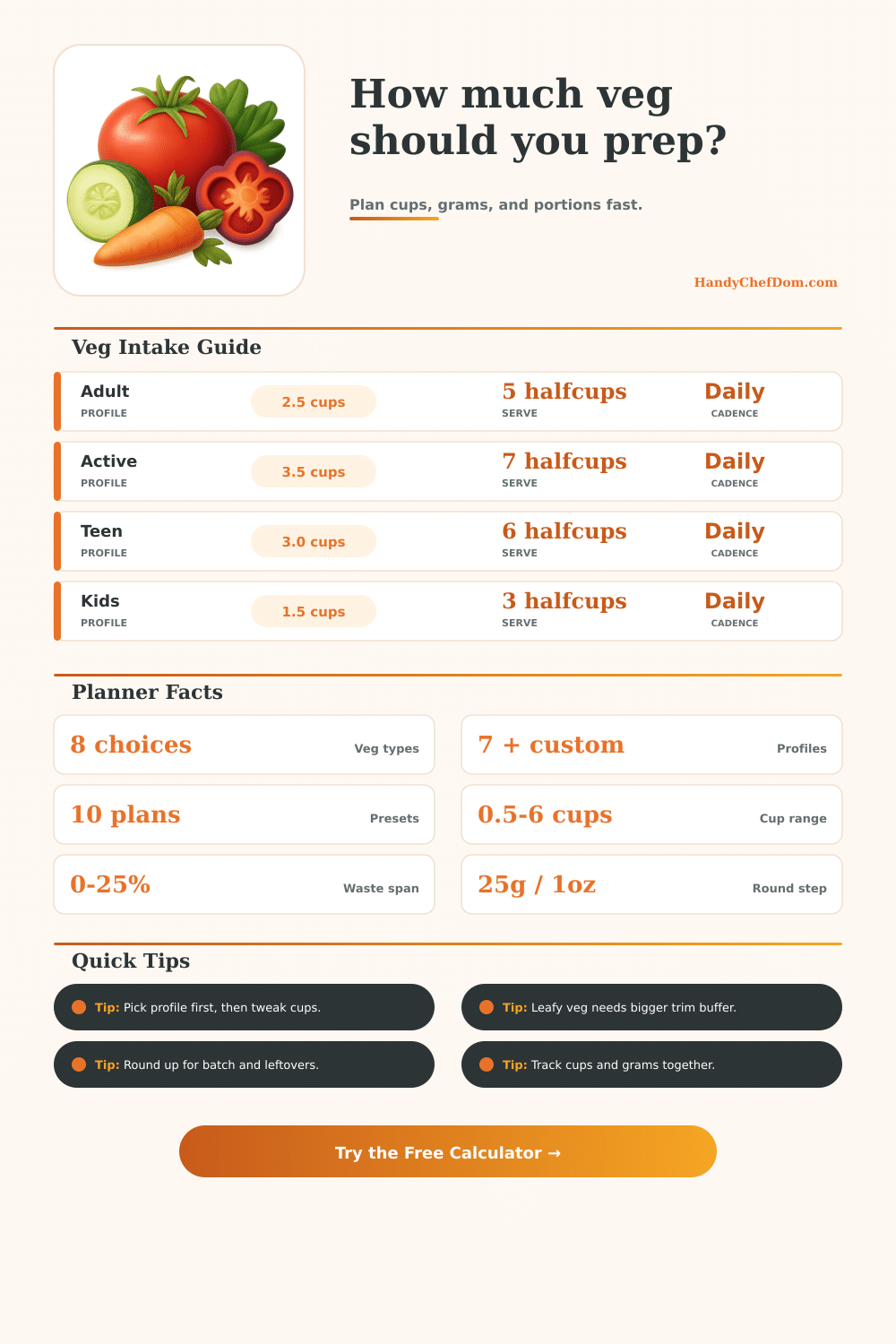
📌Preset Intake Plans
⚙Calculator Inputs
Start from a profile, then adjust people, days, meal coverage, vegetable type, and prep settings. The calculator returns a rounded buy quantity and edible cup target you can actually execute.
Vegetable intake snapshot
Rounded buy amount, edible cups, serving count, and fiber estimate from your exact planning inputs.
📊Serving Size Cues
📑Reference Tables
| Vegetable | 1 Cup (g) | Half Cup | Calories |
|---|---|---|---|
| Broccoli | 91 g | 45 g | 31 kcal |
| Spinach | 30 g | 15 g | 7 kcal |
| Carrot | 128 g | 64 g | 52 kcal |
| Bell pepper | 149 g | 75 g | 46 kcal |
| Cauliflower | 107 g | 54 g | 29 kcal |
| Green beans | 125 g | 63 g | 39 kcal |
| Zucchini | 124 g | 62 g | 21 kcal |
| Kale | 67 g | 34 g | 33 kcal |
| Group Plan | Cups/day | 7 Day Cups | Half Cup Serves |
|---|---|---|---|
| 1 person x balanced | 2.5 | 17.5 | 35 |
| 2 people x balanced | 5 | 35 | 70 |
| 4 people x balanced | 10 | 70 | 140 |
| 6 people x active | 21 | 147 | 294 |
| 12 people x event | 30 | 210 | 420 |
🧪Nutrition Snapshot Per Cup
💡Practical Tips
Planning for vegetables are the process of calculating an number of vegetables that you need to purchase in order to serve each member of your household the apropiate amount of vegetables. Many individuals who plan there vegetable consumption utilize the concept of the “daily cup” target for vegetables. The daily cup target, however, does not account for the weight of the vegetables that is lose during preparation and cooking of those vegetables.
As a result, it is necesary for individuals to calculate the weight of the vegetables that they plan to serve to their household members, calculating a number that is more greater than the weight of the vegetables that will be served to those members. Steps in the preparation of vegetables often remove vegetable components that are not edible by the human body. For instance, in order to prepare a carrot for eating by an individual, an individual may peel the carrot in order to remove the carrot skin.
How to Plan and Buy the Right Amount of Vegetables
Similarly, an individual must trim broccoli stalks before it is prepared for human consumption. These steps reduces the weight of the edible vegetable portions of the vegetable. Additionally, the cooking step for vegetables often removes some of the weight of the vegetable due to the loss of the vegetables moisture during the cooking process.
Vegetables that are roasted or stir-fried, for instance, will lose some of their moisture during the cooking process. As a result, the preparation and cooking of the vegetable changes the weight of the vegetable that an individual can consume. Thus, the vegetable calculator is a necesary tool for determining the weight of vegetables that should be purchased.
The vegetable calculator is a tool that is used to determine the correct amount of vegetables that should be purchased for the household. The calculator require the individual to input the number of people that live in the household, the number of days for which the vegetables are to be purchased, the appetite level of the individuals in the household, the activity factor of the individuals in the household, the preparation method for the vegetables, and the cooking method for the vegetables. Each of these factors is consider in the calculation of the weight of vegetables that should be purchased.
Individual vegetables contain different amount of grams of edible vegetables per cup of that vegetable. Vegetables like carrots and broccoli are more dense than vegetables like lettuce and kale, for instance; a cup of carrots will weigh more than a cup of lettuce. The calculator considers these differences in vegetables in determining the amount of each type of vegetable that should be purchased for the household.
Additionally, each cooking method will alter the amount of vegeta
First, the vegetable yield factor is use to allow the calculator to show the edible cups of vegetables after they are cooked. If you do not account for the yield factor, you may either underbuy vegetables for cooked meals or you may overbuy vegetables for raw salads. You can also adjust for waste, buffers, and leftovers in the calculator.
Buffers are needed to account for the case where each person at a buffet must be provide for. Leftovers indicate the need for an additional purchase of vegetables if the leftover vegetables are to be eaten on a different day altogether. These can be adjusted to specific percentage of vegetables that are wasted or left over from meals.
The results of the calculator use half-cup unit of measurement as many vegetable tracking systems use half-cups of vegetables to count the vegetable intake of an individual. For example, one cup of cooked broccoli contains two half-cups of vegetables. Furthermore, the calculator accounts for leafy vegetables differently as they compress during the cooking process.
The calculator also calculates the fiber and nutrients of the vegetables. However, these estimates are only approximate figure. For instance, if the vegetable selection is changed, the fiber and nutrient counts will change along with the edible cup count.
Some of the most common mistakes with this calculator include not accounting for the yield factor, treating the cup goal as a fixed number, and not rounding the calculated figures to the nearest practical unit of vegetables to purchase. The calculator will round the vegetables that must be purchased to the nearest practical unit so that individuals dont purchase less vegetables than the calculator determine they should buy. The best way to use the calculator is to compare the different vegetables and cooking methods.
By comparing the vegetables and cooking methods, individuals can determine the best way to prepare the vegetables without either overbuying them or underbuying them. Thus, the calculator is most effective if individuals consider their vegetable goal to be a changing number depending upon the cooking and eating method that they use.