🌭 Carbohydrates per Hot Dogs Calculator
Build a plate, tray, or snack count with frank, bun, topping, chili, condiment, serving, fiber, and adjustment options.
Choose each part of the hot dog build. Carbs use typical label-style estimates per hot dog, then multiply by quantity, servings, and your adjustment.
| Hot Dog Type | Total Carb | Fiber | Best Fit |
|---|---|---|---|
| Classic beef frank | 2 g | 0 g | Ballpark plates |
| Pork and beef frank | 2 g | 0 g | Cookout trays |
| Turkey hot dog | 3 g | 0 g | Lighter lunch |
| Chicken hot dog | 2 g | 0 g | Family meals |
| Veggie hot dog | 8 g | 2 g | Plant based |
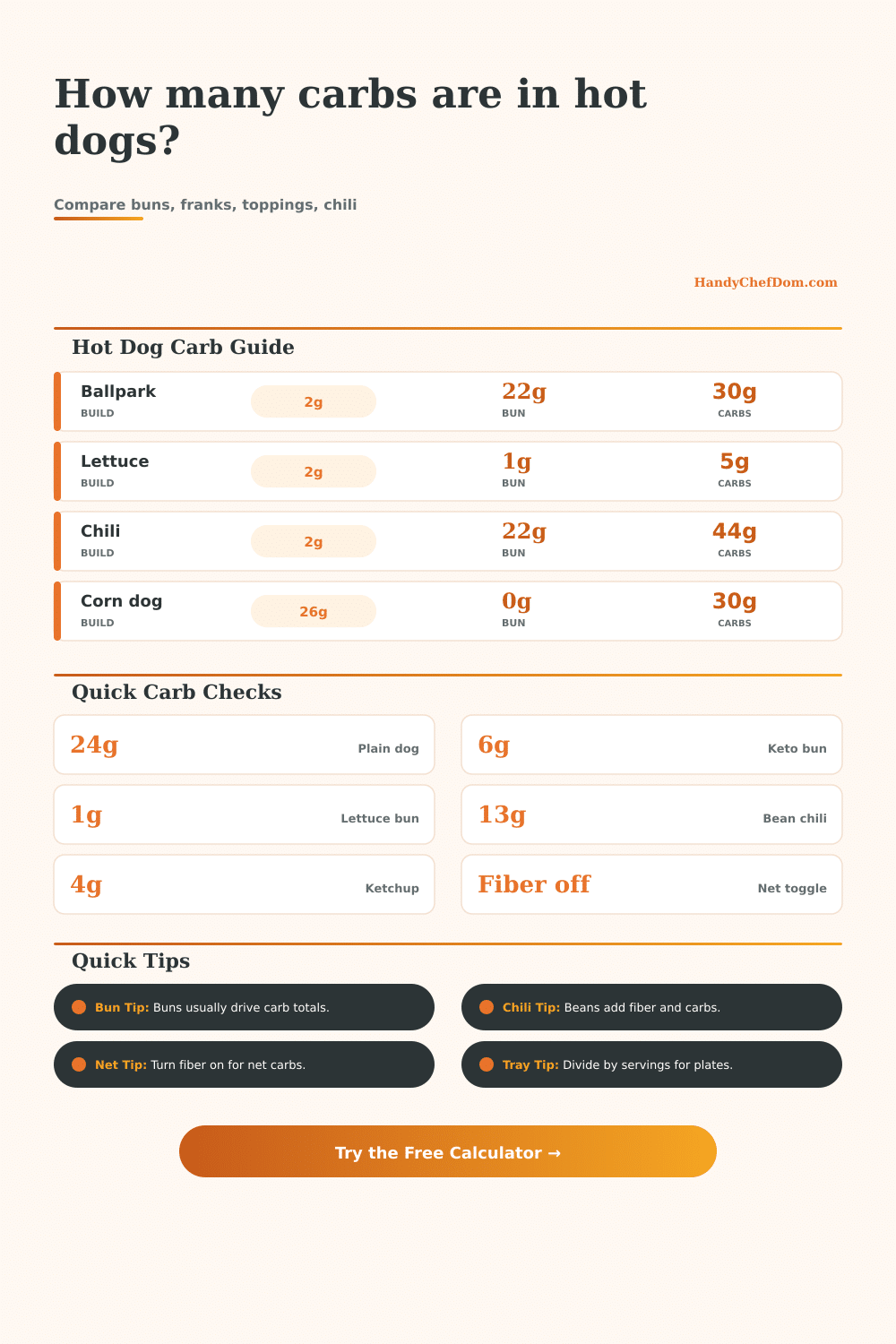
| Corn dog with coating | 26 g | 1 g | Snack plates |
| Bun Type | Total Carb | Fiber | Swap Note |
|---|---|---|---|
| Regular white bun | 22 g | 1 g | Classic base |
| Potato hot dog bun | 25 g | 1 g | Softer bite |
| Whole wheat bun | 21 g | 3 g | Higher fiber |
| Low carb keto bun | 6 g | 5 g | Net-carb cut |
| Lettuce wrap | 1 g | 1 g | Bunless feel |
| Pretzel bun | 28 g | 2 g | Stadium style |
| Add-On | Total Carb | Fiber | Portion Used |
|---|---|---|---|
| Sweet relish | 5 g | 0 g | 1 tbsp |
| Diced onions | 2 g | 0.3 g | 2 tbsp |
| Sauerkraut scoop | 1 g | 0.5 g | 2 tbsp |
| Cheese slice | 1 g | 0 g | 1 slice |
| Meat chili spoon | 5 g | 1 g | 2 tbsp |
| Bean chili scoop | 13 g | 4 g | 1/4 cup |
| Build | Frank | Bun | Approx Total |
|---|---|---|---|
| Plain ballpark dog | Beef | White | 24 g |
| Low carb lettuce dog | Beef | Lettuce | 3 g |
| Turkey ketchup dog | Turkey | White | 29 g |
| Chili cheese dog | Beef | White | 44 g |
| Veggie wheat dog | Veggie | Wheat | 31 g |
| Pretzel BBQ dog | Brat | Pretzel | 40 g |
Reference values are practical estimates for typical labeled portions. For medical meal planning, use the exact nutrition label for the brand and serving size on your package.
To illustrate, I’ve built a carb calculator (above) that will show how various ingredients impact carbohydrate in your meal. Why does this matter? Because they are based off tradeoffs we make in the real world, for example, swapping a lettuce wrap for a keto bun alters the numbers. Adding some bean chili add fiber which decreases net carbs but increases total carbs. A tool like this allow you to visualize those changes without needing to do math by hand.
It also breaks out components, letting you know what’s really important (does BBQ sauce realy matter?) versus what might be adding noise to your data. What’s it measuring? That’s the first question. On label, there’s a set number for total carbs; net carbs, on the other hand, reflect an estimate of how your body may digest it. Why? Because fiber delay absorption (thus lowering the sugar spike), so you get that more useful picture for most diet if you subtract it out.
How to Count Carbs in Your Hot Dogs
But brands differ: They guess at amount based on their method of preparing or growing. For example, a veggie dog might claim eight grams of carbs but offer two gram of fiber, resulting in a lower net impact than a lean beef frank with a sugary bun. When you turn the net toggle on, the calculator account for those differences, so you can directly compare a chili-cheese-loaded dog next to a plain one in a fair way.
The carb savings from switching out the kind of frankfurter (beef vs. Chicken vs. Turkey) is minimal here. Chicken vs. Turkey) is minimal here. There’s a much bigger saving when it comes to the bread. For example, a standard white roll has fewer carbs then a pretzel bun. A potato bun? It are typically somewhere between those two. Multiply this by however many people you’re feeding, and you’ll start to see the impact.
No one will notice the few extra gram of carbs on their own plate, but if you feed them all pretzel buns rather than regular buns, you’ve added a ton of carbohydrate to the overall meal. That’s what makes looking at the split for the bun interesting. It shows you where the majority of the carbs hide… Typically not where you might expect.
You might also be surprised by toppings. Onions and sauerkraut tend to add very little carbohydrate and tons of flavor. Sweet relish, however, is straight-up sugar in disguise. Ketchup is the same. A teaspoon or two doesn’t sound like much, but pile it all over your dogs at a picnic, and those teaspoons translate into dozens of grams of carbs across the board.
To adjust for heavy hands, we’ve included an option for adjusting for generous portions. This will come in handy when planning events that require fewer exact measurements, but rather just something to keep things within a sensible range. Another thing to notice is fiber. Yes, Bean chili contains lots of carbs, but it also has plenty of fiber. That’s going to reduce the final impact relative to the total carb count.
In fact, depending on what your goal is, the bean chili could end up being better than a thin meat chili with a sugary ketchup base, all things considered, if you’re strict on your net carbs. On the page, the reference tables does a good job of laying out how fiber reduces some of the carbohydrate load for some ingredients. It’s not huge, but details like this matter when you’re operating under a tight limit.
If you think about it, hot dogs is a versatile food: they can fit most diets. The ingredients are what make them interesting. Begin by examining the bun. That’s the base line. Next, examine the sauces and other toppings, which will tip the scale. Run the scenarios through the calculator ahead of time; don’t fire up the grill or bring home the groceries until you’ve run the numbers.
You do not need to be a nutritionist; you can simply be someone who wants to see some of the details. Next time you’re standing in front of the cooler, you’ll understand exactly what drives the number, and you’ll be able to choose based on both your taste preferences and your goals. It shouldn’t of hurt to make a better decision for yourself, and the math is easy.