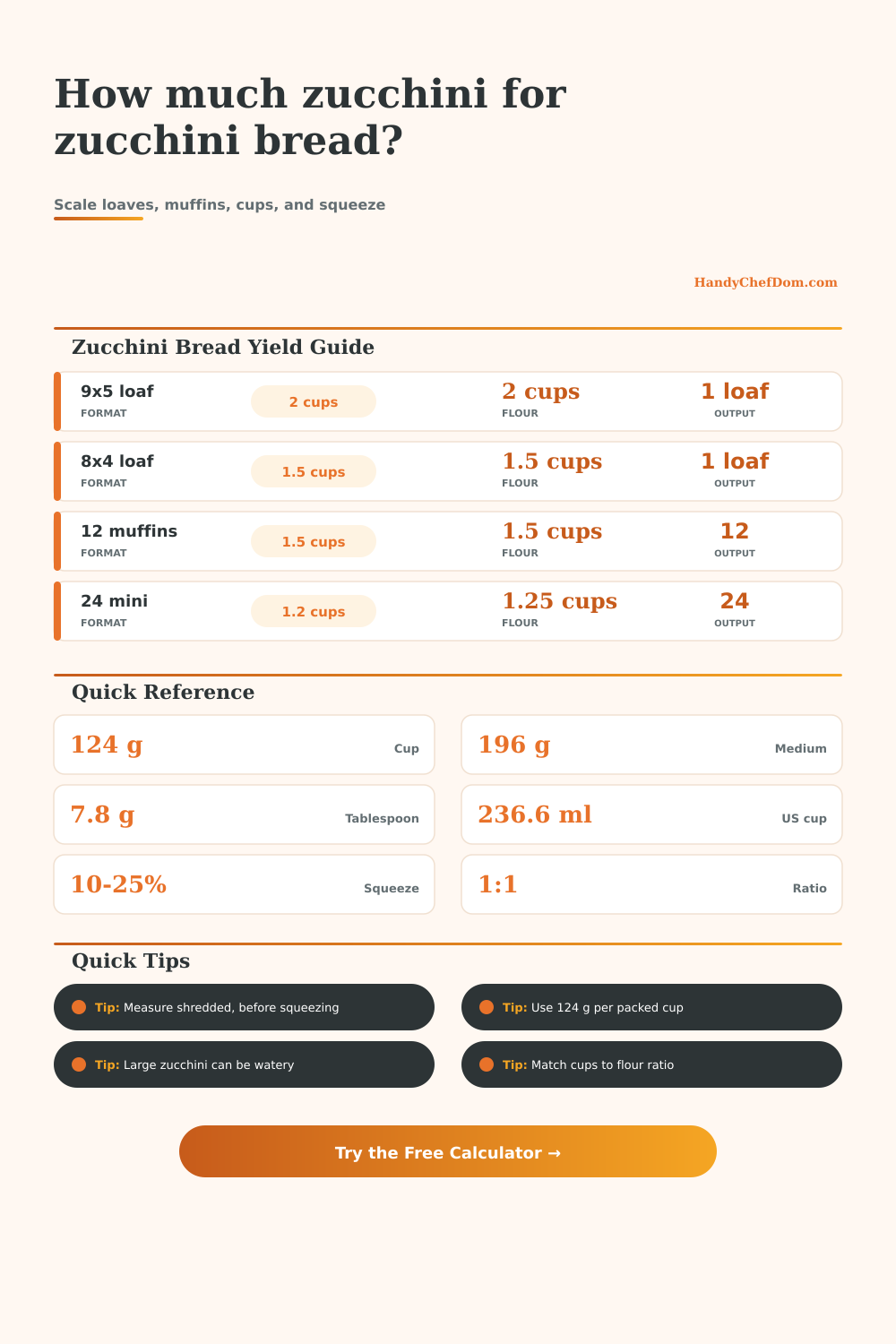
Zucchini for Zucchini Bread Calculator
Scale shredded zucchini for loaves, muffins, mini pans, squeeze loss, cup yield, zucchini size, and flour ratio
| Zucchini Size | Typical Weight | Shredded Cups | Best Use in Calculator |
|---|---|---|---|
| Baby zucchini | 55 g / 1.9 oz | About 0.4 cup | Small garden pieces |
| Small zucchini | 118 g / 4.2 oz | About 1 cup | Small loaf or muffins |
| Medium zucchini | 196 g / 6.9 oz | About 1.6 cups | Default USDA-style serving size |
| Farmstand zucchini | 275 g / 9.7 oz | About 2.2 cups | Mixed homegrown zucchini |
| Large zucchini | 323 g / 11.4 oz | About 2.6 cups | Moist bread batches |
| Extra large zucchini | 450 g / 15.9 oz | About 3.6 cups | Big garden zucchini |
| Format | Flour Baseline | Zucchini at 1:1 Ratio | Approx Output |
|---|---|---|---|
| 9×5 inch loaf pan | 2 cups flour | 2 cups zucchini | 1 large loaf / 12 slices |
| 8.5×4.5 inch loaf pan | 1.75 cups flour | 1.75 cups zucchini | 1 medium loaf / 10 slices |
| 8×4 inch loaf pan | 1.5 cups flour | 1.5 cups zucchini | 1 smaller loaf / 10 slices |
| Mini loaf pan | 0.75 cup flour | 0.75 cup zucchini | 1 mini loaf / 4 slices |
| Standard muffin pan | 1.5 cups flour | 1.5 cups zucchini | 12 muffins |
| Mini muffin pan | 1.25 cups flour | 1.25 cups zucchini | 24 mini muffins |
| Jumbo muffin pan | 1.5 cups flour | 1.5 cups zucchini | 6 jumbo muffins |
| 10-cup bundt pan | 3 cups flour | 3 cups zucchini | 1 bundt / 16 slices |
| Measure | US Volume | Standard Shred Weight | Calculator Use |
|---|---|---|---|
| 1 tablespoon | 14.8 ml | 7.8 g | Small adjustment |
| 1/4 cup | 59.1 ml | 31 g | Light ratio change |
| 1/2 cup | 118.3 ml | 62 g | Mini loaf add-in |
| 3/4 cup | 177.4 ml | 93 g | Mini loaf baseline |
| 1 cup | 236.6 ml | 124 g | Default shredded cup |
| 2 cups | 473.2 ml | 248 g | Large loaf baseline |
| Ratio Setting | Zucchini per Flour Cup | Use When | Example for 2 Cups Flour |
|---|---|---|---|
| Light | 0.75 cup | Less visible zucchini | 1.5 cups zucchini |
| Balanced | 0.9 cup | Moderate moisture | 1.8 cups zucchini |
| Classic | 1 cup | Common zucchini bread target | 2 cups zucchini |
| Moist | 1.15 cups | Softer crumb planning | 2.3 cups zucchini |
| Veggie-forward | 1.3 cups | High-zucchini batches | 2.6 cups zucchini |
| Scenario | Format | Count | Flour | After Squeeze | Fresh at 15% | Medium Zucchini |
|---|---|---|---|---|---|---|
| Weeknight loaf | 9×5 loaf | 1 | 2 cups | 2 cups | 2.35 cups | 1.5 |
| Small pans | 8×4 loaf | 2 | 3 cups | 3 cups | 3.53 cups | 2.2 |
| Muffin tray | Standard | 1 | 1.5 cups | 1.5 cups | 1.76 cups | 1.1 |
| Lunch boxes | Standard | 2 | 3 cups | 3 cups | 3.53 cups | 2.2 |
| Mini muffins | Mini | 1 | 1.25 cups | 1.25 cups | 1.47 cups | 0.9 |
| Gift loaves | Mini loaf | 4 | 3 cups | 3 cups | 3.53 cups | 2.2 |
| Jumbo pan | Jumbo | 1 | 1.5 cups | 1.5 cups | 1.76 cups | 1.1 |
| Bundt batch | 10-cup bundt | 1 | 3 cups | 3 cups | 3.53 cups | 2.2 |
Summer zucchini comes in a flood all at once. There are often too many vegetable for their use. It’s hard to plan if you don’t know what “a cup” of zucchini looks like, since the garden yields whole heavy veggie forms and recipes calls for measured amounts in cups. Before you start cooking, you want to get a sense of how moisture and other factors affects the volume and weight.
For example, most home bakers eyeball amount of shredded zucchini they need. This works for a small batch, but it is not good when you are scaling up for a crowd or down for yourself. Will two medium veggies be two cups or three? That’s where the calculator comes into play; it does the math for you so you don’t have to guess-guess.
How to Measure Zucchini for Baking
It assumes a medium zucchini yield roughly 1.6 cups when shredded. This base number is important because big seed-laden types has more water. So when a single large veggie weighs close to 450g (almost twice as heavy as a small one) and that density changes with every shift in size, it all comes down to volume. You might end up with wet, gummy bread or dry, crumbly loaves if you don’t take into account the change in density. The difference is how much water you accidently left in the dough.
The other half, though, is moisture management. When you cut up shredded zucchini, it lets go of water quickly. There is a loss setting on the tool that allow you to guesstimate what percentage of moisture you removed before mixing. If you want a really tender, moist bread, maybe only squeeze out 10 percent of moisture? For something with a firmer crumb that maintains form well, perhaps try for 25 percent loss? That makes a huge difference in terms of how much raw veggie you will start with and therefore how much you’ll have at the end (when you’re going for the same volume).
Most folks do not account for this correctly; they measure after squeezing, thinking amount will be the same as volume stated in the recipe before draining. The flour ratio plays a subtle role. In addition, it also quietly considers the ratio of flour to vegetables. For example, with classic zucchini bread, most recipes follows a one-cup-to-one-cup ratio: one cup flour to one cup zucchini (i.e., one cup of zucchini to one cup of flour). You can adjust that ratio on the calculator so that some batches is more vegetable-forward and others have more flour.
Depending on whether you’re making whole wheat loaves (which absorb more liquid than all purpose), you may want to go a little higher on the zucchini side to ensure the crumb stays soft. Or perhaps you’re making loaves with chocolate chips or nuts, which add both fat and bulk; in this case you’d want to back off a bit on the vegetable, just enough so things holds together. In practice, these tradeoffs seem easy to understand; it’s difficult to put them into numbers without a frame of reference.
Another problem for casual bakers is packaging density. A firmly packed cup of grated zucchini will weigh significantly heavier than a loosely grated cup of the same amount. Depending on how tightly you pack the item, there may be as much as 20+ grams different between two cups. When making big batches, that makes a big difference. You want to make sure you’re calculating weights based off how you measure things. Baking isn’t an exercise in approximation; it’s chemistry so pick the right packing setting.
And as muffins versus loaves go, think about what happens when you scale up the volume but change the surface area. A thicker loaf takes less time to dry out than mini muffins do. A stiffer batter may require changing amount of oil or adjusting the squeeze settings to match. The tool estimates the flour requirement based on the number and size of pans used. This helps you understand results because it doesn’t just give you a number; it shows that number within the context of the rest of the recipe.
The point is to know what’s going into the bowl. And once everything else is doing its thing, you don’t want one ingredient taking over the show. For example, zucchini should add some moisture and flavor, not more, and certainly not less, but it shouldn’t take over the texture. Weighing your fruits and vegetables is one way to take the guessing out of the process from garden to kitchen; another is by sticking to a standard of cups for every ingredient.
That’s what good scaling looks like. Good bread rises up evenly, is easy to slice, and tastes like summer (not like a water balloon). You should of used it more often.