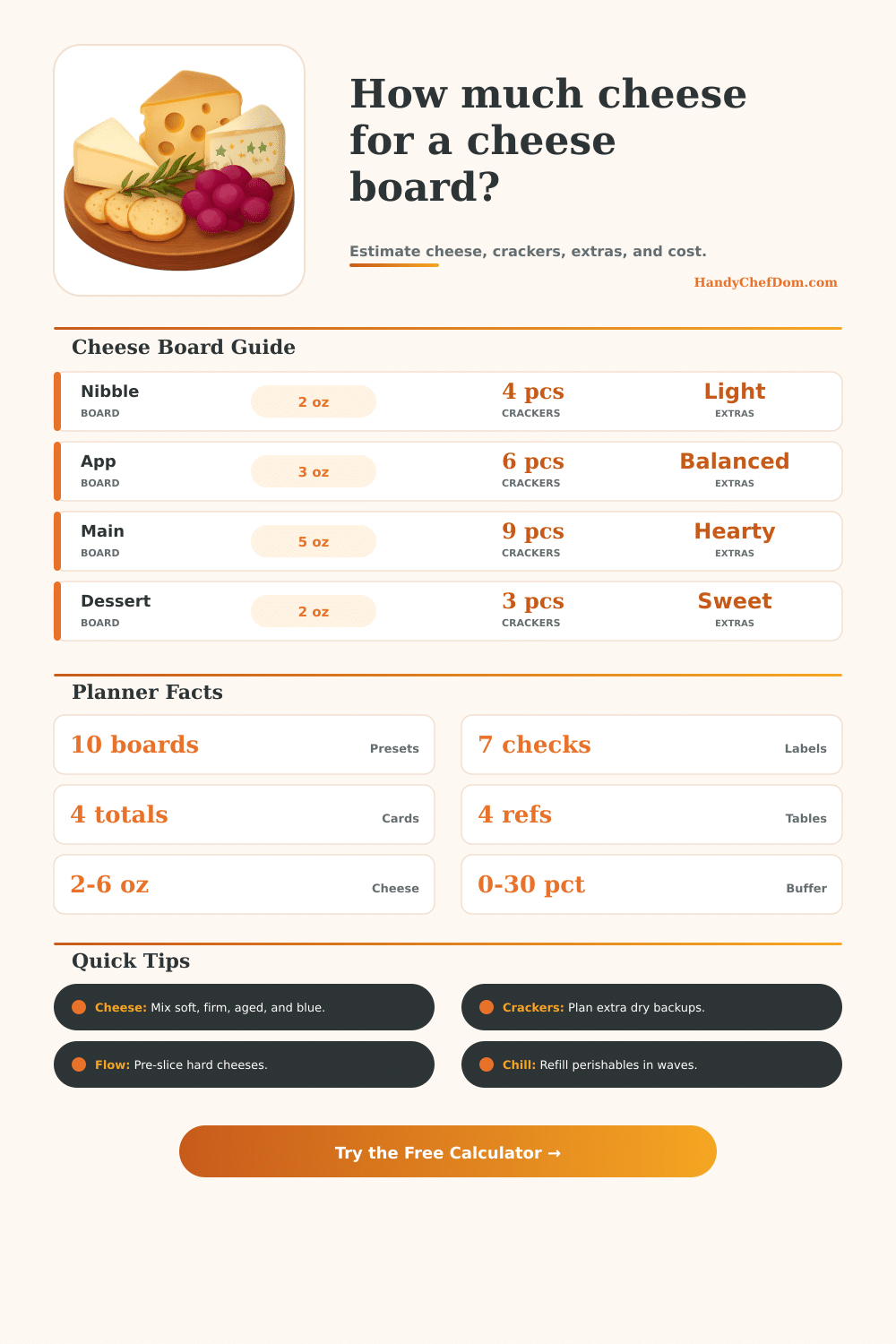
Cheese Board Calculator
Plan a cheese board that looks abundant and eats correctly. Estimate cheese weight, cracker count, accompaniments, board footprint, backup reserve, and budget from the way guests will actually use the board.
Start with a real hosting scenario, then adjust the guest count, appetite, board role, cheese style, cracker plan, and buffer. Presets are starting points, not locked recipes.
Your cheese board estimate
Best before dinner or with wine when the board is a small welcome bite, not the main food.
A flexible party board with enough variety for guests to return without eating a full meal.
Use when cheese is one of the primary foods and the board shares space with meat, fruit, bread, and dips.
A true grazing dinner needs more protein, bread, vegetables, and planned refills than a photo board.
| Board role | Cheese per guest | Crackers per guest | Extras per guest | Best use |
|---|---|---|---|---|
| Wine nibble | 1.5 to 2.5 oz | 3 to 4 pieces | 1 to 2 oz | Short tasting, date night, pre-dinner snack. |
| Classic appetizer | 2.5 to 3.5 oz | 5 to 7 pieces | 2 to 3 oz | Most parties where dinner still follows. |
| Heavy appetizer | 4 to 5 oz | 7 to 9 pieces | 3 to 4 oz | Cocktail parties, open houses, long happy hours. |
| Meal-style graze | 5 to 6 oz | 8 to 11 pieces | 4 to 6 oz | Board is a major food source with bread and protein. |
| Dessert cheese | 1.5 to 2.5 oz | 2 to 4 pieces | 2 to 3 oz sweet | After dinner with fruit, honey, chocolate, or nuts. |
| Cheese type | Classic mix | Soft-heavy mix | Aged mix | Buying cue |
|---|---|---|---|---|
| Soft and bloomy | 25% | 38% | 14% | Brie, camembert, triple cream, robiola. |
| Firm and semi-firm | 30% | 24% | 32% | Cheddar, gouda, manchego, havarti. |
| Aged and crystalline | 20% | 12% | 34% | Aged gouda, parmesan, alpine, aged cheddar. |
| Blue or bold | 10% | 8% | 10% | Blue, washed rind, smoky, spicy, or funky cheeses. |
| Fresh or mild | 15% | 18% | 10% | Goat cheese, mozzarella, ricotta dip, fresh wedges. |
| Guest count | App cheese | Heavy cheese | Cracker backup | Board footprint |
|---|---|---|---|---|
| 4 guests | 0.9 lb | 1.4 lb | 25 to 35 pieces | One small board or dinner plate. |
| 8 guests | 1.7 lb | 2.8 lb | 50 to 70 pieces | 12 to 16 in board plus bowls. |
| 12 guests | 2.6 lb | 4.2 lb | 75 to 105 pieces | 16 to 22 in board or two platters. |
| 20 guests | 4.4 lb | 7 lb | 125 to 175 pieces | Two boards or one 3 ft spread. |
| 40 guests | 8.8 lb | 14 lb | 250 to 350 pieces | Stationed platters with chilled reserve. |
| 75 guests | 16.4 lb | 26.3 lb | 470 to 660 pieces | Multiple stations or a staffed grazing run. |
| Accompaniment | Planning amount | Purpose | Board note |
|---|---|---|---|
| Fresh fruit | 1 to 2 oz per guest | Color, freshness, and palate reset. | Use clusters of grapes, berries, pears, figs, or citrus. |
| Dried fruit | 0.3 to 0.6 oz per guest | Sweetness with less water on the board. | Apricot, date, cherry, raisin, or dried fig fill gaps well. |
| Nuts | 0.3 to 0.5 oz per guest | Crunch and salt against creamy cheese. | Keep separate if allergy labeling matters. |
| Spreads | 1 to 2 tbsp per 6 guests | Honey, jam, mustard, chutney, or pepper jelly. | Small bowls add height and keep sticky foods contained. |
| Olives and pickles | 0.5 to 1 oz per guest | Acid and salt for rich cheese. | Drain well so brine does not soak crackers. |
| Chocolate or sweets | 0.5 to 1 oz per guest | Useful for dessert cheese boards. | Repeat small pieces instead of one large pile. |
How the cheese board calculator works
The calculator starts with cheese ounces per guest based on the board role. A pre-dinner nibble stays light, a standard appetizer board lands in the middle, and a meal-style grazing board gets a larger portion because guests are expected to return for more than one pass.
It then adjusts for appetite, serving time, display density, cut style, reserve plan, and buffer. The result is split into cheese textures so the board has a practical mix of soft, firm, aged, bold, and fresh cheeses instead of one giant wedge that looks impressive but eats awkwardly.
Crackers and accompaniments are calculated separately because they run out differently. Crackers disappear quickly when cheese is pre-sliced, while fruit, nuts, olives, and spreads help the board look full without forcing every guest to eat the same amount of cheese.
Planning a cheese board require considering several different variable. The amount of cheese that is required will depend upon the number of guest that will be eating, as well as the length that the guests will be eating. The number of guests that will be eating the cheese will impact the amount of cheese need.
Additionally, the length of time that the guests will be eating will also impact the amount of cheese needed. The appetite of each of the guests will also impact the amount of cheese that will be needed for the cheese board. Cheese is an expensive food, and if the cheese is left on the cheese board for too long, it will dry out.
How to Plan the Right Amount of Cheese for a Cheese Board
Therefore, these different variables will have to be considered when planning the amount of cheese that will be used for the cheese board. The calculator provide a mathematical figure as to the amount of cheese that will be needed based off the variables that the host enters. Each of the different variables that are entered into the calculator will impact the total amount of cheese that is calculate for the cheese board.
For example, the number of guests is a primary variable that will impact the amount of cheese. Similarly, the length of time that the cheese will be served will also impact the total amount of cheese. The appetite level of the guests will also impact the total amount of cheese that will be needed for the cheese board.
It is important to include a variety of textures for the cheese board. Using different texture for the cheese will prevent the guests from having flavor fatigue. If the host uses the same type of cheese for the cheese board, the cheese may become monotonous for the guests.
Additionally, soft cheeses will warm quickly, while aged cheeses will become dry at the edges. Blue cheese can also become overpowering then the other cheeses that may be on the board. Therefore, it is necessary to split the cheese into different category of texture.
The calculator determine the total pounds of cheese based upon the number of guests and the percentage of each type of cheese that will be used on the cheese board. The amount of crackers and the amount of other food accompaniments for the cheese can be calculate separately from the cheese. Crackers will be consumed quickly if the cheese is pre-sliced, as guests will eat a cracker and a piece of cheese at the same time.
The same is true for fruit and nuts, though they will contain few calories than the cheese. Because these foods are consumed at a different rate than the cheese, the amount of crackers and other accompaniments is calculate separately from the cheese. While changing the amount of crackers and other ingredient will change the total cost of the cheese board, the weight of the cheese will not change.
The budget tier will change the cost of the cheese, but it will not impact the weight of the cheese. If the budget tier for the cheese is set to premium or luxury, the calculator will calculate the price per pound of the cheese at a more high rate. This will ensure that the total cost of the cheese reflect the true cost of the expensive cheese rather than the cost of inexpensive cheese.
Additionally, the buffer percentage will add to the total weight of the cheese the amount of weight of the cheese rinds and any scrap of cheese that may be cut away from the cheese blocks when preparing them for the cheese board. The reference tables will provide an estimate of the total amount of cheese based upon the role that the cheese board will have at the party. For example, if the cheese is to be a snack rather than a meal, there will be less cheese needed than if it is to last as a meal.
For example, if there are twenty people at the party that will have a meal, there will be more cheese and more bread needed than if twenty people were having a cheese snack. One of the many mistake that people make when preparing a cheese board is to place all of the cheese on the board at the same time. Instead, some of the cheese should be left in the refrigerator.
By placing all of the cheese on the board at the same time, the soft cheeses will warm up, and the crackers may no longer be crisp. Therefore, by leaving some cheese in the refrigerator, it will stay fresh for the guests. The reserve plan will determine how much cheese should be kept in the refrigerator so that some of the cheese can be brought out in waves throughout the party.
Another variable that can be set for the cheese board is the density of the cheeses on the board. A very crowded cheese board may make it difficult for the guests to pick up the cheeses while they are drinking their beverage. By using the display density setting, the host can determine the layout of the cheeses on the board.
For example, if a lower density is chosen for the cheeses, more space on the cheese board is required. The calculator will provide an estimate of the size of the cheese board based upon the density of the cheese that will be placed upon it. During the party, there may be surprise.
The buffer percentage and the reserve plan will allow for the number of guests to change or the appetite of the guests to change. The buffer percentage and the reserve plan will ensure that there is enough cheese to eat for all of the guest that may show up to the party. By using the cheese board calculator, the host can determine the amount of cheese that is needed to serve all of the guests without having an excess amount of cheese on the cheese board.