🍗 Chicken Cooking Time Calculator
Estimate roast time, cooked yield, servings, and a finish window from cut, weight, heat level, and rest time for easier weeknight planning.
Choose the cut, add the weight per unit, and have the calculator scale the plan by batch size, start state, heat level, and rest time.
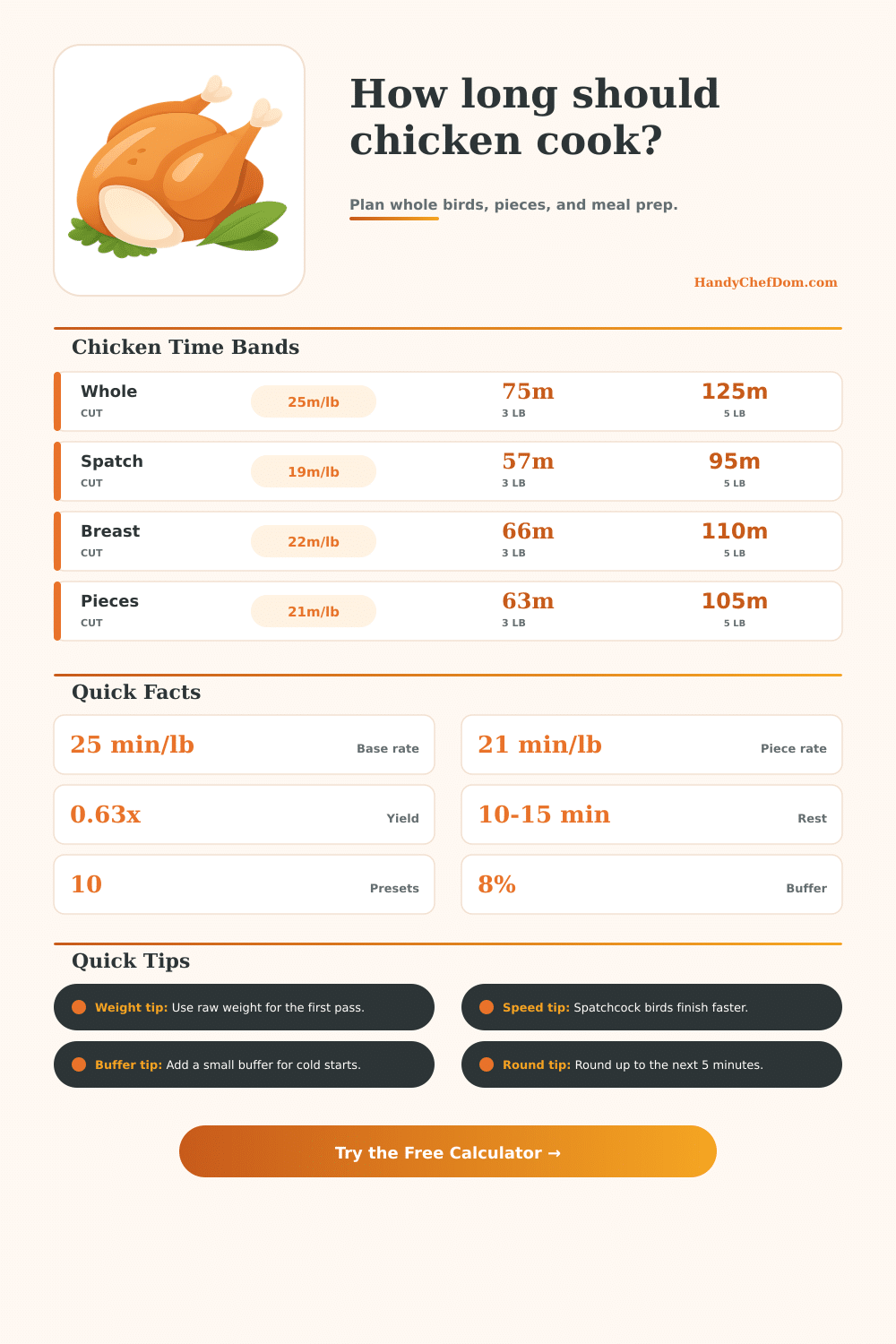
| Cut | Base | Yield | Use |
|---|---|---|---|
| Whole | 25 min/lb | 63% | Family roast |
| Spatch | 19 min/lb | 61% | Fast roast |
| Breast | 22 min/lb | 66% | Lean dinner |
| Pieces | 21 min/lb | 64% | Tray bake |
| Guests | Raw | Cooked | Note |
|---|---|---|---|
| 2 | 1.5 lb | 1.0 lb | Small meal |
| 4 | 3.0 lb | 1.9 lb | Dinner |
| 6 | 4.5 lb | 2.8 lb | Family |
| 8 | 6.0 lb | 3.8 lb | Batch cook |
| Units | 0.5 lb | 1 lb | 1.5 lb |
|---|---|---|---|
| 1 | 30m | 50m | 70m |
| 2 | 60m | 100m | 140m |
| 4 | 120m | 200m | 280m |
| 6 | 180m | 300m | 420m |
| State | Factor | Pad | Note |
|---|---|---|---|
| Fridge | 1.08x | 15m | Slowest |
| Chilled | 1.04x | 10m | Standard |
| Room | 1.00x | 5m | Fastest |
| Very cold | 1.12x | 20m | Extra pad |
Use this chicken cooking time calculator to estimate roast time, cooked yield, servings, and a finish window from cut, weight, heat level, and rest time for easier weeknight planning.
Cooking chicken require an understanding of the importance of timing. If the cook dont properly manage the timing of the cooking of the chicken, the chicken will either be dry or undercooked. To successfully cook chicken, an understanding of the impact of the weight of the chicken, the cut of the chicken, and the heat of the oven on the cooking time is required.
Different cut of chicken require different cooking methods due to the difference in the fat and moisture content of each cut. For instance, chicken breast are lean and will dry out during the cooking process if not managed properly, while chicken thighs and chicken drumsticks contains more fat which retain moisture during the cooking process, making them more forgiving during the cooking process. The method used to prepare the chicken will also impact the cooking time of the chicken.
How Long to Cook Chicken and How to Keep It Safe
For instance, if the cook spatchcock the chicken (chicken backbone removed to flatten the bird), the cooking time will be faster due to the even exposure of the chicken to the heat of the oven. Additionally, a whole chicken will take longer to cook than chicken pieces. A whole chicken will take approximately 25 minutes of cooking time per pound of the chicken.
The starting temperature of the chicken will also impact the cooking time of the chicken. If the chicken come out of the fridge (cold starting temperature), it will take longer to cook the chicken than if you allow the chicken to sit at room temperature prior to being cooked. The oven in which the chicken is cooked can also play a major role in the cooking process of the chicken.
Standard oven typically reach 375 degrees. This temperature allow for the formation of the crust of the chicken and also allows for carryover cooking of the chicken. Carryover cooking is the continued cooking of the chicken after the cook removes the chicken from the oven due to the increase of the internal temperature of the chicken.
If a higher heat is used, the chicken will cook faster but may dry out the lean cuts of the chicken. Convection oven use fans to circulate the hot air within the oven. These ovens can cook the chicken 10 to 20 percent faster than a conventional oven.
However, because each oven model isnt the same, it is important to test the specific oven in which the chicken will be cooked. The weight and the quantity of the chicken to be cooked must also be accounted for. The raw weight of the chicken will impact the cooking time.
Additionally, the number of individual piece of the chicken will also play a role in the cooking time. For instance, cooking a single 4-pound chicken will cook differently than eight half-pound chicken thighs of the same weight. If the thighs are crowded in the pan, they will take longer to cook due to the buildup of the steam between the thighs.
Therefore, the cook should space the chicken at least one inch apart from each other. Calculating the yield of the chicken will allow the cook to determine the number of individuals that the cooked chicken will feed. Raw chicken will decrease in weight once cooked due to the evaporation of the moisture and the rendering of the fat of the chicken.
Raw chicken will weigh 60 to 70 percent of its raw weight when cooked. Therefore, the cook should determine the number of half-pound of chicken per individual that will be eating the chicken. Half a pound of cooked chicken per person is standard for dinner, but if the chicken is part of a large spread of finger foods, only a quarter pound of cooked chicken per person may be needed.
The most important factor in the cooking of the chicken is safety. The internal temperature of the chicken must reach 165 degrees Fahrenheit to ensure that the chicken is cooked and safe to eat. A thermometer can be used to measure the internal temperature of the chicken, but the thermometer should not touch the bone within the chicken as the temperature will be inaccurate.
For dark meat, such as chicken thighs, 175 degrees Fahrenheit is acceptable. Finally, the cook should allow the chicken to rest for 10 to 15 minutes after being removed from the oven. This allows the juices within the chicken to redistribute throughout the chicken and ensures that the chicken will remain moist after being removed from the oven.