Chicken Shelf Life Calculator
Estimate chicken storage timing for raw, cooked, thawed, and leftover poultry using official cold-storage guidance.
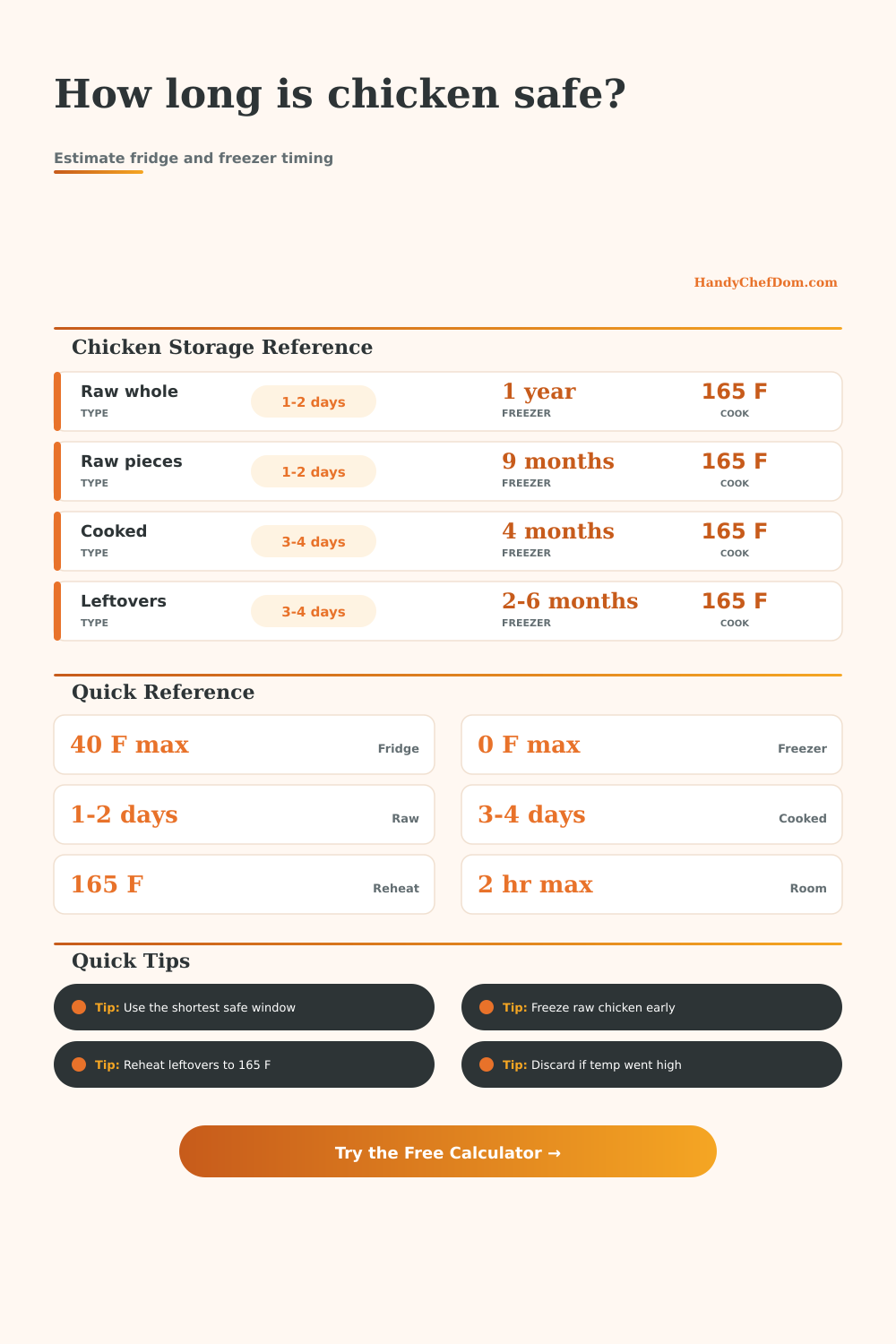
| Product | Refrigerator 40°F or Below | Freezer 0°F or Below | Calculator Cut | Use Note |
|---|---|---|---|---|
| Chicken or turkey, whole | 1 to 2 days | 1 year | Raw Whole Bird | Cook or freeze early |
| Chicken or turkey, pieces | 1 to 2 days | 9 months | Raw Pieces | Breasts, thighs, wings |
| Ground poultry | 1 to 2 days | 3 to 4 months | Raw Ground Chicken | Use shortest window |
| Giblets | 1 to 2 days | 3 to 4 months | Raw Giblets | Store separately sealed |
| Cooked Chicken Type | Refrigerator 40°F or Below | Freezer 0°F or Below | Calculator Cut | Use Note |
|---|---|---|---|---|
| Cooked poultry, plain pieces | 3 to 4 days | 4 months | Cooked Plain Pieces | Cool in shallow containers |
| Fried chicken | 3 to 4 days | 4 months | Fried Chicken | Quality drops when frozen |
| Cooked poultry casserole | 3 to 4 days | 4 to 6 months | Cooked Casserole | Reheat evenly |
| Pieces with broth or gravy | 1 to 2 days | 6 months | Chicken With Broth or Gravy | Use liquid-covered window |
| Rule | Official Target | Calculator Effect | Best Input Choice | Action |
|---|---|---|---|---|
| Refrigerator storage | 40°F or below | Full fridge window | Refrigerator | Use appliance thermometer |
| Freezer storage | 0°F or below | Quality month window | Freezer | Wrap airtight for quality |
| Cold water thaw | Cook immediately | Remaining time becomes 0 | Thawed in Cold Water | Cook now |
| Microwave thaw | Cook immediately | Remaining time becomes 0 | Thawed in Microwave | Cook now |
| Room temperature | 2 hours maximum | Uses 0.083 day limit | Room Temperature Exposure | Discard after limit |
| Food State | Heat Target | Thermometer Location | Applies To | Calculator Action |
|---|---|---|---|---|
| Raw chicken | 165°F internal | Thickest part | Whole, pieces, ground | Cook before eating |
| Leftovers | 165°F reheated | Center of food | Casseroles and pieces | Reheat if serving hot |
| Cold cooked chicken | Already cooked safely | Prior cooking record | Salads and meal prep | Stay inside 3 to 4 days |
| Frozen chicken | 165°F after thaw/cook | Thickest part | Raw frozen poultry | Thaw safely, then cook |
| Scenario | Condition | Cut or Dish | Fridge Days | Freezer Quality | Temp Target | Best Next Step |
|---|
It’s Thursday night, and although you planned a simple meal with some chicken breasts, they’re still sitting in the fridge in their original packaging. Are they still OK to prepare? No one likes wasting food (guessing at expiration dates does that), but most don’t want to risk it either. The calculator spares you from any guesswork… Just plug in your information and let computer do the rest.
However, when it comes to safety, what looks safe may not cook the same way. Cooked chicken last longer than raw chicken, usually for three to four days compared to just one or two for raw pieces. That’s important, the distinction between unsafe food and delicious food comes down to a few hours. Here’s how long chicken will last, both as a piece of meat and as a bird.
How Long Is Chicken Safe To Eat?
Here is the thing about cooked chicken. Cooking it kills off some of that bacteria (and starts the “safety” clock over again). If you’re refrigerating leftovers, do so promptly and tightly wrapped, and they’ll stay good for up to four days. The tool lets you plug in specifics, such as cooked or raw chicken, packaged how, and provide an accurate answer using government guidance. That’s far better than getting conflicting information all over the web.
Freshness is also dependent on refrigerator temperature: Refrigeration isn’t a rock-solid guarantee; fridges don’t keep themselves at exactly forty degrees, all the time. A poorly ventilated fridge that’s been opened often will run hotter, which reduces the safety margin for any food, including chicken, more quicklier than normal charts recommend. Rather than relying on possibly inaccurate dial readings (especially if they’ve been around a while), get an inexpensive refrigerator thermometer and check real numbers.
Bacteria don’t continue growing when they’re frozen. However, freezing doesn’t stop quality from getting worse. A whole raw bird will keep for approximately one year in a tight wrapping to avoid freezer burn, or about nine months in the freezer. Cooked food isn’t as good for long-term storage since it reacts different than when re-heated due to water content changes. Many people report finding meal prep to be dry after being stored in the freezer for a few month.
What you do next depends heavily on how you’ve defrosted the food. If you defrost by putting it into warm/hot water or microwaving, cook it immediately. These defrosting techniques warms up the outside of the item and promote bacteria growth. Refrigerated defrosting takes longer but maintains even temperature (cold) throughout the food so that when it goes from raw to fully defrosted, there’s no danger zone involved. It also preserves the remaining shelf life, giving you more of a safety margin.
With poultry and many other foods, smell isn’t a good indicator of freshness. Even if you think it’s spoiled, dangerous bacteria such as salmonella may be present but undetectable by smell or sight. The numbers factor-in worst case scenarios that your nose might not catch. Use the data, it can help keep everyone healthy by accounting for worst-case scenarios that your nose might miss when tracking storage times.
Knowing how to properly cool food down and accurately timing it will save money (less waste) and keep everyone safe. You don’t have to worry over each package anymore; the calculator is backed by solid science and tells you what to do in no uncertain terms. If you learn to trust the data instead of your anxiety, then that mental space can be used for other things like meal planning and recipe creation, not worrying over out-of-context expiration dates.
You should of trusted it more early on. It’s moddern technology. Actualy, you could have also checked the fridge temperatuer to be sure.