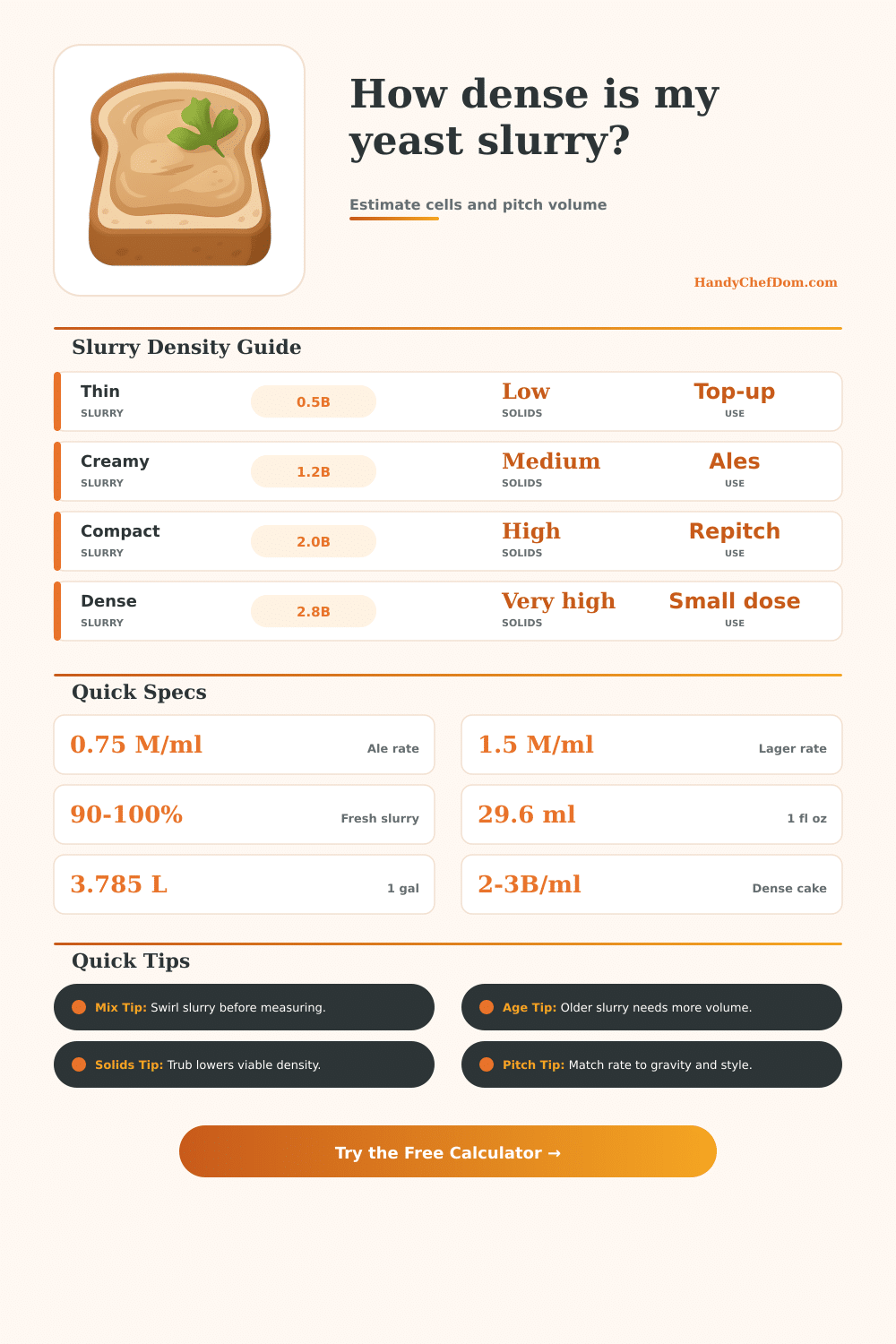
🍞 Yeast Slurry Density Calculator
Estimate viable slurry density, total cell count, and pitch volume from thickness, age, solids, gravity, and batch size.
Use this as a practical repitch estimate. Slurry cell density varies by strain, settling time, trub carryover, and how evenly the jar is mixed before measuring.
| Slurry appearance | Estimated density | Typical solids | Best calculator match |
|---|---|---|---|
| Thin milky pour | 0.4 to 0.7 billion cells/ml | Mostly liquid, lightly suspended yeast | Thin milky pour |
| Loose settled layer | 0.7 to 1.0 billion cells/ml | Soft layer that flows easily | Loose settled slurry |
| Creamy compact slurry | 1.0 to 1.5 billion cells/ml | Common washed or rinsed harvest texture | Creamy compact slurry |
| Firm bottom layer | 1.5 to 2.2 billion cells/ml | Thick jar sediment after settling | Firm jar bottom layer |
| Dense yeast cake | 2.0 to 2.8 billion cells/ml | Heavy cake with limited free liquid | Dense yeast cake |
| Packed cone harvest | 2.6 to 3.2 billion cells/ml | Very compact commercial-style harvest | Packed cone harvest |
| Fermentation profile | Pitch rate | How to read it | Calculator use |
|---|---|---|---|
| Standard ale | 0.75 million cells/ml/°P | Common neutral ale target | Everyday ale batches |
| Clean lager | 1.50 million cells/ml/°P | Often about double ale rates | Lagers and cold ferments |
| Kveik-style low pitch | 0.35 million cells/ml/°P | Intentional lower pitch estimate | Kveik-style fermentations |
| Hybrid / altbier | 1.00 million cells/ml/°P | Middle ground between ale and lager | Hybrid yeasts |
| High gravity ale | 1.25 million cells/ml/°P | Extra cells for stronger wort | Big beers over about 1.070 SG |
| Saison / Belgian ale | 0.65 million cells/ml/°P | Moderate ale pitch estimate | Characterful ale fermentations |
| Age and storage | Viability estimate | Multiplier used | Planning note |
|---|---|---|---|
| 0 to 3 days, fresh harvest | 96% to 100% | Very low decay | Usually the tightest estimate |
| 1 week refrigerated | About 90% to 95% | Low decay | Good repitch window |
| 2 weeks refrigerated | About 80% to 90% | Moderate decay | Increase volume slightly |
| 1 month refrigerated | About 65% to 80% | Higher decay | Consider a vitality step |
| Warm transport | Highly variable | Fast decay | Use conservative viability |
| Lab counted slurry | Use measured value | Override field | Best when a count is available |
| Batch example | Gravity | Cells needed | Creamy slurry pitch |
|---|---|---|---|
| 3 gal standard ale | 1.048 | About 100 billion | 80 to 105 ml |
| 5 gal standard ale | 1.052 | About 185 billion | 150 to 190 ml |
| 5 gal high gravity ale | 1.075 | About 340 billion | 280 to 360 ml |
| 5 gal clean lager | 1.050 | About 350 billion | 290 to 365 ml |
| 10 L hybrid batch | 1.046 | About 115 billion | 95 to 120 ml |
| 1 gal test batch | 1.045 | About 32 billion | 25 to 35 ml |
Yeast slurry is a mixture that contain yeast cells and that is used to initiate the fermentation of a batch of beer. In each batch of beer that is prepared using yeast slurry, it is necessary to decide how much yeast slurry to use in that batch. The amount of live yeast cells contained within the yeast slurry can change over time for various reasons, including the age of the yeast slurry, the presence of hop fragments within the yeast slurry, and the temperatures at which the yeast slurry were stored.
Using the correct amount of yeast cells within the batch is important in that ensuring that the correct amount of yeast cells will lead to the brewing of beer that undergoes a clean fermentation, while using the incorrect amount can lead to issue in the brewing process, such as a dragging fermentation stage or the production of unwanted esters by the yeast. The density of yeast slurry is not a fixed number due to the fact that the slurry is a mixture of different ingredients. In order to determine the number of viable yeast cells that should be used in a batch of beer, a calculator is used.
How to Calculate Yeast Slurry Needed for Brewing Beer
This calculator utilize various variables regarding the yeast slurry to calculate the number of yeast cells that will ensure that the beer ferment properly. One such variable is the gravity of the beer, which is important in that beers with a higher gravity will require more yeast cells to ferment to completion. The gravity will be converted from its original gravity measurement to degrees Plato; the pitch rate will be applied to the gravity in degrees Plato.
Ales will contain around 750,000 cells per milliliter per degree Plato of beer; however, lagers will contain around double that amount. The reason for this additional amount of yeast required for lagers is that the temperatures at which lagers are brewed will slow the metabolism of the yeast; thus, more yeast is required to ensure that there is a sufficiently long lag phase before fermentation begins. Furthermore, high-gravity wort will require more yeast to ferment than lower gravity worts due to the osmotic stress that is placed upon the yeast cells during the brewing process.
Another variable within the yeast slurry is the thickness of the slurry; this is one of the visual indicators of the density of that yeast slurry. For instance, thin and milky yeast slurry may contain as few as 500 million cells per milliliter of liquid; however, dense slurry may contain three times as many yeast cells per milliliter of liquid. The thickness of the slurry will be entered into the calculator to establish the density of the yeast slurry; however, other variables will also help to adjust the density that is established from the thickness alone.
Factors that affect the density of yeast slurry include the age of the yeast slurry, the temperatures at which the yeast slurry is stored, and the way in which the yeast slurry was generated. With regard to age, the viability of the yeast within the slurry will decrease over time, reducing its density. Storage temperatures can also affect the density within the slurry; yeast will die at a faster rate if the slurry is stored at warm temperatures rather than cold temperatures.
Additionally, each time the yeast slurry is repitched into another batch of beer, its strength will be slightly reduced. Another variable to consider when calculating the amount of yeast to place into a batch of beer is the solids percentage of the yeast slurry. Various solids, including trub and hop matter, will take up the space within the yeast jar; thus, if the jar is full of these solids, the density of the slurry is likely only 70% yeast by volume.
Additionally, the decant field can be used to remove the watery layer that forms on top of the yeast slurry; the layer will not contain the same density of yeast as the bottom of the yeast jar. Furthermore, the measured volume of the yeast slurry will not necessarily be the same as the usable volume; the usable volume will be less if the yeast slurry also contains non-yeast solids within its volume. The calculator will provide the yeasts’ estimated viable density and total number of cells that are required to ferment the beer; the yeast slurry calculator will also calculate the volume of yeast slurry that should be used in the batch, along with a small buffer around that calculated volume.
The buffer around the calculated amount of yeast slurry is established as a ten percent safety margin; yeast cells and yeast slurry cannot always be measured absolutely, so a small buffer will ensure that the yeast will be sufficient for the batch of beer. Furthermore, the yeast slurry calculator will provide a percentage value regarding the coverage of the yeast slurry for the batch; this percentage will reveal whether or not the calculated amount of yeast slurry will contain enough yeast to completely ferment the beer, or if a yeast starter must be built to provide the required amount of yeast for the batch. Prior to measuring the amount of yeast slurry that is calculated by the yeast slurry calculator, it is important to swirl the jar of yeast slurry prior to taking any measurements.
Yeast slurry may settle into different layers within the jar over time, so yeasts will be different in strength within the jar if yeasts are taken from the top of the jar compared to the bottom of the jar. It is also important to keep notes regarding the performance of the yeast slurry within each batch of beer that is brewed. These notes will allow the brewer to adjust the yeast slurry estimate for variables like age of the yeast slurry and the amount of solids within the slurry in the future batches of beer.
For example, if the yeast slurry is found to be slightly under-pitched for the batches of ale, the yeast will likely be able to fully ferment the batch of beer. However, if the yeast slurry is under-pitched for lager beers, it is possible for the fermentation process to stall or for the yeast to produce diacetyl. Thus, although a yeast slurry calculator will assist in the brewing process in avoiding under-pitching of the yeast slurry for the batch of beer, the calculator cannot replace the brewer’s individual judgments regarding the strength of different strains of yeast.