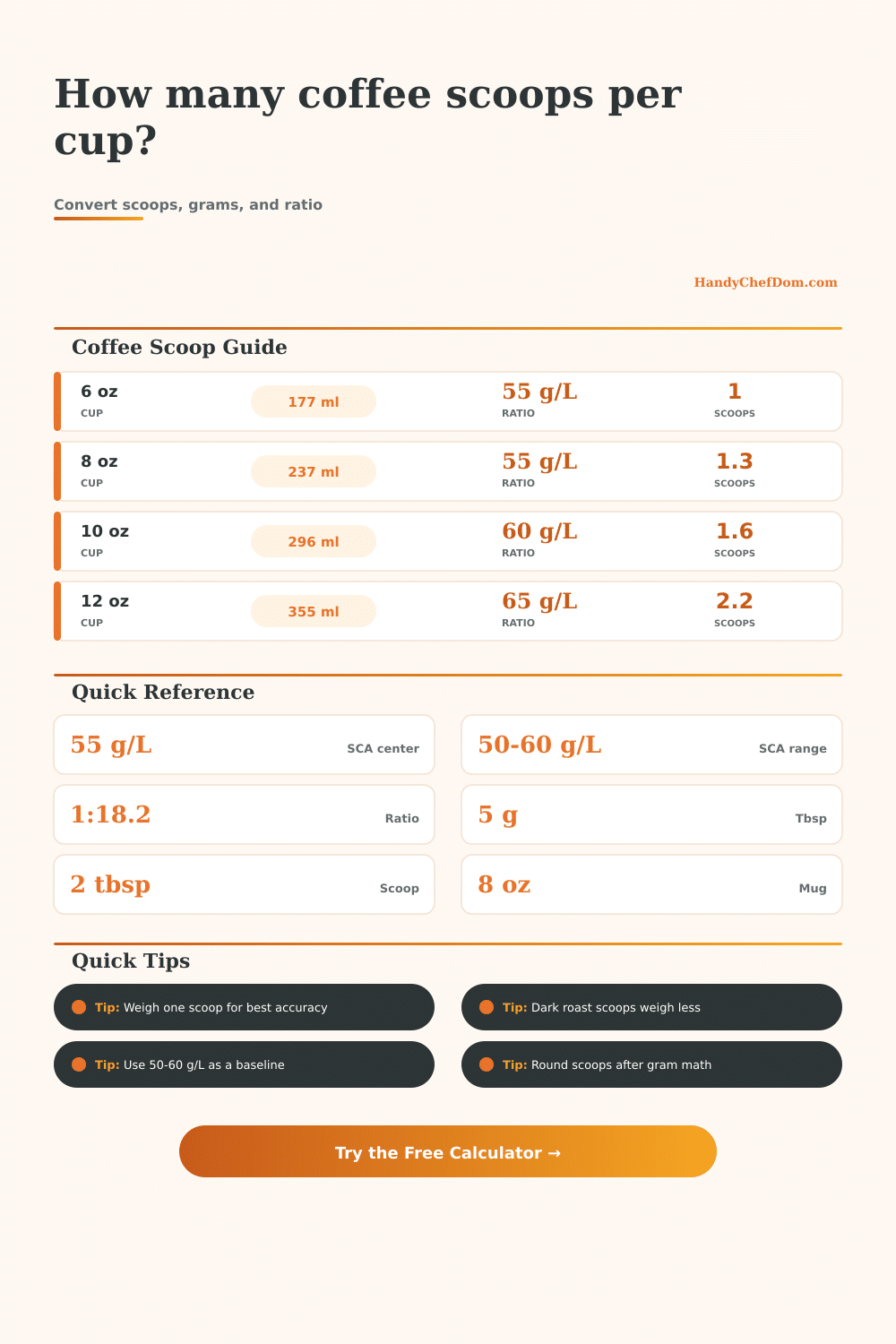
Coffee Scoops Per Cup Calculator
Convert cup size, brew method, scoop volume, roast density, grind, strength ratio, and cup count into scoops, tablespoons, grams, and water ratio.
| Ratio target | g/L coffee | Water:coffee by weight | Use in calculator |
|---|---|---|---|
| Mild cup | 50 g/L | 1:20.0 | Use for lighter daily drip coffee |
| SCA-style center | 55 g/L | 1:18.2 | Good baseline for balanced drip and pour-over |
| Upper SCA-style range | 60 g/L | 1:16.7 | Use when mugs taste thin at 55 g/L |
| Bold manual brew | 65 g/L | 1:15.4 | Good for French press and fuller cups |
| Concentrated cup | 80 g/L | 1:12.5 | Use for short immersion or ready cold brew |
| Scoop size | At 4.8 g/tbsp | At 5.2 g/tbsp | At 5.8 g/tbsp |
|---|---|---|---|
| 1 tbsp mini scoop | 4.8 g | 5.2 g | 5.8 g |
| 1.5 tbsp scoop | 7.2 g | 7.8 g | 8.7 g |
| 2 tbsp standard scoop | 9.6 g | 10.4 g | 11.6 g |
| 2.5 tbsp scoop | 12.0 g | 13.0 g | 14.5 g |
| 3 tbsp large scoop | 14.4 g | 15.6 g | 17.4 g |
| Cup size | Water volume | 55 g/L grounds | Standard 2 tbsp scoops |
|---|---|---|---|
| 5 fl oz coffee-maker cup | 148 ml | 8.1 g | 0.8 scoops at 5.2 g/tbsp |
| 6 fl oz traditional cup | 177 ml | 9.8 g | 0.9 scoops at 5.2 g/tbsp |
| 8 fl oz mug | 237 ml | 13.0 g | 1.3 scoops at 5.2 g/tbsp |
| 10 fl oz large mug | 296 ml | 16.3 g | 1.6 scoops at 5.2 g/tbsp |
| 12 fl oz travel mug | 355 ml | 19.5 g | 1.9 scoops at 5.2 g/tbsp |
| Brew method | Starting ratio | Grind type | Default scoop density |
|---|---|---|---|
| SCA-style drip | 55 g/L | Medium | 5.2 g per tablespoon |
| Light auto drip | 50 g/L | Medium | 5.2 g per tablespoon |
| Bold auto drip | 60 g/L | Medium | 5.2 g per tablespoon |
| Pour-over | 60 g/L | Medium-fine | 5.6 g per tablespoon |
| French press | 65 g/L | Coarse | 4.8 g per tablespoon |
| Moka pot | 100 g/L | Fine | 6.1 g per tablespoon |
| Cold brew ready-to-drink | 80 g/L | Coarse | 4.8 g per tablespoon |
So what do you do? You grab the included coffee scoop and throw in a couple of scoops hoping it comes out alright. Most likely, it’s somewhere between watery dissapointment and bitter sludge. You feel as if you’re playing a guessing game; there’s no benchmark to follow.
But here’s the thing: Coffee grinds aren’t uniform particles, so volume measurement are unreliable. The quantity changes based off the roast level, grind size; and more. Even though kitchens will only give you scoops, grams matter more then scoops.
Why You Should Measure Coffee by Weight
That’s where our calculator comes in. It takes the guesswork out of figuring out how much coffee you need to use based on the size of your cups (and the number of cup). It does all the math for you. It takes your coffee goals (i.e., how many cups do I want?) and your scoop sizes. And then translates that into real-world terms: how much coffee should I be using? It connects the dots between “home convenience” and “professional precision.”
How does it work? Why does it matter? Why do I care if I adjust this setting? What’s it measuring? What happens if I choose a different brew method, say, pour-over instead of French press? By adjusting the ratio, the calculator changes. Immersion brewing extracts differently than drip filtration. A French press has hot water sitting there for longer. As such, it require a specific strength and a more coarse grind. Otherwise, it’ll get over extracted. To take this into account, our calculator shifts its base line of grams-per-liter to match. Don’t worry about getting some muddy water just because you decided to switch brew methods.
The volume measurements throw off because darker roasts is less dense than lighter roasts. They puff up more when fired. A level scoop of dark roast coffee doesn’t weigh the same as a level scoop of light roast out of the same bag. Your dark roast cups will taste thin and your light roast cups will be overpowering, if you treat it like equal amounts of coffee. With the tool, you can account for that difference in density. Whatever volume of coffee you’re thinking is what you’re getting. Whether its airy or compacted into pellets.
Maybe you’re swapping from a light roast to a dark roast. But without accounting for the difference in volume, you think you have just as much coffee as yesterday. In reality, you’re underdosing.
For most home brewers, that means seeking balance in their cup, typically around 55 grams of coffee to every liter of water. That’s about a one-to-eighteen ratio by weight. We think it’s the sweet spot between body and clarity. Want something lighter? Back down closer to fifty grams per liter. Looking for a bolder kick start to your day? Going up to sixty or even sixty-five will add some needed heft while keeping things from getting bitter. The reference table on the page explains all this clearly. It illustrates how small changes in ratio shift the resulting taste profile. Tweak these numbers according to what sounds good to you. Then use the strength adjustment slider to home in on the final result before grinding a single bean.
And finally, what effect does grind size have on how tightly packed those grounds will be inside a spoon? Coffee grounds from a French press (coarse) sit lightly; espresso-type (fine) grounds pack closely. To account for these differences between setups, you can specify the approximate number of grams per tablespoon in the calculator. Better to calibrate once than to estimate each morning. Use a kitchen scale to weigh out one level tablespoon of your coffee, then enter it into the calculator. Now when you measure by volume you’ll be grounded in reality, not just theory.
It also takes the mental math out of it. You won’t have to convert fluid ounces into grams in your sleep-deprived mind or figure out what your brew water should of been in milliliters. Just input desired brew strength and number of cups. Let the tool sort out the grind packing, roast density, and volume of water. And spit out a clean scoop count that equates to the taste you desire.
Coffee making is half science wrapped up in a ritual. Righting the ratios makes the ritual reliably produce a tasty cup. With this as your base, it’s safe to play around. When you’re in need of a bolder cup, you know exactly how much extra coffee you are adding. Math’s clear; there’s no guessing game involved regarding whether the bitter taste is due to over-grinding or bad beans. Tossing is out the window. Instead, you have a tunable system that lets you adjust accordingly. Stick with the same variables and try some different beans, you’ll soon figure out just what your machine and grinder can handle.
The goal is to make coffee that tastes intentional rather than accidental. Once you get over the idea that each scoop is a rigid number and you begin to think about it as an approximation by weight, you’ll find yourself making better cups. A couple more grams here or a couple less there is all the difference between a so-so morning and a really great one.
And guess what? You’ve got the equipment for this right in your kitchen. You simply don’t know how much it weighs.