Self Raising to Plain Flour Calculator
Convert self raising flour amounts into plain flour blends with baking powder and salt ratios, including density profile, sifting style, and batch scaling.
| Flour profile | g per cup | Protein | Best use |
|---|---|---|---|
| US all-purpose | 120 | 10-12% | General baking |
| UK plain flour | 115 | 9-10% | Scones and cakes |
| Cake flour | 110 | 7-9% | Light crumb |
| Pastry flour | 113 | 8-10% | Tender bakes |
| Bread flour | 127 | 12-13% | Higher structure |
| Whole wheat pastry | 118 | 11-13% | Hearty muffins |
| Gluten-free blend | 125 | n/a | Blend formulas |
| Spelt plain blend | 120 | 10-12% | Nutty flavor |
| Scenario | SR Target | Plain Flour | Baking Powder |
|---|---|---|---|
| 6 muffins | 180 g | 180 g | 3 tsp |
| 12 muffins | 360 g | 360 g | 6 tsp |
| Loaf pan | 300 g | 300 g | 5 tsp |
| Sheet cake | 480 g | 480 g | 8 tsp |
| Cupcakes x24 | 520 g | 520 g | 8.7 tsp |
| Party tray | 720 g | 720 g | 12 tsp |
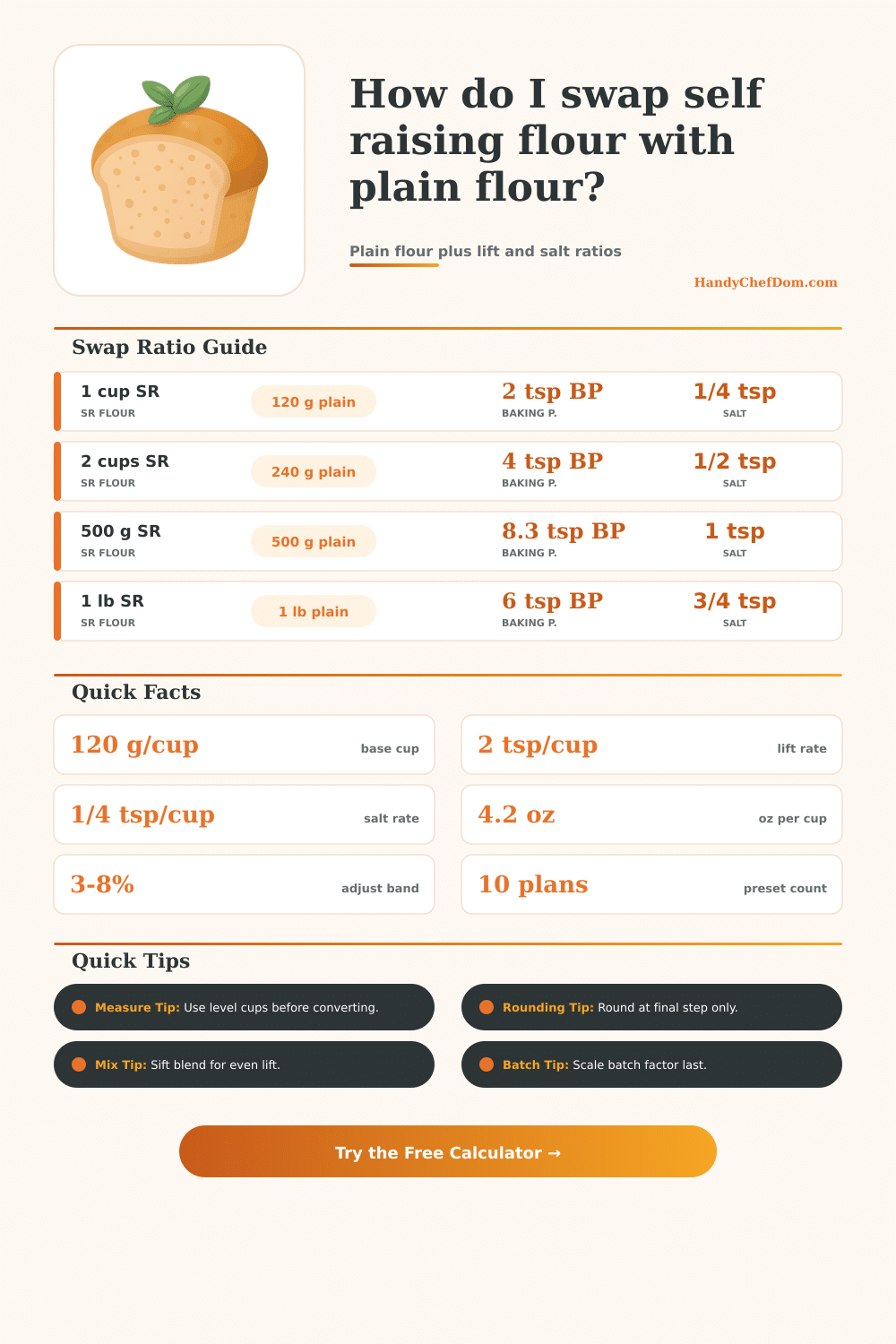
You can use plain flour to replace self-raising flour if you adds baking powder and salt to the plain flour. Self-raising flour are a mixture of base flour, an leavening agent (like baking powder), and salt. Plain flour is simply base flour without baking powder or salt add to it.
In order for plain flour to act like self-raising flour, you must add baking powder and salt to the plain flour in the correctly amounts to ensure that the cake will rise and have the apropriate texture. Baking powder are the ingredient that will allow the cake to rise. If you dont add enough baking powder to the plain flour, the cake will not rise and will possibly be gummy.
How to Make Self-Raising Flour from Plain Flour
However, if you add too much baking powder to the plain flour, the cake may have a metallic taste. The amount of baking powder that is added to plain flour is crucial, as the amount will affect the flavor and texture of the baked goods. Many baking recipe also include ingredients like buttermilk or lemon that contains acidity.
Salt is another ingredient that are necessary in most recipes. A small amount of salt must be added to the plain flour to enhance the sweetness of the recipe. Unless the recipe says otherwise, a quarter teaspoon of salt should be added to each cup of plain flour.
If the recipe contain another ingredient with salt, such as cheese, you can adjust the amount of salt. If salt is skipped altogether in the recipe, the baked good will have a flatly flavor. The density of the flour are another important ingredient.
The weight of the plain flour will change depending on whether the plain flour is sifted or packed into the measuring cup. For instance, cake flour is less dense than bread flour because it contain less protein. The amount of weight of plain flour will change depending on the type of flour that is used.
The type of flour and the sifting of the flour will change the weight of flour that is used in the recipe. In order to scale a recipe, all ingredient must be doubled in amount. For instance, if a recipe say that plain flour should be measured out in 1 cup, when the cook is to double that recipe, the amount of plain flour that should be used will also be doubled.
The same rule will apply to the amount of baking powder and salt that are to be use in the recipe. If the recipe is to be doubled, the amount of ingredients will double so that the rise of the baking good will still be consistant. A calculator can help to scale a recipe correct.
Some of the most common baking mistake include not accounting for the leavening agent in the recipe. One of the most common mistakes is to simply use plain flour instead of self-raising flour without adding baking powder to the flour. Using this type of flour will cause the baked good to collapse.
Another common mistake is adding too many baking powder to the plain flour, this will give the baked good a bad aftertaste. Following a specific ratio of baking powder, salt, and plain flour will prevent these common baking mistake. Using a reference table will make finding this ratio for your needs more easier.
The third common mistake is using plain flour from another part of the world. The salt and protein content of plain flour can change depending on the part of the world from which you purchased the flour. The protein content of the flour will change the texture of the baked good.
Thus, if the type of flour in your kitchen change, the amount of liquid or leavening agent may need to be change in the recipe. By using plain flour as your main ingredient, you can simply make self-raising flour as and when you need it by adding baking powder and salt to the plain flour. Using plain flour will make your kitchen simpler and will also reduce the amount of waste that might happens in your kitchen.
By using plain flour and adding the correct amount of baking powder and salt to it, you will achieve the same result as if you used self-raising flour in your baking recipe.