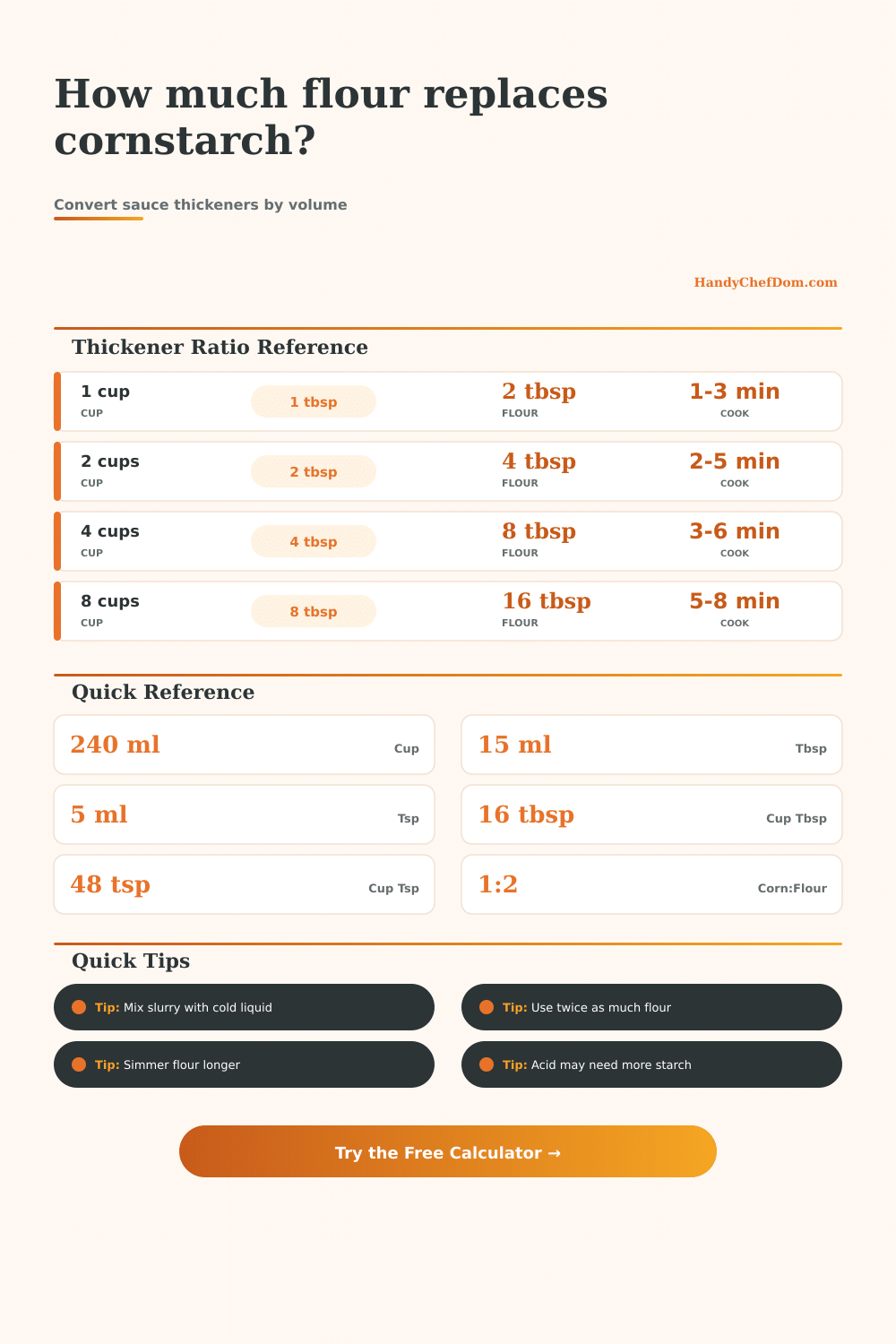
Cornstarch to Flour Thickener Converter
Convert cornstarch and flour amounts for sauces, gravies, fillings, and glazes using volume, target thickness, slurry ratio, cook time, acid, sugar, and gluten-free needs.
| Target | Cornstarch per Cup | Flour per Cup | Texture Use | Notes |
|---|---|---|---|---|
| Light Coat | 0.5 tbsp | 1 tbsp | Soup body | Thin, pourable finish |
| Medium Sauce | 1 tbsp | 2 tbsp | Gravy, stir-fry | Most common converter anchor |
| Thick Sauce | 1.5 tbsp | 3 tbsp | Spoon sauce | Clings strongly to food |
| Pie Filling | 2 tbsp | 4 tbsp | Fruit filling | Adjust for fruit juice and sugar |
| Sauce Style | Factor | Why It Changes | Best Thickener | Cook Note |
|---|---|---|---|---|
| Broth or stock | 1.00 | Neutral water base | Either | Simmer until glossy |
| Gravy or drippings | 1.05 | Fat and solids reduce clarity | Flour or corn | Whisk well before simmering |
| Cream or milk | 0.95 | Dairy already has body | Flour | Use gentle heat |
| Fruit filling | 1.20 | Juice and sugar soften set | Cornstarch | Cook until clear and thick |
| Tomato or vinegar | 1.18 | Acid can weaken starch set | Cornstarch | Add in stages |
| Sweet glaze | 1.10 | Sugar delays thickening | Cornstarch | Allow full bubbling |
| Rich butter sauce | 0.90 | Reduction and fat add body | Flour | Use less at first |
| Vegetable stew | 1.08 | Solids dilute the sauce layer | Either | Stir through evenly |
| Thickener | Cold Liquid Ratio | Typical Simmer | Visual Cue | Risk |
|---|---|---|---|---|
| Cornstarch | 1 to 1 or 1 to 2 | 1-3 min | Glossy and clear | Long boiling may thin it |
| All-purpose flour | 1 to 2 or more | 3-6 min | Opaque and smooth | Raw flour taste if undercooked |
| Gluten-free flour blend | 1 to 2.5 | 4-7 min | Matte and smooth | Blend formulas vary |
| Arrowroot-style starch | 1 to 1 | 30-90 sec | Clear shine | Can loosen with dairy |
| Volume | Milliliters | Tablespoons | Teaspoons | Medium Cornstarch | Medium Flour |
|---|---|---|---|---|---|
| 0.5 cup | 120 ml | 8 tbsp | 24 tsp | 0.5 tbsp | 1 tbsp |
| 1 cup | 240 ml | 16 tbsp | 48 tsp | 1 tbsp | 2 tbsp |
| 2 cups | 480 ml | 32 tbsp | 96 tsp | 2 tbsp | 4 tbsp |
| 4 cups | 960 ml | 64 tbsp | 192 tsp | 4 tbsp | 8 tbsp |
| 8 cups | 1920 ml | 128 tbsp | 384 tsp | 8 tbsp | 16 tbsp |
| Batch Volume | Volume ml | Target | Cornstarch tbsp | Flour tbsp | Slurry tbsp | Cook Time | Best Use |
|---|
Standing at the stove over a simmering pan, do you ever look down at what is suppose to be a sauce and see mostly water? It happens all the time in kitchen everywhere. The recipe says: Cornstarch! But you’re out; it’s flour or vice versa. Or maybe you know which starch you’ve got but don’t know how much to use. Add the stuff on hand and cross your fingers (that hardly ever succeeds).
Starches aren’t a one-to-one substitution, nor do they perform identical in any given dish. How do you get from cloudy gravy to glossy stir-fry glaze? What starch will you choose (and why)? How much will you use (and why)? Knowing that will take understanding.
How to Use Sauce Thickener Calculator
Once you know how much sauce you want to make (and roughly how thick it will be), you can let the calculator do the rest: Plugging these numbers into our calculator lets you skip the guesswork of coefficients. First, remember the kitchen chemist’s golden rule. Use double the amount of flour by volume for every cup of liquid to get the same thickening power as cornstarch. So if your recipe says “1 Tbsp cornstarch,” don’t assume that you can substitute “1 Tbsp flour.” The result? A runny, lumpy goop. The calculator automatically adjust for this ratio, depending on what you enter.
And because not all sauces is alike, the calculator also takes that into account. For example: Let’s talk about sugar and acid. Too much vinegar in a sauce (or too much tomato) can literal break down the starch granules in the sauce. Flour will get mushy and fail to hold, while cornstarch is tougher and holds better under pressure from harsh flavor elements. So what does that mean? If you choose a sweet or acidic profile, the converter notes that and then adjusts the amount it recommends to match. You need a little bit more thickener because now you’re up against the environment! And that’s where many people goes wrong. They don’t think about how ingredients will impact each other, nor do they think about the interaction between ingredient and starch itself.
Time is also important: How long do you want to cook? Flour takes longer than cornstarch. Cornstarch works nearly immediately, but flour needs time until it is fully hydrated and the chalky rawness are cooked away. This lets you choose how long you want to cook it, which affects how much you add. This way, if you’re doing a weeknight dinner when minutes matter, or a stew that will simmer for an hour on low, you plan for that with the tool and tweak the suggested amount accordingly. If you’re making something that has to cook a long time, it doesn’t suggest quite so much so that it won’t break down over time. So it keeps you from underseasoning your long-cooked item.
Then there’s the added variable of gluten-free cooking. If some (or all) of your diner are allergic to gluten, you can’t just reach for flour. When that option is turned on, the converter suggests gluten-free flour blends instead. Be aware that these may not act the same as regular wheat flour. You will need a bit more liquid in the slurry phase to avoid clumping. It also sets the liquid-to-roux ratio correctly, adjusting as necessary.
Regardless of which thickener you choose, it reminds you: Always make the slurry with cold water, then pour into hot sauce. Dumping dry powder right into hot stuff means guaranteed lumps, and whacking those won’t help at all.
Now we know a little about the science of texture, but what about our own preferences? Whether we like thick or runny depends on the food; maybe you want a runny body for soup but want something more substantial to hold up in a pie with all those juicy fruits. It’s all laid out in the table on the page (above) that explains the thickness, how many tablespoons for every cup of the liquid. Want a spoon coating of whatever you’re making? Or something thin enough to pour? Then use the calculator to connect your vision to the number of tablespoons (or grams) required for measuring.
So the key to thickening is ultimately both proportion and also patience. Add the right amount based off our calculations and still go slowly. Add only three-quarters of the slurry at first, stir, and bring the sauce to a very gentle boil, allowing it to thicken. If it’s too thin, you can always add some more. If too thick? Well, you can’t take it out. Well then, tough noogies. That approach helps you avoid that dreaded over-thickened slop that ruins whatever it was you were making in the first place.
This way, your eyes complete the race; the tool provides the starting line. And once you get used to this switch, you’ll never be stuck at home without a thickener again. Just change the ratio and let it happen.